
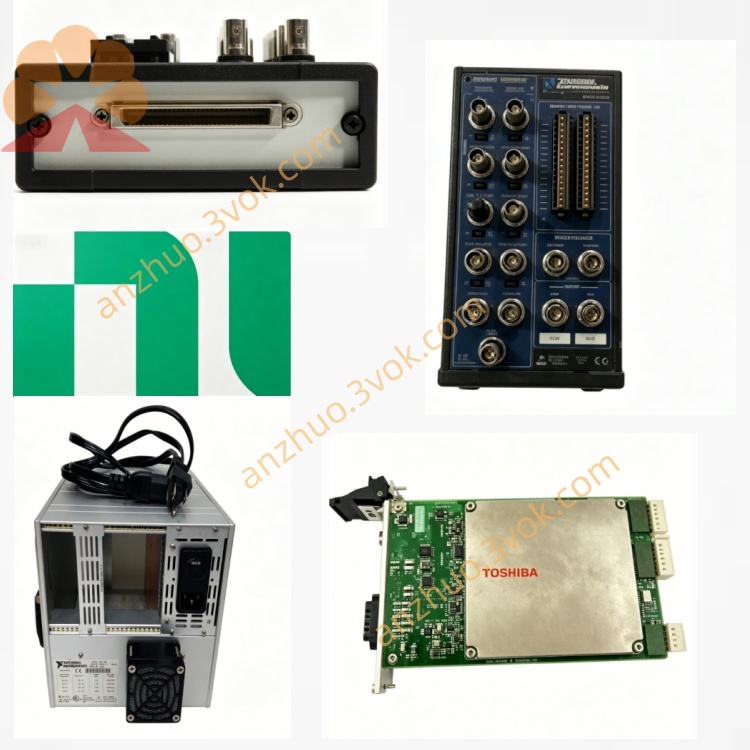
NI PXIe-8234 4-Port Gigabit Ethernet PXIe Interface Module
Description
Product Introduction
The NI PXIe-8234 is a 3U single-slot PXIe high-speed RAID storage module, specifically designed for PXI/PXIe test systems. It integrates a four-drive array architecture and focuses on high bandwidth and large-capacity local data storage. This module can be directly installed in a PXI chassis and, in conjunction with acquisition, FPGA, and RF modules, enables real-time storage of high-speed data streams. It does not require an external storage device and is suitable for scenarios involving long-term and high-bandwidth data recording, featuring industrial-grade stability and array data protection capabilities.
Model Interpretation
PXIe represents the use of the PXI Express bus and follows the 3U single-slot mechanical specification, compatible with standard PXIe chassis slots. 8234 belongs to the NI PXI storage series model. The number 34 in the digital code represents a four-drive design, positioning it as an internal high-performance disk array unit in the chassis, specifically responsible for real-time writing of test data, local caching, and data retention, without undertaking the system control function. Technical Specifications
Storage hardware
The module is equipped with four standard hard disk trays, supporting 2.5-inch SATA interface solid-state drives and mechanical hard drives. Users can select the capacity and type of hard drives as needed. It supports various RAID array modes, enabling performance acceleration, data redundancy backup, and balancing read and write speeds with data security.
Bus and read/write performance
It adopts the PXIe Gen2 bus, achieving high-speed data interaction with other functional modules through the chassis backplane. The overall read/write bandwidth can match the data flow rate of high-speed acquisition and FPGA modules, meeting the requirements for continuous and uninterrupted real-time storage. An independent storage control chip is built-in to share the storage computing pressure of the embedded controller.
Electrical and environmental parameters
The entire unit is of 3U standard size, compatible with the conventional PXIe chassis installation specifications. The working power consumption is moderate, and with the chassis cooling system, it can support continuous read/write operations around the clock. The standard operating temperature range is 0 degrees Celsius to 55 degrees Celsius. It has shock resistance, dustproof, and electromagnetic protection capabilities, and can operate stably in laboratory, industrial production lines, and other environments. The module is equipped with a hard disk status indicator light to display the operating status of each hard disk in real time.
Interface and communication configuration
Host bus interface
It connects to the chassis backplane through the PXIe Gen2 bus, receiving raw data from the acquisition modules and FPGA modules within the chassis, and interacting with the embedded controller for storage instructions, status information, and file data. It is compatible with the conventional trigger and clock signals of the PXI system and can simultaneously start the data recording task.
Front panel interface
The panel is equipped with only a hard disk status indicator light and a hard disk pop-out latch, without external signal interfaces. The four hard disk bays can be replaced by inserting and removing from the side of the panel, supporting quick disassembly and assembly of hard disks even in the power-off state.
Driver and software communication
It is compatible with the dedicated storage driver and can run normally in Windows and NI real-time operating systems. Through NI-MAX, you can view the hard disk status, configure RAID array modes, monitor read/write rates and disk health. It is fully compatible with NI software suites such as LabVIEW and TestStand, providing application interfaces for file reading and writing, data stream recording, and storage start/stop control.
Core functions
It supports a four-disk array configuration, allowing flexible selection of different RAID modes, respectively achieving high-speed throughput or data backup protection. It can receive high-speed data streams generated by various modules within the chassis, complete local uninterrupted writing, and be suitable for long-term data recording tasks. The independent storage architecture can share the load of the main control controller, avoiding the occupation of system computing resources by large data storage. It supports starting and stopping recording based on trigger signals and synchronizes with the timing of the entire test system. Hard disks can be replaced quickly with the exception of hot plugging, facilitating data export and hard disk expansion. It has a disk failure monitoring function, which can promptly report disk abnormalities and reduce the risk of data loss. Applicable scenarios
In the field of high-speed signal acquisition, it is used for long-term continuous recording of large bandwidth data such as vibration, acoustics, and transient signals. For RF and wireless communication testing, it stores the original I/Q data of high-frequency RF for radar and mobile communication. For semiconductor and electronic testing, it retains the test logs, waveform data, and batch test results of chips. In the field of scientific research experiments, it records the massive raw data generated by physical experiments and optical experiments. For automated production line testing, it enables local archiving of test data and simplifies the wiring for external storage.
User and Maintenance Instructions Instruction Manual
After the equipment is powered off, insert the standard 3U PXIe chassis empty slot and tighten the fixing screws. Then, install the hard drives into the corresponding positions and secure them. After powering on, identify the module through NI-MAX, and configure RAID mode, storage partitions, and read/write parameters according to the requirements. When setting up the test process, synchronize the trigger signal to control the start and stop of storage. During operation, it is strictly prohibited to plug or unplug the hard drives while powered on to avoid data damage. Ensure that the air duct of the chassis is unobstructed and prevent the hard drives from experiencing read/write abnormalities due to high temperature.
Maintenance Instructions
Regularly use a dry soft cloth to wipe the panel indicator lights and the position area, clean the dust, keep the opening and closing of the position smooth, and strictly prohibit contact with the module by liquids. Regularly check the disk health status and read/write error records through software, and replace the aging hard drives in time. When using the equipment continuously for a long time, regularly check the cooling effect of the chassis. When the module is idle for a long time, remove the hard drives and store them separately, place the entire machine in a dry environment of minus twenty degrees Celsius to sixty degrees Celsius with a relative humidity of less than 60%, and take measures to prevent static electricity. When there is a storage interruption or read/write error, prioritize checking the contact of the hard drive, RAID configuration, and bus connection; when the indicator light is abnormal, check if the corresponding hard drive is faulty.
Get a Quote