
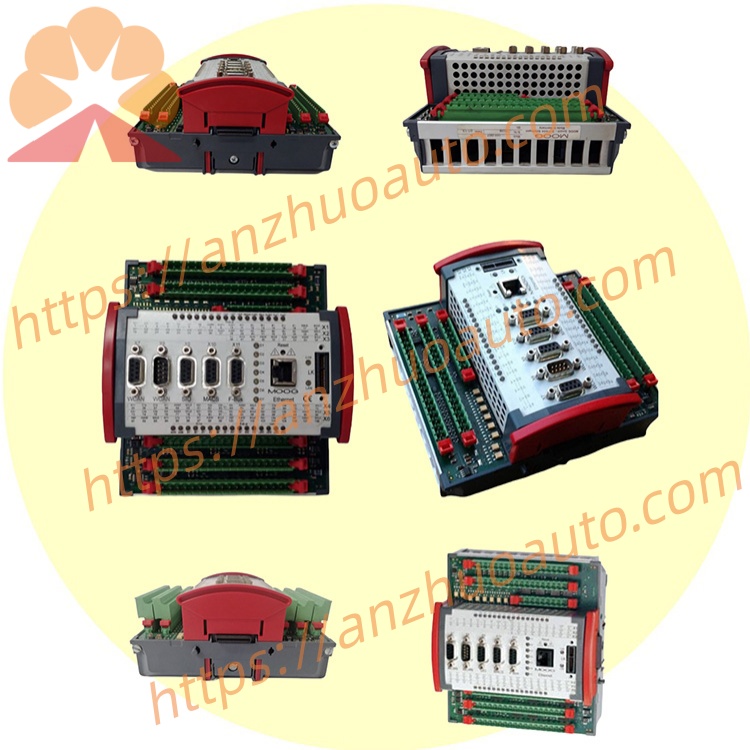
MOOG D136-002-005 MSCⅡ Multi-axis Servo Motion Controller
Description
Model Explanation
D136: MSCⅡ Universal Controller Product Platform;
002: Second-generation Optimized Hardware Substrate;
005: Bus Expansion Configuration Code, originally equipped with Profibus-DP slave station + EtherCAT master station dual field buses. Encoder channels and IO points are expanded and upgraded compared to 004. Technical Specifications
Electrical parameters
Power Supply: DC24V (18~36VDC, ±10%), no-load 0.3A, full-load 0.8A, total power consumption 46W
Control Unit: 32-bit floating-point PowerPC processor, clock frequency 400MHz, 128MB RAM + 32MB battery-backed flash memory
Control Cycle: Minimum servo task cycle 100μs (better than 250μs of 004)
Built-in I/O: 16 channels of 16-bit high-precision analog input, 8 channels of ±10V analog output (single channel 120mA direct drive Moga servo valve); 32 input 32 output programmable digital quantity; 4 channels of SSI / incremental encoder feedback interface
Form: 124×170×85.5mm, IP20 protection, standard 35mm DIN rail installation Communication configuration
Standard configuration: Dual CAN/CANopen, 2 RS232 ports, 100 Mbps Ethernet, 2×USB1.1, E-BUS internal expansion bus
Unique configuration: Built-in Profibus-DP slave station + EtherCAT master station dual bus (the core difference of this model from 004), RS port expandable Modbus-RTU, Ethernet supports TCP/UDP for remote debugging and program downloading
Environmental parameters
Operating temperature: +5℃~+55℃; Storage -25℃~+70℃; Humidity 10%~95% RH without condensation, complies with EN61000 industrial EMC anti-interference standard
Interface and communication configuration
Red plug-and-play terminals in two layers, upper end for digital signal connection, lower end for analog signal connection; Side of the body for network ports, bus terminals arranged in zones; E-BUS bus can be cascaded up to 7 expansion modules, expand IO and bus resources as needed. Core function
Up to 8-axis synchronous closed-loop control, universal control for hydraulic servo valves and servo motors, and the ability to switch between position/velocity/force control modes with one click;
Built-in complete small PLC functions, no need to connect an external PLC to complete equipment interlock and sequential logic;
EtherCAT high-speed bus connects to servo drivers, Profibus connects to upper-level DCS/PLC, dual bus supports large and small-scale automation networking;
It comes with built-in fault self-diagnosis, automatic alarms for overvoltage, short circuit, and open circuit, and parameter power-off flash memory for long-term preservation;
It is equipped with MuGe dedicated function libraries, and the fatigue curve of the test bench and multi-channel synchronous algorithms can be quickly called for programming. Applicable scenarios
Aerospace actuator durability testing equipment, automotive chassis / component fatigue testing machine, metal material mechanical performance test bench, large steam turbine unit EH electro-hydraulic speed regulation system, high-precision hydraulic forming multi-cylinder synchronous equipment.
Operation and maintenance instructions
Install dust filters on the control cabinet to prevent hydraulic oil mist and dust from entering the terminals;
Check the stability of the 24V DC power supply every quarter to avoid voltage fluctuations exceeding ±10%;
Calibrate the zero point of the analog channel of the precision force control condition every half year;
Keep away from corrosive gases and high-frequency vibration environments, and tighten the bus terminal connections once a year to prevent oxidation and poor contact.
Get a Quote