
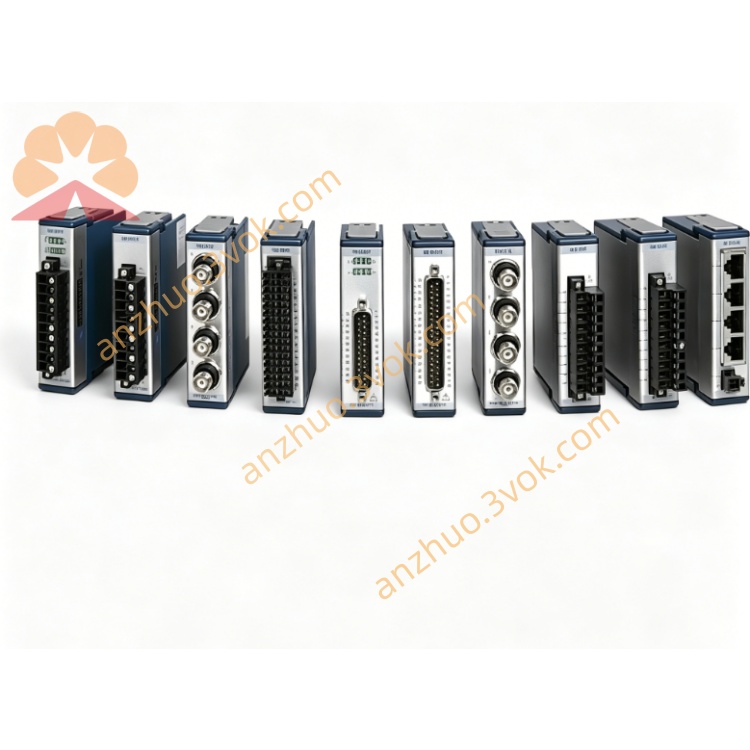
NI PXI‑6251 M‑Series Multifunction DAQ Module
Description
II. Model Interpretation
PXI: 3U single slot, standard PXI bus (compatible with PXIe chassis)
6251: High-speed version of the M series, 16AI/2AO/24DIO, 16-bit, 1.25 MS/s
M series: Multi-function, high-speed sampling + general I/O
Part number: 779117-01
Status: Out of production;
III. Technical Parameters (25℃)
1. Analog Input (AI)
Channels: 16 single-ended / 8 differential (software selectable)
Resolution: 16 bits (no bit loss)
Sampling rate: 1.25 MS/s per channel, 1 MS/s for multiple channels
Range: ±0.1/±0.2/±0.5/±1/±2/±5/±10 V (programmable) NI
Input impedance: >10 GΩ || 100 pF
Overvoltage protection: ±25 V
CMRR: 100 dB (DC–60 Hz)
FIFO: 4 k samples, supports 6 DMA channels
2. Analog Output (AO)
Channels: 2
Resolution: 16 bits
Update rate: 2.8 MS/s (per channel)
Range: ±10 V (default, software adjustable)
Drive: ±5 mA
Stabilization time: 2 μs (full scale)
3. Digital I/O (DIO)
Configuration: 24 bidirectional (5 V TTL/CMOS)
Rate: Maximum 10 MHz (hardware timing)
Protection: 2 channels support ±20 V overvoltage input
Function: Anti-jitter filtering, programmable input/output
4. Counter / Timer
Quantity: 2 32-bit channels (80 MHz base time)
Function: Event counting, frequency / period, pulse output, quadrature encoding (X1/X2/X4)
FIFO: 2 samples
5. Physical and Environmental
Size: 3U single slot (22×124×126 mm)
Operating temperature: 0~55℃
Power consumption: Approximately 8 W
Calibration: NI-MCal technology, recommended every 2 years once
IV. Interface and Communication Configuration
Front panel interface: 68-pin SCSI-II female connector (with SH68-68-EP cable, CB-68LP wiring box) NI
Bus: PXI (PCI, trigger, 10 MHz reference clock, RTSI)
Driver: NI-DAQmx, supports LabVIEW, Python, C#, TestStand
Synchronization: PXI trigger bus / RTSI, multi-module synchronization
PFI lines: 8 programmable function inputs for triggering and timing routing
V. Core Functions
High-speed dynamic acquisition: 1.25 MS/s + 16 bits, accurately captures vibration, transient voltage, high-frequency signals.
Flexible multi-channel configuration: 16AI/2AO/24DIO integration, reduces module quantity, simplifies system.
High-precision measurement: NI-PGIA2 amplifier + low drift, maintains 16-bit accuracy across all channels at full speed.
Strong real-time control: 2.8 MS/s analog output + 10 MHz digital I/O, suitable for high-speed closed-loop control.
Rich triggering and timing: analog/digital triggering, PFI routing, counter, suitable for complex timing logic.
VI. Application Scenarios
High-speed dynamic signal testing: vibration analysis, shock testing, noise measurement, modal analysis.
Power electronics testing: voltage/current transient acquisition of switching power supplies, inverters, frequency converters. Automated Test System (ATE): PCB functional testing, component parameter testing, mass production calibration.
Research and Laboratory Automation: High-speed data recording, sensor calibration, precise control.
General Multi-parameter Measurement and Control: Mixed system that simultaneously collects analog, digital, and counter signals.
VII. Installation and Maintenance Instructions
Installation and Power On
Disconnect the card when power is off, ground the chassis; after power-on, NI-DAQmx self-checks, preheats for 15 minutes.
Operating Temperature: 0–55℃. Keep the air duct unobstructed and avoid blocking the fan.
Wiring and Operation
Differential shielded lines for analog input are preferred to reduce common-mode interference; input voltage ≤ ±11 V.
Avoid frequent plugging and unplugging of 68-pin interface; it is recommended to use CB-68LP wiring box; pay attention to level matching for digital I/O.
High-speed signals should be routed away from interference sources such as power supplies and motors, and use impedance-matched cables.
Daily Maintenance and Calibration
It is recommended to conduct traceability calibration once every 2 years; built-in self-calibration compensates for temperature drift.
Keep interfaces clean, prevent dust accumulation during long-term inactivity; avoid strong vibrations and condensation.
Get a Quote