
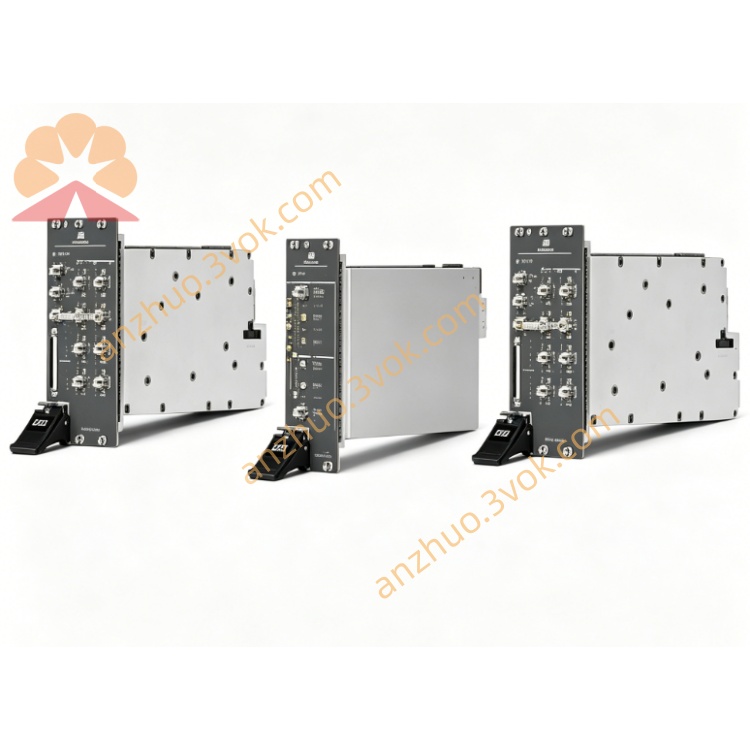
NI PXI-7954R Virtex-5 FlexRIO FPGA PXI Module
Description
Basic Information
Model: PXI‑7953R (Part Number: 780562‑01)NI
Form Factor: 3U single‑slot PXI module
FPGA: Xilinx Virtex‑5 LX85
Onboard Memory: 128 MB DDR2 DRAM (64 MB × 2 banks)
I/O Channels: 132 single‑ended, configurable as 66 differential pairsNI
Programming Environment: LabVIEW FPGA, LabVIEW Real‑Time, Windows
Status: Discontinued; recommended replacement: PXIe‑7966R
Typical Power Consumption: ~6.5 W
Operating Temperature: 0 °C to 55 °C
Function and Positioning
Core Performance Parameters
FPGA Core
FPGA Model: Xilinx Virtex‑5 LX85
Logic Resources: 12,960 slices, 51,840 LUTs, 31,104 flip‑flops
Block RAM: 3,456 kbit (embedded)
DSP Slices: 48 DSP48 slices (18×18 multipliers)
Clock Speed: Default 40 MHz; FPGA internal up to 500 MHz; I/O up to 100 MHz
Configuration: LabVIEW FPGA, online reconfiguration supported
Digital I/O
Channel Configuration: 132 single‑ended / 66 differential pairsNI
I/O Standards: 1.2 V, 1.5 V, 1.8 V, 2.5 V, 3.3 V, LVDS, LVTTL, TTL
Max Rate: Single‑ended 100 MHz; differential 200 MHz
Functions: Input/output, counter/timer, PWM, encoder, custom protocols
Memory and Bus
Onboard DRAM: 128 MB DDR2 (64 MB × 2 banks), max bandwidth 6.4 GB/s
FIFO: 3,456 kbit block RAM
DMA: 3 DMA channels, 32 DMA interrupt channels; PXI bus up to 400 MB/s
Synchronization: PXI trigger bus, RTSI; sync accuracy <25 ns
Physical and Electrical
Dimensions: 3U (160 mm × 100 mm)
Connector: 1 × dedicated FlexRIO adapter interface
Power: +3.3 V, +5 V from PXI backplane
Weight: ~200 g
Compatible Accessories
FlexRIO Adapter Modules
NI‑6581: High‑speed digital I/O adapter, 100 MHz, 132 channels
NI‑5781: High‑speed analog input/output adapter for signal generation/acquisition
NI‑5751: 16‑channel digitizer adapter, 50 MS/s, 14‑bit
NI‑5791: RF transceiver adapter for wireless communication testing
NI FlexRIO Adapter MDK: Development kit for custom adapter design
Software
NI‑FlexRIO Driver: Hardware configuration, FPGA programming, DMA management
LabVIEW FPGA Module: Graphical FPGA development for complex real‑time logic
LabVIEW Real‑Time: Deterministic control and high‑speed data processing
Application Fields
Advanced Real‑Time Signal Processing: Radar/sonar signal processing, communication protocol decoding, high‑speed FFT analysis, hardware‑in‑the‑loop (HIL) simulation.
High‑Speed Digital Test Systems: High‑speed digital circuit verification, 100+ MHz pulse generation/acquisition, custom high‑bandwidth digital bus emulation.
Aerospace and Defense: Avionics interface testing, satellite communication signal processing, high‑speed data logging for flight systems.
Semiconductor Test: High‑speed IC validation, memory testing, SoC interface verification, wafer probe test systems.
Industrial Automation and Control: High‑speed multi‑axis motion control, complex encoder signal processing, real‑time industrial communication (e.g., EtherCAT, PROFINET).
Scientific Research and Instrumentation: High‑energy physics experiment control, high‑speed imaging data processing, custom scientific instrument development.
Get a Quote