
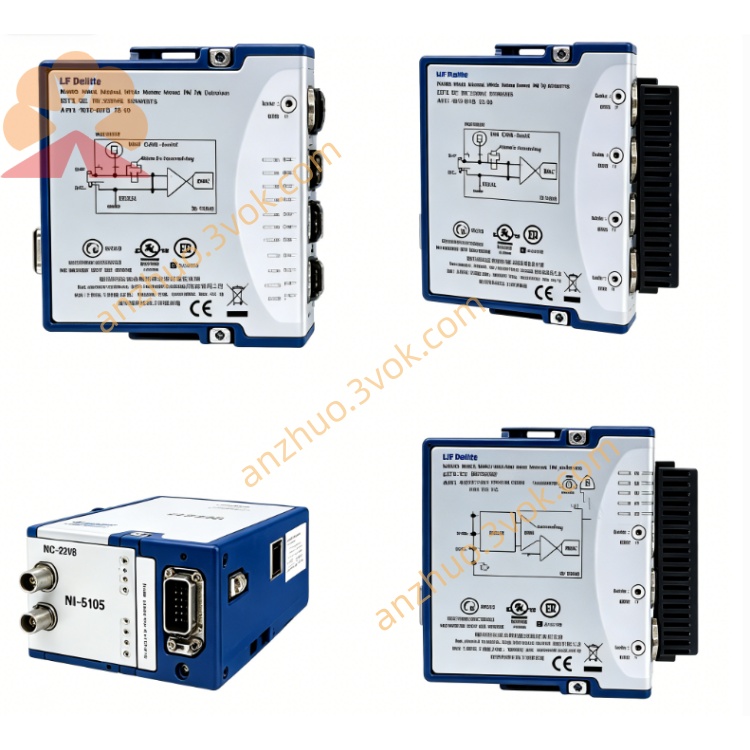
NI PXI-7953R Virtex-5 FlexRIO FPGA PXI Module
Description
II. Model Interpretation
PXI: Compliant with the PXI (PCI eXtensions for Instrumentation) modular instrument bus standard
7953: Product series number, 795x represents the first-generation FlexRIO FPGA carrier board, 3 indicates the medium-high performance level
R: Reconfigurable (reconfigurable), indicating that the onboard user-programmable FPGA is available
Full meaning: PXI bus, 795x series, medium-high performance, reconfigurable FPGA carrier board module
III. Technical Parameters
1) Basic Specifications
Form: 3U single-slot PXI module
Part Number: 780562-01
FPGA: Xilinx Virtex-5 LX85
Onboard Memory: 128 MB DDR2 (64 MB×2), bandwidth 6.4 GB/s
Block RAM: 3,456 kbit
DSP Slice: 48 DSP48 (18×18 multipliers)
Logic Resources: 12,960 slices, 51,840 LUTs, 31,104 triggers
Power Consumption: Approximately 6.8 W
Operating Temperature: 0 ℃~55 ℃
Storage Temperature: -40 ℃~71 ℃
2) Digital I/O
Channels: 132 single-ended / 66 differential pairs
Voltage Standards: 1.2 V, 1.5 V, 1.8 V, 2.5 V, 3.3 V, LVDS, LVTTL, TTL
Rates: Single-ended up to 100 MHz, differential up to 200 MHz; PXI bus up to 400 MB/s
Functions: Input/output, counter/timer, PWM, encoder, custom protocol, high-speed streaming disk
3) Clocks and Synchronization
Default System Clock: 40 MHz
FPGA Internal Clock: Up to 500 MHz
Synchronization Interface: PXI trigger bus, RTSI; Multi-module synchronization accuracy < 25 ns
4) Bus and DMA
Bus Interface: PXI (PCI)
DMA: 3 DMA channels, 32 DMA interrupt channels
Data Transfer: DMA, interrupt, programmable I/O
IV. Interface and Communication Configuration
1) External Interfaces
1 dedicated FlexRIO adapter interface (connects to NI-6581/5761/5781/5791 etc. front-end modules)
PXI Backplane: +3.3 V, +5 V power supply, PXI trigger bus, RTSI synchronization bus
2) Software Communication and Programming
Driver: NI-FlexRIO, NI-RIO
Programming Environment: LabVIEW FPGA (graphical), LabVIEW Real-Time, Windows; Supports VHDL mixed programming
Operating System: Windows 7/10, LabVIEW Real-Time
V. Core Functions
Medium-scale custom FPGA hardware logic
Based on Virtex-5 LX85, it can achieve medium complexity parallel computing, custom timing, dedicated protocols, high-speed control, and independent CPU hard real-time execution.
High-density high-speed digital I/O control
132 configurable channels, supporting 100 MHz single-ended / 200 MHz differential, suitable for high-speed digital testing, bus simulation, encoder/motion control interface.
Real-time signal processing and data throughput 48 DSP slices + 128 MB high-bandwidth memory, supporting FFT, filtering, demodulation, multi-sensor fusion, HIL simulation; PXI bus 400 MB/s, DMA high-speed disk.
Modular expansion and software-defined instrument
Combined with FlexRIO adapter, it can quickly build high-speed digitizers, arbitrary waveform generators, RF transceivers, and parallel digital test systems.
Multi-module precise synchronization
With PXI triggering and RTSI bus, achieve multi-card nanosecond-level synchronization, suitable for multi-channel parallel testing and distributed acquisition.
Six. Application scenarios
Semiconductor testing
Medium-high-speed IC verification, interface testing, memory testing, wafer testing (medium parallelism).
Communication and radio frequency testing
Mid-frequency / baseband signal processing, LTE protocol decoding, RF transceiver testing, software radio (SDR).
Aerospace and defense
Aeronautical interface testing, communication signal processing, data recording, small and medium-sized electronic warfare systems.
Industrial automation and motion control
Multi-axis (6–10 axes) high-speed motion control, encoder processing, industrial Ethernet (EtherCAT) hardware implementation, machine vision integration.
Research and precise measurement
Physical experiment control, high-speed imaging data processing, customized scientific instruments, medium-scale parallel data acquisition.
Seven. Usage and Maintenance Instructions
1) Installation and Power On
It must be installed in a standard 3U PXI/PXIe chassis, using dedicated rails and locking devices.
Only take power from the PXI backplane, do not use external power supply; confirm the power supply of the chassis is sufficient (≥10 W / slot) before powering on.
When installing the FlexRIO adapter, perform the operation with power off, align the guide slot and push in evenly and lock.
2) Programming and Configuration
Must install: LabVIEW, LabVIEW FPGA module, NI-FlexRIO driver, NI-RIO driver.
FPGA logic is compiled and downloaded through LabVIEW FPGA, supports online reconfiguration (no power off required).
High-speed I/O and DMA transmission requires timing constraints and cache design at the FPGA end to avoid data loss.
3) Heat Dissipation and Environment
Operating temperature 0–55 ℃, ensure the fan of the chassis operates normally and the air duct is unobstructed; in high-temperature environments, use reduced specifications.
Humidity: 10%–90% RH (no condensation); avoid dust, corrosive gases and strong electromagnetic interference.
4) Maintenance and Fault Diagnosis
Regularly clean the chassis filter and module gold fingers (wipe with isopropyl alcohol after power off).
Driver abnormality: reinstall NI-FlexRIO/NI-RIO driver and restart; do not mix use of different versions of drivers.
FPGA loading failure: check the adapter connection, recompile the BIT file, and confirm the stable power supply of the chassis.
Long-term unused: store in a dry environment with power off, and power on for 1 hour per month to prevent moisture and mold.
5) Safety and Compliance
Only used in indoor industrial / testing environments, altitude ≤ 2000 m, pollution grade 2.
When scrapped, follow the electronic waste recycling specifications, do not discard randomly.
Get a Quote