
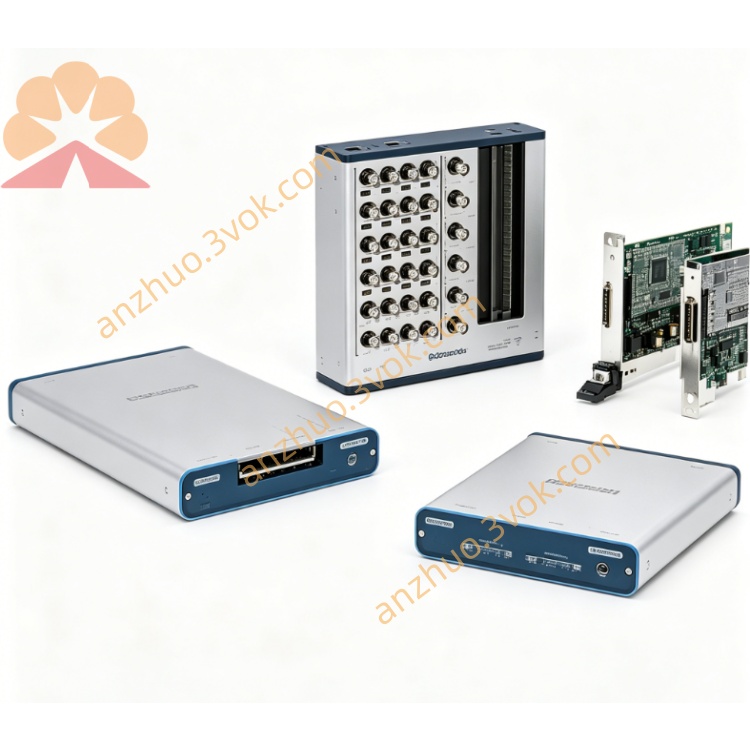
NI PXI‑6025E E‑Series Multifunction DAQ Module
Description
II. Model Interpretation
PXI: Compliant with the PXI bus standard, 3U size, single slot, compatible with PXI/PXIe chassis.
6025E: NI E series DAQ model, representing a 12-bit, 200 kS/s, 16 analog input multi-functional I/O module.
Part Number: 777798-01 (standard model).
III. Technical Parameters (25℃)
1. Analog Input (AI)
Number of channels: 16 single-ended / 8 differential (software selectable)
Resolution: 12 bits
Maximum sampling rate: 200 kS/s (single channel), multi-channel time-division multiplexing
Voltage range: ±10 V (default), selectable ±5 V, ±2 V, ±1 V
Input impedance: 1 MΩ
Coupling mode: DC coupling
Absolute accuracy: ±0.04% FS (typical)
2. Analog Output (AO)
Number of channels: 2
Resolution: 12 bits
Output range: ±10 V
Drive capability: ±5 mA
Setup time: 10 μs (to 0.01%)
3. Digital I/O (DIO)
Number of channels: 32 (bidirectional TTL)
Voltage level: TTL (high ≥ 2.4 V, low ≤ 0.4 V)
Maximum rate: 1 MHz
4. Counter / Timer
Number: 2 24-bit counters
Function: event counting, pulse generation, frequency / period measurement
Time base: 100 MHz internal clock
5. Physical and Environmental
Size: 3U, single slot (approx. 22 mm × 124 mm × 126 mm)
Weight: approximately 100 g
Operating temperature: 0~55℃
Power consumption: approximately 5 W (PXI backplane power supply)
IV. Interface and Communication Configuration
Front panel / connectors
100-pin SCSI type I/O interface (requires CB-50LP and other wiring boxes)
No front panel indicator lights, status read by software
Bus and software
Backplane: PXI bus (PCI, trigger, 10 MHz reference)
Driver: NI-DAQmx, supports LabVIEW, TestStand, Python, C#
Synchronization: supports multi-module synchronization of PXI trigger bus and RTSI bus
V. Core Functions
Flexible analog input: 16 single-ended / 8 differential selectable, suitable for voltage and sensor signals, meeting multi-channel measurement requirements.
Medium-rate high-precision acquisition: 200 kS/s, 12 bits, suitable for medium-speed transient signals and steady-state measurements.
Complete multi-functional I/O: AI + AO + DIO + counter integrated, balancing measurement, control and timing.
Low cost high integration: all functions integrated in a single slot, simplifying the system and reducing costs.
Reliable industrial-grade design: wide temperature operation, anti-interference, suitable for laboratory and industrial sites.
VI. Application Scenarios
Industrial automation: production line analog quantity monitoring (temperature, pressure, level), closed-loop control.
Sensor measurement: thermocouple, RTD, strain bridge, voltage-type sensor data acquisition.
Laboratory research: teaching experiments, basic physics / chemistry signal recording, small test system.
General testing: PCB function testing, electronic component parameter measurement, low-speed data recording.
Motion and process control: used with counters for encoder speed measurement, pulse output control for actuator.
VII. Usage and Maintenance Instructions
Installation and power-on
Disconnect power, insert PXI single slot, chassis reliably grounded; power on, NI-DAQmx self-checks.
Keep the operating temperature within 0~55℃, keep the air duct unobstructed.
Wiring and operation For analog input, use shielded cables and differential wiring to suppress common-mode interference; the input voltage should not exceed ±10 V.
The 100-pin interface is not suitable for long-term insertion and removal; it is recommended to be connected with a wiring box as a transition.
When multiple modules are synchronized, share the PXI trigger bus and 10 MHz reference.
Daily maintenance and calibration
It is recommended to conduct a traceability calibration once a year to compensate for gain/offset drift.
Keep the interface clean; cover it with a dust-proof cover when not in use; avoid strong vibrations and humid environments.
Perform anti-static operations to prevent static damage to the input circuit.
Get a Quote