
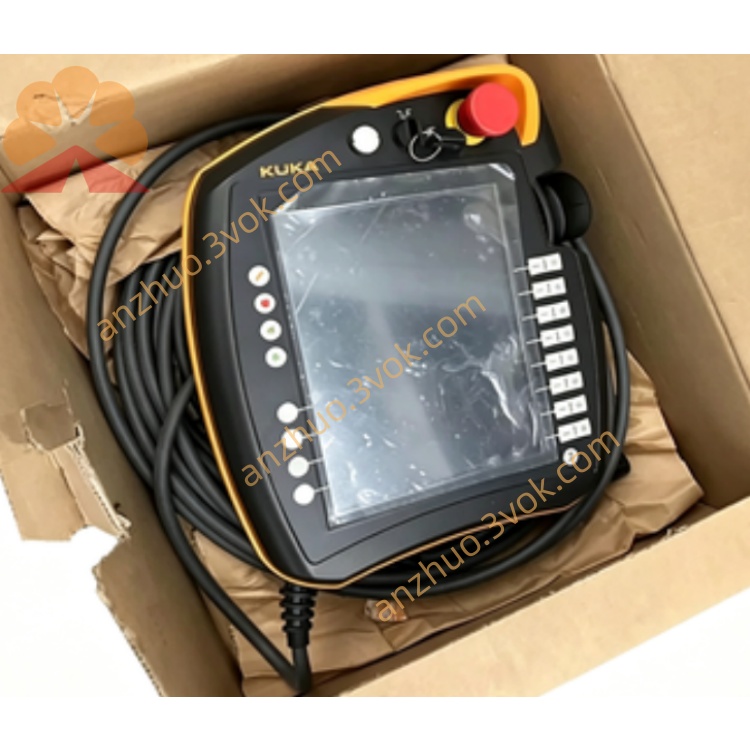
KUKA KRC4 Industrial Robot Controller Cabinet Complete Control System
Description
2. Technical Specifications
Model: KRC4 (compact/smallsize‑2/standard/midsize/extended)
Controller Type: Multi‑core PC‑based, real‑time Linux, integrated PLC/safetyKUKA
Compatible Robots: KR QUANTEC, KR CYBERTECH, KR CYBERTECH‑2, KR IONTECK, KR QUANTEC nano
System Software: KSS V8.x / V9.x (Linux‑based)
Power Supply: 3×208/400/415/480/575 V AC, 49–61 Hz, 25–32 A
Standard Interfaces: Ethernet (10/100/1000 Mbps), CANopen, USB 2.0, RS‑232
Optional Fieldbuses: PROFINET, EtherCAT, PROFIBUS, DeviceNet
Drives: Integrated digital servo drives for 6 robot axes + up to 3 external axesmyKUKA
Teach Pendant: smartPAD (10.1” touchscreen, 6D joystick, IP65)
Protection Class: IP54 (cabinet), IP65 (smartPAD front)myKUKA
Operating Temp: +5°C to +45°CmyKUKA
Storage Temp: -20°C to +60°C
Dimensions (W×H×D):
Compact: ~400×500×300 mm
Standard: ~792×960×602 mmmyKUKA
Weight: 33–240 kg (varies by model)KUKA
3. Main Components & Controls
3.1 Control Cabinet
Main Power Switch: 3‑phase AC input ON/OFF.
Emergency Stop (E‑Stop): Red mushroom button; dual‑channel safety cuts servo power.
Reset Button: Clears faults, resets safety, restarts system.
Status LEDs: Power (green), Run (green blinking), Error (red), Servo Ready (yellow).
Control PC: Multi‑core CPU, 1 GB RAM, 16 GB flash memory.
Safety Controller: Integrated dual‑channel safety (EN ISO 13849‑1 Cat. 4).
Servo Drives: Integrated for axes 1–6 + up to 3 external axesmyKUKA.
I/O Module: 64 digital / 32 analog (expandable).
Fieldbus Slots: PROFINET, EtherCAT, PROFIBUS options.
USB/Ethernet: For program backup/restore, WorkVisual connection.
3.2 Teach Pendant (smartPAD)
10.1” TFT Touchscreen: 1280×800 resolution, color display.
6D Joystick: Cartesian (X/Y/Z/A/B/C) or axis‑specific (A1–A6) jogging.
3‑Position Enabling Switch (Rear):
0: Disabled (no motion)
1: Enabled (manual jog; must be held)
2: Disabled (no motion)
Mode Switch:
T1: Manual low speed (≤250 mm/s; teaching)
T2: Manual high speed (verification)
AUT: Automatic mode (production)
EXT: External PLC control
Alphanumeric Keypad: Program editing, data input.
Function/Softkeys: Menu navigation, command selection (e.g., PTP, LIN, CIRC).
Touchscreen: Direct menu access, program editing, diagnostics.
4. Safety Instructions
E‑Stop: Use only in emergencies; stops all servo motion via dual‑channel safety.
Enabling Switch: Must be held in Position 1 for manual jog; robot stops if released.
Mode Rules:
T1: Reduced speed; use for teaching/testing.
T2: High speed; ensure workspace is clear.
AUT: No personnel in workspace; safety doors closed.
EXT: External PLC control; safety interlocks required.
Integrated Safety: Dual‑channel safety controller monitors E‑stop, enabling switch, safety doors, and axis limits (Cat. 4, PL d).
No Modification: Never bypass or modify safety circuits (E‑Stop, safety controller, enabling switch).
Work Envelope: Stay clear of robot’s full range of motion.
5. Installation & Connection
Positioning: Place cabinet on flat, level floor; allow 100 mm clearance for ventilation.
Power Connection: Connect 3‑phase AC to X1; ensure correct voltage (400 V AC standard).
Motor Cables: Connect axes 1–6 motors to X20; tighten connectors.
smartPAD Connection: Connect smartPAD cable to KCP port; lock connector.
Fieldbus Setup: Install PROFINET/EtherCAT/Ethernet cables; configure addresses.
I/O Wiring: Connect 24 V DC I/O to terminal blocks; check polarity.
Grounding: Earth cabinet and robot base per local codes.
WorkVisual: Connect PC via Ethernet for configuration, programming, and diagnostics.
6. Operating Instructions
6.1 Power‑Up
Turn main power switch ON.
System boots Linux real‑time OS and KSS V8.x/V9.x.
Check LEDs: Power ON, Run blinking, Error OFF.
Press Reset to clear faults and reset safety.
Switch to T1 mode; hold enabling switch (Position 1).
Jog robot to verify motion.
6.2 Manual Jogging (T1/T2)
Mode: T1 (low speed) or T2 (high speed).
Hold enabling switch in Position 1.
Joystick:
Axis Mode: Move individual joints (A1–A6).
Cartesian Mode: Move TCP in X/Y/Z; rotate A/B/C.
Adjust speed with HOV (Handwheel Override) keys (0–100%).
6.3 Programming (T1)
T1 mode; enable switch held.
Jog to desired position; press Record to store.
Add commands:
PTP: Point‑to‑point motionLIN: Linear motionCIRC: Circular motionWAIT: PauseIF/FOR: Logic controlSPS: Integrated PLC commands
Name program; save to flash or USB.
Use WorkVisual for offline programming and simulation.
6.4 Automatic Operation (AUT)
Select program from list.
Mode: AUT.
Clear workspace; close safety doors.
Press Start on smartPAD or external panel.
Press Stop to pause; E‑Stop for emergency.
6.5 External Operation (EXT)
Connect external PLC via PROFINET/EtherCAT/Ethernet.
Configure I/O signals for Start/Stop, Fault Reset, Program Select.
Mode: EXT; ensure safety interlocks are closed.
Control robot via PLC commands.
7. Maintenance
Daily: Check E‑Stop function; inspect cables for damage.
Weekly: Clean cabinet filters; verify fan operation.
Monthly: Check servo drive temperatures; tighten connectors.
Quarterly: Backup programs to USB; test restore.
Annual: Replace battery (CMOS/encoder); calibrate smartPAD touchscreen.
Environment: Keep cabinet dry; avoid dust and vibration.
Get a Quote