
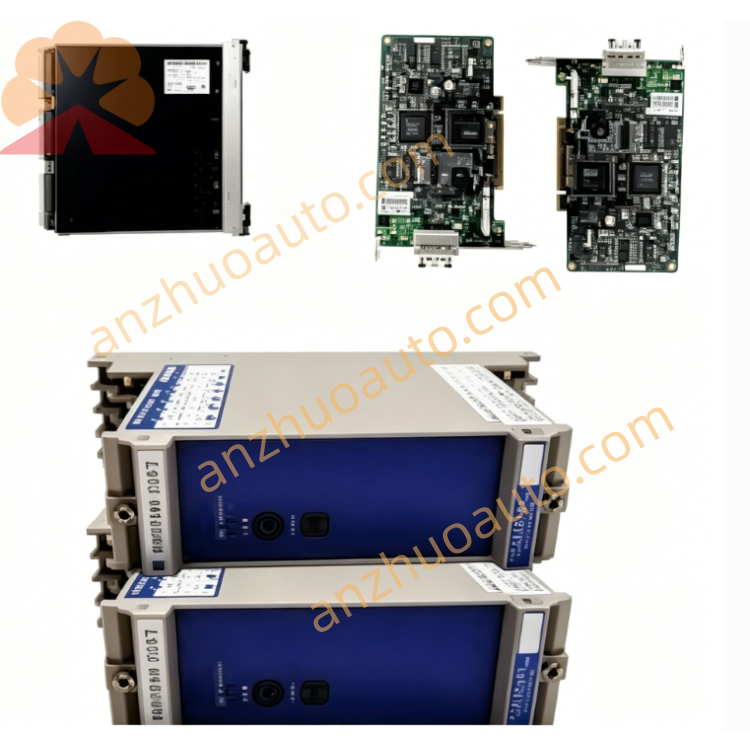
GE DS200NATOG1A Speedtronic Mark V LCI Voltage Signal Conditioning Board
The DS200NATOG1A is a standard base model network analog transceiver daughter card manufactured by General Electric for the GE Mark V (GE2) gas and steam turbine-generator safety control system. It acts as a dedicated bidirectional analog signal bridge between local rack analog I/O modules and the Mark V distributed control network bus, handling transmission and reception of standardized analog measurement and control signals across multi-rack turbine control architectures. This module converts internal rack parallel analog data into serial network-compliant signals for cross-rack data exchange, and restores incoming network analog commands/process values into parallel analog signals compatible with local AI and AO daughter boards. Full hot-swap capability is supported on energized control racks; module insertion or removal will not interrupt continuous analog measurement, closed-loop regulation or network communication of turbine critical process loops. Designed for general-purpose power plant control room and turbine enclosure deployment, the base DS200NATOG1A features standard galvanic isolation, basic multi-stage EMI filtering and single-layer conformal PCB coating, delivering reliable analog network communication under typical industrial temperature, humidity and moderate electromagnetic interference operating conditions.
Description
GE DS200NATOG1A Network Analog Transceiver I/O Interface Module
Product Overview
The DS200NATOG1A is a standard base model network analog transceiver daughter card manufactured by General Electric for the GE Mark V (GE2) gas and steam turbine-generator safety control system. It acts as a dedicated bidirectional analog signal bridge between local rack analog I/O modules and the Mark V distributed control network bus, handling transmission and reception of standardized analog measurement and control signals across multi-rack turbine control architectures. This module converts internal rack parallel analog data into serial network-compliant signals for cross-rack data exchange, and restores incoming network analog commands/process values into parallel analog signals compatible with local AI and AO daughter boards. Full hot-swap capability is supported on energized control racks; module insertion or removal will not interrupt continuous analog measurement, closed-loop regulation or network communication of turbine critical process loops. Designed for general-purpose power plant control room and turbine enclosure deployment, the base DS200NATOG1A features standard galvanic isolation, basic multi-stage EMI filtering and single-layer conformal PCB coating, delivering reliable analog network communication under typical industrial temperature, humidity and moderate electromagnetic interference operating conditions.
Core Functional Description
The DS200NATOG1A integrates multiple independent bidirectional analog signal transceiving channels paired with standard isolation and signal conditioning circuits for network bus communication. In transmit mode, the module collects parallel analog process data from local analog input, temperature and vibration acquisition boards, performs signal sampling, analog-to-network protocol conversion and noise filtering, then transmits serialized analog value frames over the Mark V internal control network to remote racks and the main master controller. In receive mode, it accepts serial analog control setpoints and remote measurement feedback data from the network bus, converts serial network signals back to stable parallel analog levels, and distributes conditioned analog signals to local analog output regulation boards for valve positioning and excitation control loops. Each channel is fitted with standard galvanic isolation to eliminate cross-rack ground loop potential differences that would distort low-level analog signals during long-distance network cabling transmission. Built-in multi-order LC EMI filter arrays suppress power frequency harmonics and mild radiated electromagnetic interference from nearby rotating equipment and medium-voltage switchgear. Continuous cyclic on-board self-test logic runs during full operation to detect network wiring open-circuit faults, bus short-circuits, analog signal over-range drift, isolation circuit degradation, internal reference voltage deviation and loose terminal block connections. All detected fault events carry standard timestamps and unique channel identifiers, stored in basic-capacity non-volatile on-board memory for routine maintenance fault checking and simple post-failure event tracing. The base DS200NATOG1A unit provides fundamental analog network communication functionality without the enhanced surge suppression, expanded diagnostics or triple anti-corrosion coating featured on upgraded suffix revision variants.
Key Technical Specifications
Manufacturer: General ElectricModel Part Number: DS200NATOG1ACompatible Control Platform: GE Mark V (GE2) Turbine-Generator Integrated Safety Control SystemForm Factor: Standard single-width compact daughter card matching unified mechanical slot dimensions of all Mark V series rack assembliesOperating Ambient Conditions: Operating temperature range -20°C to +70°C; storage temperature range -50°C to +125°C; relative humidity 5%–95% non-condensing; single-layer anti-mold conformal protective coating applied to the PCB assembly.Power Supply Input: Dual wide-range DC 12V / DC 24V adaptive power input, three-stage standard protection circuits against reverse polarity, overvoltage and input surge transients.Transceiver Channel Configuration: Multiple bidirectional isolated analog network transceiving channels compatible with Mark V proprietary internal control communication bus.Analog Signal Compatibility: Supports standard 4–20mA process measurement signals, 0–10V regulation setpoint signals and low-level temperature/vibration analog feedback signals from all Mark V analog I/O daughter boards.Isolation Performance: Per-channel standard galvanic isolation rated for 1500V AC one-minute dielectric withstand testing; minimum insulation resistance reaches 1200 MΩ at 500 VDC test voltage.EMC Performance: Standard multi-stage LC EMI filter network delivering minimum 40 dB power frequency interference attenuation, compliant with basic IEC 61000-6-2 industrial EMC requirements and GE general power plant electromagnetic screening standards.Mechanical Reliability: Withstands continuous 8g vibration loading across the 10 Hz–150 Hz frequency band, single transient shock pulse of 25g with 11 ms duration; standard PCB mechanical layout for normal vibration turbine foundation environments.Hot Swap Capability: Basic per-channel soft-start power control circuit enables live insertion and removal on energized racks, preventing temporary analog communication dropout during routine module replacement maintenance.Self-Diagnostic Coverage: Standard real-time detection of network cable breakage, bus loop short circuit, analog signal amplitude over-range, internal isolation component degradation, reference voltage drift and loose terminal contact; basic fault classification library for general wiring and circuit failure identification only.Design Service Life: Minimum 100,000 hours of uninterrupted 24/7 continuous operation under rated nominal environmental working conditions.Warranty Term: Twelve-month global unified factory warranty valid for new original GE units and GE certified refurbished DS200NATOG1A modules.
Application Scenarios
The DS200NATOG1A base network analog transceiver module is widely deployed in standard GE Mark V (GE2) control racks installed in central power plant control rooms and moderately ventilated turbine auxiliary cabinet rooms across all power generation facilities. Primary application fields include fossil-fuel steam turbine standard control panels, combined-cycle gas turbine basic monitoring racks, general industrial mechanical drive turbomachine auxiliary control enclosures and small-capacity grid-connected generator distributed control cabinets. Multiple DS200NATOG1A modules are installed in separate local I/O racks to establish inter-rack analog data communication links, enabling seamless exchange of generator load, vibration, temperature, valve position and speed analog signals between distributed subracks and the central master controller rack. All transceived analog network data supports real-time cross-rack HMI parameter display, coordinated multi-loop turbine startup sequence control, shared analog protection threshold monitoring and basic abnormal analog signal event trending storage. This base model is selected for sites with moderate electromagnetic interference, normal cabinet heat dissipation and standard humidity levels where high-end anti-surge and advanced diagnostic upgrades are not mandatory. The module enables scalable expansion of Mark V control systems by connecting additional I/O racks via the internal analog network bus without reconfiguring the main master control backplane. Basic on-board fault logging stores core communication error timestamps to assist maintenance crews with simple network wiring and transceiver circuit troubleshooting workflows.
Compatibility & Installation Guidelines
The DS200NATOG1A shares fully identical mechanical outer dimensions, backplane edge connector pin definitions, Mark V proprietary network bus communication protocols and rack mounting interfaces with all suffix upgraded revision variants of the NATOG series, supporting direct plug-and-play drop-in replacement without cabinet structural modification, network cabling rearrangement or master controller software reconfiguration. It supports flexible mixed installation alongside all other Mark V functional daughter boards including generator differential/ground fault protection analog cards, speed and load monitoring modules, vibration acquisition boards, discrete DI/DO logic cards, RTD/thermocouple temperature input modules and pulse encoder signal boards to build complete multi-rack distributed turbine-generator safety control architectures. Standard field installation practices require dedicated shielded network cable trays for analog communication wiring, physically separated from high-current power and high-voltage control cables to limit electromagnetic coupling interference; annual full-channel isolation withstand testing and analog signal transmission linearity calibration is recommended to maintain long-distance network communication precision. All factory-new and GE certified refurbished DS200NATOG1A modules complete a standard 72-hour full-load high-low temperature cyclic aging test and basic electromagnetic stress screening prior to factory shipment to guarantee consistent analog network transceiving performance under general power plant operating environments.
Core Limitations Compared to Upgraded Suffix Revision Models
As the baseline standard A model, the DS200NATOG1A lacks several enhancements featured on ABA, AAA, ADA and other revised variants: standard 1500V isolation rather than reinforced 2500V isolation transformers, three-tier basic surge suppression instead of five-stage bidirectional transient protection, 40 dB EMI attenuation instead of optimized 45 dB high-order filter performance, single-layer conformal PCB coating without anti-salt-fog and heavy anti-corrosion properties, basic limited-capacity fault event memory without extended transient waveform storage, and only standard fault detection functions without advanced wiring insulation degradation and intermittent fault diagnostic logic. It is not recommended for high-interference generator bays, high-voltage substation adjacent cabinets or coastal salt-fog power plant sites where upgraded NATOG revision variants are required for stable long-term operation.
Get a Quote