
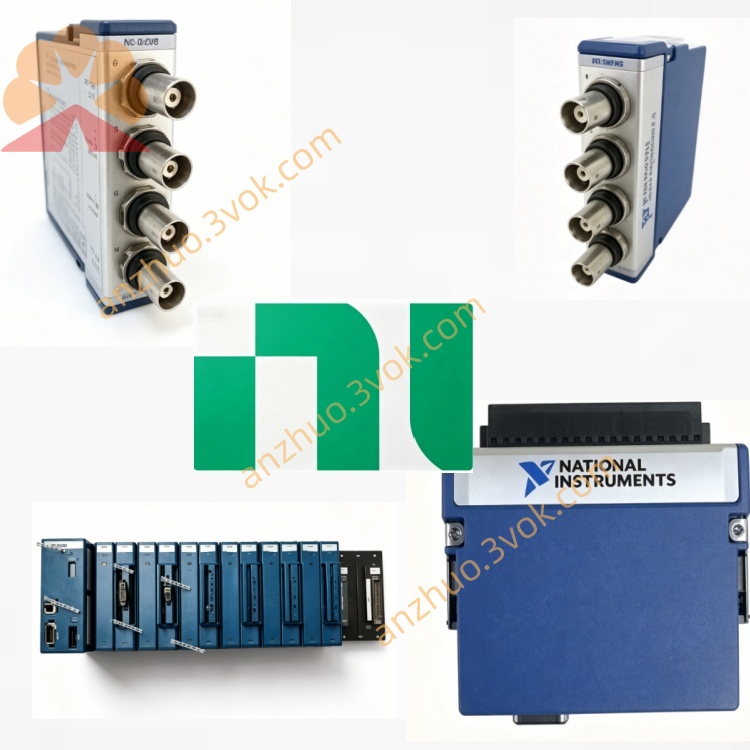
NI PXIe-4610 Low-Noise Low-Distortion Audio Power Amplifier Module
Description
Model Nomenclature
PXIe: PXI Express high‑speed modular instrumentation bus
46: Dynamic Signal Analysis (DSA) power amplifier series
10: 2‑channel, ±14 V/±2.2 A, low distortion, PXIe single‑slot amplifier
Technical Specifications
Form factor: 3U single‑slot PXIe module
Channels: 2 independent differential amplifier channels
Gain: 20 dB (fixed, ±0.031 dB unadjusted, ±0.011 dB adjusted)
Input: AC‑coupled differential, ±1.414 Vpk (1 Vrms full‑scale), 10 kΩ || 100 pF impedance
Output: DC‑coupled differential, ±14.14 Vpk (10 Vrms full‑scale)
Peak current: ±2.235 A (1.581 A rms) per channel
Slew rate: ±15 V/μs (voltage), ±0.5 A/μs (current)
Frequency response: 10 Hz to 100 kHz (±0.5 dB)
Total harmonic distortion (THD): <0.005% (1 kHz, 1 W into 8 Ω)
Noise: <10 μVrms (20 Hz–20 kHz, A‑weighted)
Offset drift: 50 μV/°C
Protection: Overvoltage, overcurrent, short‑circuit, overtemperature
Operating temperature: 0 °C to 55 °C
Storage temperature: −40 °C to 70 °C
Connectors: Front‑panel BNC (input), screw terminals (output)
Weight: approx. 200 g (7.1 oz)
Interface and Communication Configuration
Bus: PXIe Gen1, plug‑and‑play compatible with PXI/PXIe chassis
Driver: NI‑DAQmx 19.0 or later
Software: NI‑MAX, LabVIEW, C/C++, Python, .NET; full API for configuration and control
Triggering: PXI trigger lines 0–7; synchronized with other PXIe DSA modules (e.g., 446x, 447x)
I/O: 2×BNC (differential input), 4×screw terminals (differential output, force/sense)
Data transfer: DMA for high‑speed streaming of amplifier status and telemetry
Core Features
Low distortion & low noise: <0.005% THD and <10 μVrms noise for high‑fidelity signal amplification
High power density: 2 channels of ±14 V/±2.2 A from a single PXIe slot, no external amp required
Differential I/O: AC‑coupled differential input, DC‑coupled differential output for noise rejection
Fixed gain (20 dB): Precision gain with tight accuracy for consistent amplification
Built‑in protection: OVP, OCP, short‑circuit, and overtemperature safeguards for DUT and module
PXIe synchronization: Tight timing alignment with other PXIe instruments for closed‑loop testing
Application Scenarios
Audio testing: Speaker, headphone, and audio component characterization (frequency response, distortion)
Vibration testing: Shaker and transducer driving for modal analysis and structural testing
Automotive: In‑car audio, infotainment, and NVH (noise, vibration, harshness) validation
Aerospace: Avionics audio, vibration, and environmental simulation testing
Industrial: Dynamic load testing, actuator driving, and precision signal amplification in manufacturing
Get a Quote