
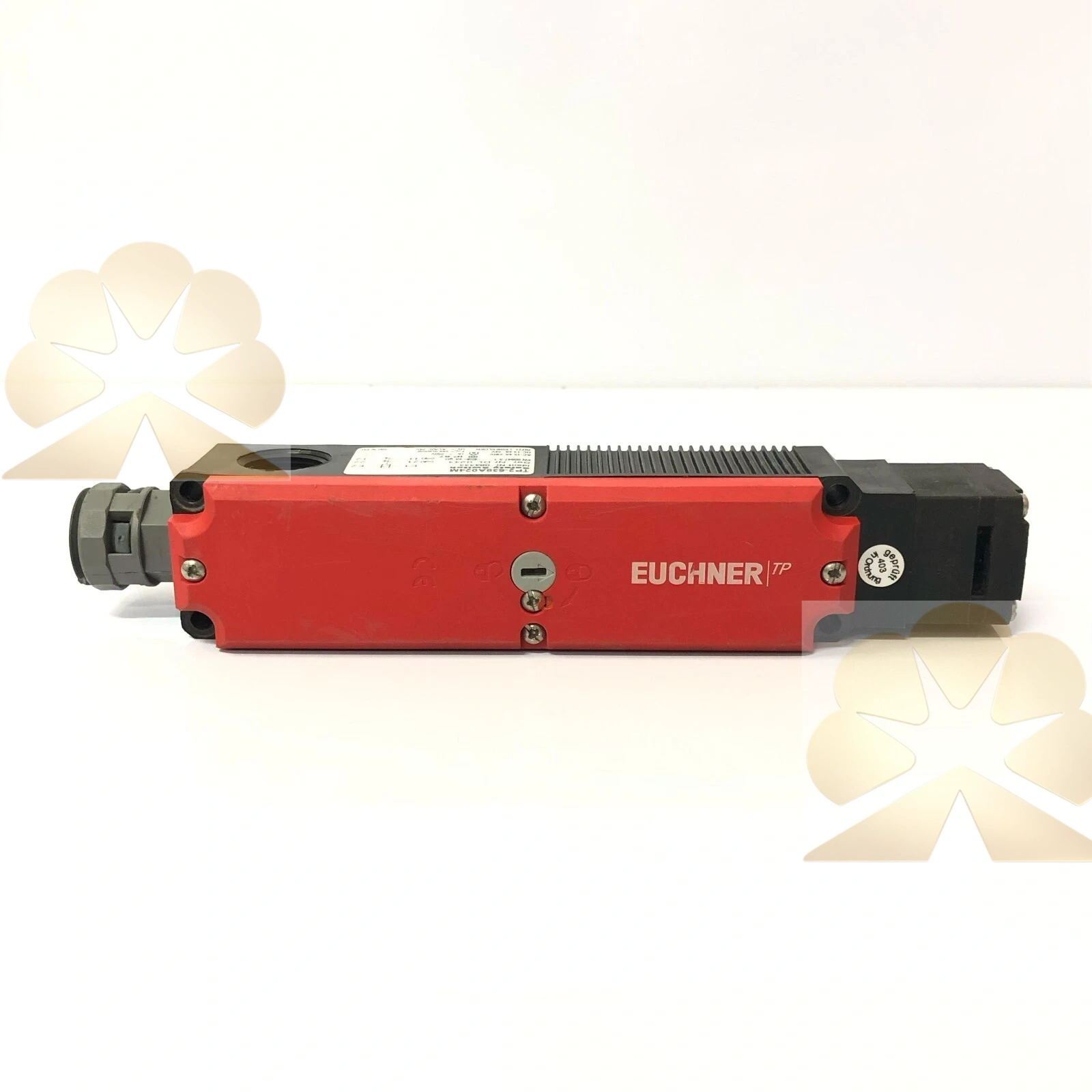
Description
EUCHNER TP2-538A024M DL0244: TP Guard Locking Safety Switch Product Description
Brand and Product Identification
The EUCHNER TP2-538A024M, with reference DL0244, is a TP series electromechanical safety switch with guard locking for machine guard doors or flaps. The Euchner order number for the base TP2-538A024M is 084333, gross weight 0.439 kg and GTIN 4047048000537. The TP2 prefix identifies the TP2 open-circuit current locking version, 538 identifies the switching element and wiring diagram, A024 identifies the 24 V design, and M identifies the M20 cable entry version. The DL0244 number is the related unit or internal identification reference associated with this switch. The actuator is not included with the safety switch.
Product Function and System Role
The TP2-538A024M monitors and locks a machine guard during hazardous machine operation. The switch provides two positively driven contacts for guard lock monitoring, so the safety control system can verify that the guard is locked before hazardous motion is enabled. The device uses cable entry rather than a plug connector and includes an auxiliary release for emergency access. It is a guard locking safety switch, not a standard door limit switch, safety relay, contactor, PLC, actuator or sensor by itself.
Guard Locking Principle
The TP2 version uses the open-circuit current principle, also described as power-on-to-lock. On a guard with open-circuit current guard locking, the guard is locked until the power supply to the guard locking solenoid is interrupted; unlocking is by spring force. This arrangement is also called electrical guard locking. The solenoid supply and contact state must be wired according to the Euchner TP operating instructions and the machine safety circuit.
Electrical Specifications
Rated AC/DC solenoid supply is 24 V, minus 15 percent to plus 10 percent. Power consumption is 8 W. Solenoid duty cycle is 100 percent. Minimum switching current is 12 V at 10 mA and 1 mA at 24 V. Thermal rated current Ith is 4 A. Rated insulation voltage Ui is 250 V, and rated impulse voltage Uimp is 2.5 kV. AC-15 contact rating is 4 A at 230 V, and DC-13 rating is 4 A at 24 V. Fuse protection is maximum 4 A gG. Connection cross section is 0.34 to 1.5 mm².
Contacts and Mechanical Ratings
The switching element has two positively driven contacts for guard lock monitoring. The switch has three M20 by 1.5 cable entries and no contacts for door position according to the product description. Contact material is silver alloy with gold flashing. Housing is reinforced thermoplastic. Locking force F maximum is 1300 N, and locking force F Zh is 1000 N. Extraction force is 20 N, actuating force is 10 N and retention force is 10 N. Maximum approach speed is 20 m per minute. Actuation frequency is maximum 1200 cycles per hour. Degree of protection is IP67.
Actuator Compatibility and Mounting
Approach direction is horizontal and vertical, adjustable in 90 degree steps. Increased overtravel is available for the horizontal approach direction. With actuator ACTUATOR-P-GT, horizontal overtravel is 2 mm and vertical overtravel is 1.5 mm. With actuator ACTUATOR-P-GNT, horizontal overtravel is 7 mm. Mounting plates EMP-B1, EMP-B2 or EMP-SB and switch brackets are available for CTP, CTA, TP, STA, STP and TX switches. The actuator must be selected separately and aligned to the switch according to the dimensional drawing.
Safety Characteristics
Guard lock monitoring B10D is 3 times 10 to the power of 6, with mission time 20 years, valid at DC-13 100 mA at 24 V. Overall performance level, category and SIL depend on the complete safety circuit, contactor or relay redundancy, actuator, door monitoring arrangement and external control design. The switch must be evaluated as part of the machine guard safety system according to EN ISO 13849-1 and EN IEC 62061.
Auxiliary Release
The auxiliary release on the front allows access to the machine during a malfunction such as a power failure. Unlocking is performed using a tool or key. The auxiliary release must be protected against misuse, for example by sealing or lacquering, according to the operating instructions. This feature supports maintenance or egress access when the solenoid or machine control cannot release the guard normally.
Typical Application Scenarios
Typical applications include machine guards on packaging machines, machine tools, presses, robotic cells, assembly lines, injection molding machines, conveyor guards, welding cells and other machinery where hazardous motion must be prevented while the guard is open or unlocked. The M20 cable entry version suits installations where cable glands are preferred over plug connectors, and the lock monitoring contacts provide feedback to a safety relay or safety controller.
Installation and Commissioning Notes
Installation must follow the Euchner TP operating instructions, machine safety standards and local safety requirements. Mount the switch and matched actuator on the guard and frame, verify approach direction, insertion depth, overtravel and alignment, wire the 24 V solenoid supply, two guard lock monitoring contacts and auxiliary release circuit, and connect cable glands to the three M20 entries. Test locking, unlocking, lock monitoring contacts, auxiliary release and safety circuit response before machine release. Confirm the guard remains locked while machine function is active and that machine start is prevented while guard locking is released.
Advantages and Selection Notes
The TP2-538A024M offers TP2 open-circuit current guard locking, two positively driven lock monitoring contacts, 1300 N maximum locking force, 1000 N locking force, three M20 cable entries, auxiliary release, IP67 reinforced thermoplastic housing, 24 V solenoid supply and Euchner TP series mechanical compatibility. When selecting a replacement, confirm TP2 versus TP1 locking principle, 538 switching element, cable entry versus plug connector, door position contacts, actuator model, solenoid voltage and lock monitoring contact configuration. The TP2-538A024M is a guard locking safety switch, not a standard limit switch, safety relay, contactor, controller or actuator; its role is to monitor and lock machine guards in an industrial safety circuit.
Get a Quote