
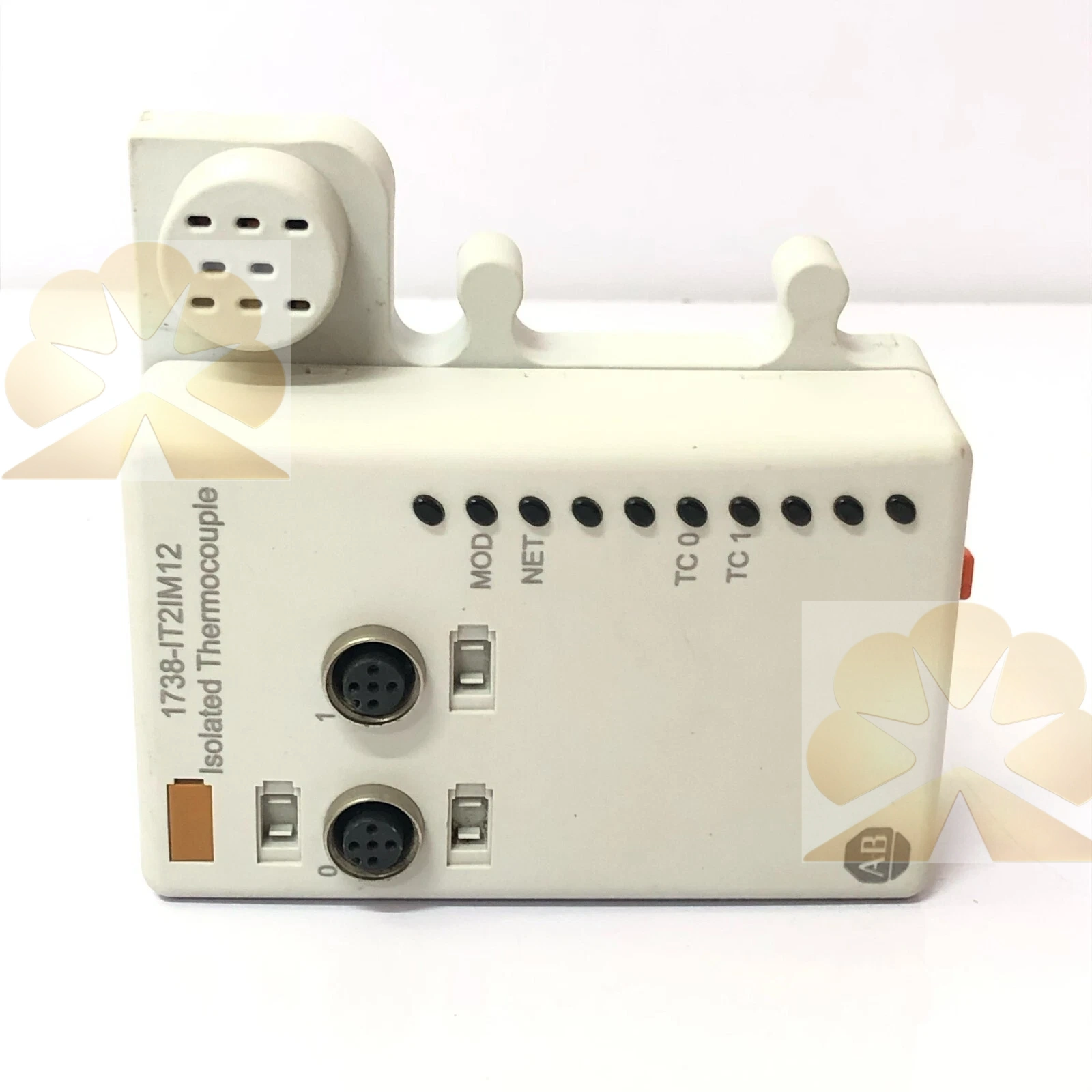
Description
ALLEN BRADLEY 1738-IT2IM12: ArmorPoint Thermocouple Analog Input Module Product Description
Brand and Product Identification
The ALLEN BRADLEY 1738-IT2IM12 is an ArmorPoint I/O thermocouple and millivolt analog input module from Rockwell Automation Allen-Bradley. The 1738 prefix identifies the ArmorPoint modular I/O family, IT identifies a thermocouple input module, 2 identifies two input channels, I identifies individually isolated differential inputs, and M12 identifies the sealed M12 micro connector connection. The module is Series A and designed for distributed machine I/O without a separate enclosure when the IP-rated housing is used correctly.
Product Function and System Role
The 1738-IT2IM12 converts thermocouple or low-level millivolt sensor signals into digital temperature or voltage values transmitted over the ArmorPoint PointBus to the controller. The two differential, individually isolated input channels connect to thermocouple sensors through M12 connectors. The module performs cold junction compensation, signal conversion, notch filtering and signal conditioning so the PLC or controller program can read process temperature values. It is an analog temperature input module, not a digital I/O module, RTD module, analog output module, controller, sensor or thermocouple itself.
Input and Sensor Specifications
The module has two differential, individually isolated inputs. Input range is plus or minus 75 mV. Resolution is 15 bits plus sign, with 2.5 mV per count. Supported thermocouple types are B, C, E, J, K, N, R, S and T, with sensor ranges and average resolution over span listed in the Rockwell specification sheet. Cold junction compensation range is 0 to 70 degrees Celsius. Input resistance is 1 MΩ and input impedance is 100 kΩ for the thermocouple version. Conversion type is Delta Sigma, and data format is signed integer.
Accuracy, Filtering and Update Rate
Absolute accuracy is 0.1 percent full scale at 25 degrees Celsius, including offset, gain, non-linearity and repeatability error terms. Accuracy drift with temperature is 30 ppm per degree Celsius. Common mode rejection ratio is 120 dB, and normal mode rejection ratio is 100 dB. Input update rate per module ranges from 20 ms at a 50 Hz notch to 2 ms at a 480 Hz notch. Step response per channel ranges from 60 ms at 50 Hz to 6 ms at 480 Hz. Notch filter frequencies correspond to line and notch settings listed in the ArmorPoint specification sheet.
Connectors and Wiring
The module uses two sealed M12-A style connectors, M12-A and M12-B, for the two thermocouple channels. Pin assignment for the IT2IM12 module: pin 1 is CJC plus, pin 2 is TC 0 plus on M12-A or TC 1 plus on M12-B, pin 3 is CJC minus, pin 4 is TC 0 minus on M12-A or TC 1 minus on M12-B, and pin 5 is no connect. Analog modules have earth grounded metal rings, which should be considered when choosing shielded cables and grounding techniques. All connectors and caps must be securely tightened to maintain the sealed connection rating.
Power, Isolation and Status Indicators
POINTBus current for the 1738-IT2I module is 175 mA at 5 V DC. No external DC power is required for the module. Channel isolation is tested at 50 V rms, with dielectric test of 1000 V rms flash for one second. The module has one green or red LED module status indicator on the logic side. The mounting base ships with the module, and the ground lug connection also serves as a mounting hole.
Mechanical and Environmental Ratings
Module dimensions are 31.75 mm height, 66.80 mm width and 107.95 mm depth, equivalent to 1.25 by 2.63 by 4.25 inches. Enclosure rating meets IP65, IP66 or IP67 when marked and connectors are sealed. Operating temperature ranges from minus 20 to plus 60 degrees Celsius, or minus 4 to 140 degrees Fahrenheit. Storage temperature ranges from minus 40 to plus 85 degrees Celsius, or minus 40 to 185 degrees Fahrenheit. Relative humidity is 5 to 95 percent non-condensing. Mounting base screw torque is M4 or number 8 screw, 0.85 Nm in aluminum and 1.8 Nm in steel.
Typical Application Scenarios
Typical applications include industrial machine temperature monitoring, oven and furnace temperature feedback, plastic machinery, packaging machines, packaging heat seal monitoring, process heating, exhaust or bearing temperature monitoring, food and beverage equipment, metalworking temperature measurement and distributed remote I/O installations where thermocouple signals are located near the machine rather than in a central cabinet. The sealed ArmorPoint housing suits washdown or exposed machine locations where M12 connectors and IP-rated modules are used.
Installation and Configuration Notes
Installation should follow the ArmorPoint RTD and thermocouple input module installation instructions, Rockwell Automation wiring and grounding guidelines, and local electrical codes. Mount the module on the ArmorPoint mounting base, connect thermocouple extension wire or compensated cable to the correct M12 pins, configure thermocouple type, range, units, filter notch and scaling in the controller software, and verify cold junction compensation and temperature readings after commissioning. Confirm shield grounding, channel isolation, sensor type and signal wiring before energizing. The input is not overvoltage protected, so verify sensor wiring and avoid wiring errors that could apply excessive voltage.
Advantages and Selection Notes
The 1738-IT2IM12 offers two differential individually isolated thermocouple inputs, plus or minus 75 mV millivolt range, 15-bit plus sign resolution, cold junction compensation, support for B, C, E, J, K, N, R, S and T thermocouples, M12 sealed connectors, IP65 to IP67 sealed housing, PointBus connection and no external module power. When selecting a replacement, confirm thermocouple versus RTD module, channel isolation, M12 connector, sensor type, input range, PointBus current, enclosure rating and controller compatibility. The 1738-IT2IM12 is an analog thermocouple input module, not a digital I/O module, RTD module, analog output, controller, thermocouple sensor or contactor; its role is to acquire and condition thermocouple temperature signals for the ArmorPoint distributed I/O system.
Get a Quote