
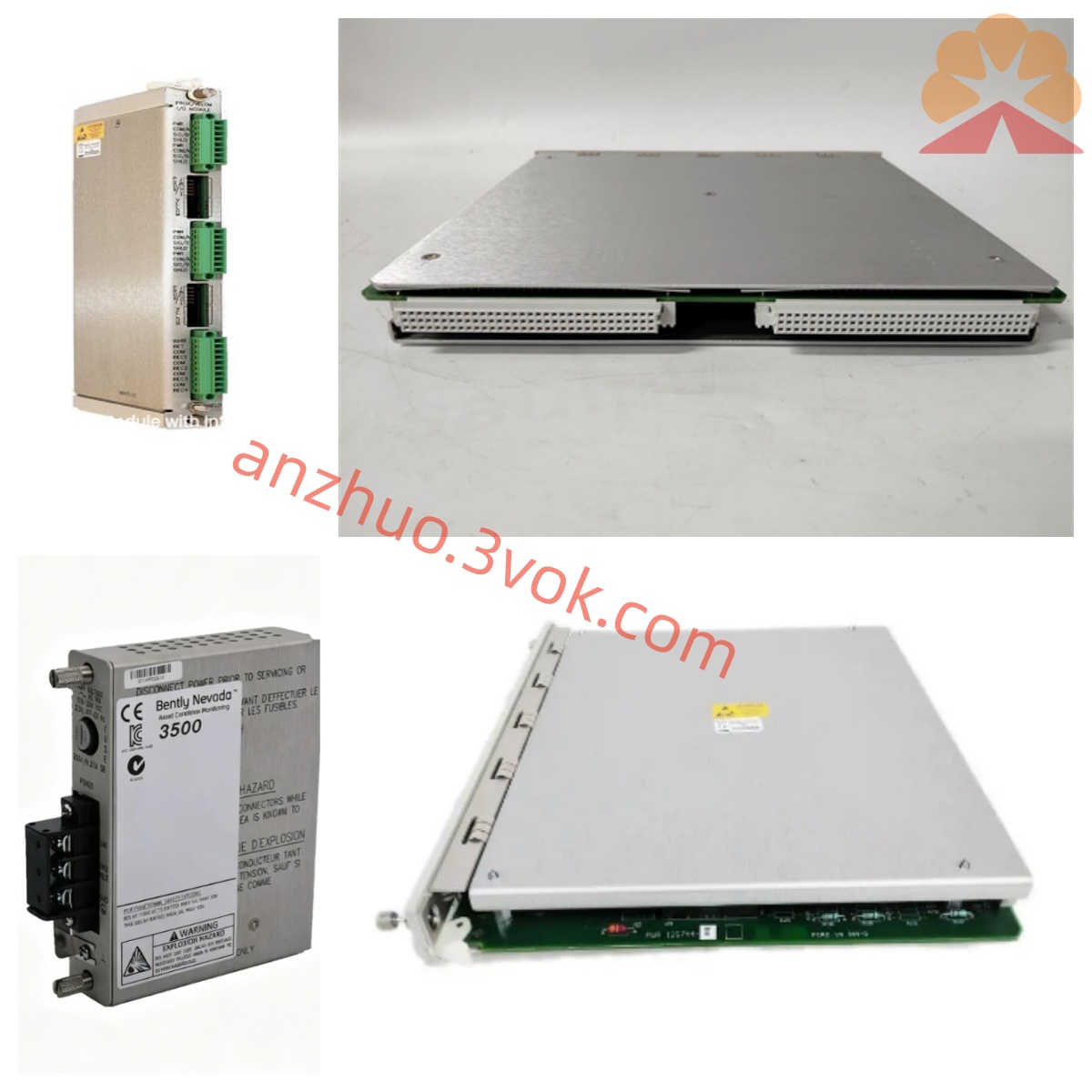
Bently Nevada 330100-50-03 Eddy Current Probe Extension Cable
Description
Bentley 330100-50-03 Preamplifier Product Description
I. Product Introduction
330100-50-03 is a preamplifier for the 3300 XL 8mm eddy current sensor system of Bently Nevada (a part of the ABB Group), strictly following the API 670 industry standard. This device serves as the signal processing core of the entire monitoring system, mainly providing high-frequency excitation power for the accompanying eddy current probes, while collecting the impedance change signals from the probes and converting the mechanical clearance quantity linearly into standard DC voltage signals. This product is specifically designed for industrial rotating machinery condition monitoring, capable of measuring parameters such as shaft vibration, axial displacement, shaft eccentricity, key phase, and rotational speed. It is widely used in TSI systems and features high measurement accuracy, stable operation, and strong anti-interference capability. It is a core component for the safety monitoring of large-scale units in the power, petrochemical, and metallurgical industries.
II. Basic Information
This product belongs to the 3300 XL standard series and is a dedicated preamplifier for 8mm probes. In the model code, 50 represents the total cable length of the sensor system is 5 meters, and 03 represents the standard probe cable length specification. The product is designed in a modular manner, supporting DIN rail installation in the control cabinet or panel-mounted fixed installation. The standard protection level is IP20, suitable for indoor control cabinet environments. The product has passed multiple international safety and electromagnetic compatibility certifications, fully meeting the industrial site usage specifications. The operating temperature range is 0°C to 45°C, the storage temperature range is -51°C to 100°C, the operating relative humidity requirement is 5% to 95%, and there is no condensation or corrosive gas in the environment. The overall structure is compact, the enclosure is made of flame-retardant industrial materials, lightweight, and convenient for on-site installation and later maintenance.
III. Electrical Technical Parameters
Power Supply Parameters
The device is powered by a negative direct current supply, with a rated power supply voltage range of -17.5VDC to -26VDC. The working current consumption is stable and can be long-term adapted to the industrial standard TSI cabinet power supply circuit. The power supply circuit has a surge protection design, capable of withstanding instantaneous voltage fluctuations in the site, ensuring the continuous operation of the equipment.
Signal Input Parameters
The input is matched with the entire series of 8mm standard eddy current probes (such as 330101, 330103, etc.), and the total cable length of the entire system is 5 meters, including the probe's built-in cable and the external extension cable. The overall calibration is completed at the factory, and no secondary calibration is required at the site. The preamplifier has a built-in high-frequency oscillation circuit, continuously outputting high-frequency excitation signals to the probe, and receiving the impedance change signals generated by the probe due to the eddy current effect.
Signal Output Parameters
The standard output sensitivity is 7.87V per millimeter, corresponding to 200mV per mil in imperial units. The effective linear measurement range is 2 millimeters, and the complete working range covers 0.25 millimeters to 2.3 millimeters. The output signal is a continuous DC voltage, with an output range of -1VDC to -17VDC, and the signal linear error does not exceed ±1%. The equipment's frequency response range is 0 hertz to 10 kilohertz, and the signal attenuation throughout the range meets the standard requirements, capable of fully capturing various vibration frequency components of rotating machinery. The output end has excellent load capacity and can directly connect to TSI monitoring cards, PLCs, DCS, secondary display instruments, and data acquisition equipment.
IV. Core Functions
Signal Conversion and Measurement Function
Based on the eddy current working principle, the preamplifier outputs high-frequency signals to the probe. Between the probe and the measured metal shaft, eddy current is generated, and the gap change will alter the impedance of the probe coil. Pre-filter accurately captures impedance changes and converts them into standard voltage signals in a fixed ratio, enabling non-contact measurement. It can precisely monitor radial shaft vibration, axial thrust displacement, and shaft eccentricity, and when paired with corresponding functional modules, it can also pick up phase signals and measure rotational speed. It is suitable for monitoring various rotating machinery.
Temperature compensation function
An all-encompassing automatic temperature compensation circuit is built-in, which can eliminate measurement deviations caused by changes in ambient temperature and probe operating temperature. Even if the equipment operates in a temperature fluctuating environment for a long time, its sensitivity and linearity can remain stable, with measurement drift controlled within the standard range across the entire temperature domain, effectively ensuring the accuracy of long-term monitoring data.
Line fault self-check function
An integrated hardware self-check circuit enables automatic detection of common faults such as probe breakage, short circuit, damaged connection cables, and abnormal power supply. Once a line or power supply fault is detected, the equipment will output a fixed fault voltage signal, which, when combined with the back-end monitoring system, can achieve fault alarm, helping maintenance personnel quickly locate the problem and avoid monitoring blind zones due to sensor failure.
Anti-interference and signal isolation
The circuit layout has been optimized for electromagnetic interference, featuring excellent EMI/RFI electromagnetic anti-interference capabilities. It can withstand electromagnetic interference generated by industrial equipment such as frequency converters, high-power motors, and contactors. The signal input, output, and power supply circuits are isolated, effectively eliminating common-mode signal interference, ensuring stable data transmission. The entire component supports on-site interchangeability of products of the same specification, and replacement does not require re-calibration, significantly simplifying the on-site maintenance process.
VII. Installation and Wiring Requirements
The standard installation method for the equipment is DIN rail mounting, and it can also be fixed on the control cabinet panel using screws. The installation location is recommended to be away from large-power electrical equipment, heating elements, and strong magnetic fields to reduce external interference. The entire system must be used in accordance with the 5-meter bus cable length specification. The combined length of the probe cable and extension cable cannot be changed arbitrarily, otherwise, it will affect the measurement accuracy. The wiring is divided into power supply end, probe signal end, and analog output end. The terminal labels are clear, and after completing the wiring according to the specifications, it is recommended to set the probe installation gap at the midpoint of the linear range, with the corresponding output voltage approximately -9VDC, to achieve the best measurement effect. The equipment is only suitable for indoor control cabinets and cannot be directly installed on the unit body, outdoors, or in areas with oil mist or water spray direct jets.
VIII. Operation Protection and Reliability Design
The entire circuit has overvoltage, reverse connection, and instantaneous surge protection functions, which can prevent equipment damage caused by wiring errors or abnormal voltages. The internal components are all selected from industrial-grade long-life devices, which have undergone strict working condition tests and can meet the 7×24-hour continuous operation requirements of industrial sites. The product is factory-calibrated, and the entire sensor component has good consistency, with no significant parameter deviation over the long term, reducing the frequency of calibration and maintenance.
IX. Typical Application Scenarios
In the power industry, it is mainly used for large auxiliary machinery such as steam turbine generators, water turbine units, boiler feed pumps, induced draft fans, and exhaust fans, to monitor shaft vibration and axial displacement to ensure the safe and stable operation of the unit. In the petrochemical field, it is paired with centrifugal compressors, gas turbines, process pump sets, and mixing units to achieve online monitoring of equipment status, and to predict faults such as bearing wear and rotor friction in advance. In the metallurgical industry, it is applied to blast furnace fans, large transmission motors, and rolling mill supporting rotating equipment, to complete vibration and displacement monitoring. At the same time, this product is also a standard front-end component of various large-scale TSI safety monitoring systems, widely used in equipment condition maintenance, fault diagnosis, and dynamic balance analysis, providing precise data support for equipment operation.
Get a Quote