
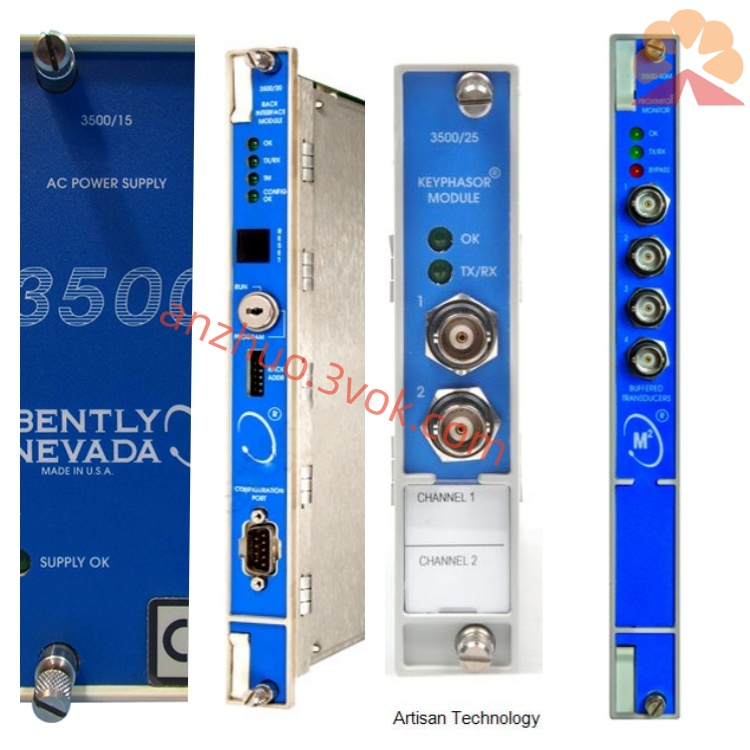
Bently Nevada 330101-00-60-10-02-05 Eddy Current Proximity Probe
Description
Bentley 330101-00-60-10-02-05 Eddy Current Probe Detailed Description
I. Product Introduction
330101-00-60-10-02-05 is a full-length threaded non-armored eddy current probe of the 3300 XL 8mm series from Bently Nevada under Baker Hughes. It is the front-end sensing unit of the rotating machinery TSI condition monitoring system and must be combined with the same series extension cable and preamplifier to form a complete measurement chain. The product is designed with 0.0 inch non-threaded section + 6.0 inch medium-long housing + 1 meter standard cable, suitable for medium-depth installation holes, points requiring full-thread fixation, and conventional distance signal transmission scenarios. Based on the eddy current effect, it achieves non-contact high-precision measurement, mainly used for radial shaft vibration, axial displacement, phase angle, and rotational speed monitoring, in line with API 670 industry standards. It has strong structural rigidity, wide installation adaptability, strong anti-interference ability, and stable long-term operation, and is widely used in large-scale unit condition monitoring in industrial areas such as power, petrochemical, and metallurgy.
II. Basic Information
Model: 330101-00-60-10-02-05
Brand: Bently Nevada
Series: 3300 XL 8mm Eddy Current Sensor System
Type: Standard non-armored proximity eddy current probe (330101 is non-armored version, different from 330102 armored version)
Thread Specification: 3/8-24 UNF American fine thread, full-length threaded design, uniform fixed force
Model Code Meaning: 00 = Length of non-threaded section 0.0 inch (full-length threaded, no bare rod); 60 = Total length of housing 6.0 inches (medium-long housing); 10 = Length of built-in cable of the probe 1 meter; 02 = Miniature ClickLoc coaxial connector, standard non-armored cable; 05 = With explosion-proof certification (explosion-proof configuration)
Structural Features: The housing is made of AISI 303/304 stainless steel, the sensing end is made of high-temperature resistant PPS material; non-armored flexible cable, length 1 meter; patented TipLoc one-piece molding process, the end is firmly bonded to the housing, resistant to vibration loosening; full-length threaded suitable for medium-depth hole installation, strong housing rigidity, resistant to deformation
Connector Type: Miniature ClickLoc coaxial connector, tool-free insertion and removal, reliable connection, convenient for on-site rapid assembly
Certifications: CE, UL industrial safety and electromagnetic compatibility certification, explosion-proof certification (suitable for flammable and explosive hazardous areas)
Protection Grade: IP54 (probe body), suitable for dry, low dust, and non-corrosive environments
Compatible Systems: 3300 XL full series preamplifiers, 3300/3500 series TSI monitoring cards, compatible with mainstream PLC, DCS
III. Electrical Parameters
Sensitivity: 7.87V/mm (200mV/mil), full-scale linear error ≤ ±1%, full-temperature range stability ≤ ±1.5%
Linear Range: 2.0mm (80mil), effective working range 0.25mm–2.3mm (corresponding output - 1VDC to - 17VDC)
Output Signal: Cooperates with preamplifier to output - 1VDC to - 17VDC standard DC voltage
Frequency Response: 0–10kHz (+0/-3dB), covering the full vibration frequency band of rotating machinery
Probe DC Resistance: 7.59Ω ± 0.50Ω (1 meter cable)
Minimum Target Diameter: 8.9mm (0.35 inches), recommended shaft diameter ≥ 50.8mm (2 inches) System Compatibility: Must be compatible with the 3300 XL front-end unit. The total electrical length (probe cable + extension cable) should be consistent with the calibration length of the front-end unit. Do not cut the cables at will.
IV. Environmental and Mechanical Parameters
Environmental Parameters
Operating Temperature: -52°C to +177°C. Can withstand short-term temperatures up to +218°C.
Storage Temperature: -52°C to +260°C
Relative Humidity: 5%–95% (no condensation), no strong corrosive gases
Interference Resistance: Complies with CE EMI/RFI standards. Resists strong electromagnetic interference from frequency converters and motors
Explosion-proof Rating: Has explosion-proof certification. Suitable for flammable and explosive hazardous areas in petrochemicals and natural gas
Mechanical Parameters
Non-threaded Segment Length: 0.0 inch (full-length threaded, no smooth rod)
Shell Total Length: 6.0 inches (medium-length shell, suitable for medium-depth installation holes)
Cable Specifications: 1-meter standard non-armored flexible cable, resistant to oil, aging, suitable for medium-distance laying
Installation Torque: Recommended 1.1–1.4 N·m. Avoid damage to the threads or deformation of the shell
Cable Bend Radius: ≥ 3 times the cable diameter. Prohibit sharp bends and dragging
Weight: Approximately 0.20 kg. The medium-length shell is strong and resistant to vibration and displacement, with no loosening over the long term. The installation concentricity is high, and the fixation method is stable and evenly distributed.
V. Core Functions
1. Non-contact Precision Measurement
Based on the eddy current effect, the end coil of the probe receives the 0.5–2 MHz high-frequency excitation signal from the front-end unit, generating an alternating magnetic field; when close to the metal shaft, the surface of the shaft induces eddy currents, reversing the impedance of the coil, and in combination with the front-end unit, converting it into a linear voltage signal, accurately reflecting the gap change between the probe and the shaft, simultaneously collecting static displacement and dynamic vibration signals, with nanometer-level precision, without mechanical wear.
2. Full-length Thread + Medium-length Shell Suitable for Medium-depth Holes
0.0 inch non-threaded segment (full-length threaded) + 6.0 inches medium-length shell, specially designed for medium-depth installation holes and points requiring full-thread fixation; the stainless steel medium-length shell is strong and resistant to vibration and deformation, with no loosening over the long term, and the installation concentricity is high, with a stable and evenly distributed fixation method.
3. 1-meter Standard Cable Suitable for Routine Distance Transmission
1-meter non-armored flexible cable, suitable for medium-distance connection scenarios between the probe and the front-end unit / extension cable; the flexible material facilitates flexible space bending and laying, maintaining the original factory length to ensure impedance matching, and cannot be cut.
4. Wide Temperature Stability and Temperature Compensation
Built-in high-temperature coils and insulating materials, combined with the system's automatic temperature compensation circuit, have a sensitivity fluctuation of ≤ ±1.5% within the -52°C to +177°C wide temperature range, suppressing temperature drift, and ensuring stable long-term monitoring data.
5. Explosion-proof Adaptation for Hazardous Areas
Has explosion-proof certification, can be directly applied to flammable and explosive hazardous areas, meeting the safety monitoring requirements for high-risk conditions, while maintaining measurement accuracy and stability.
6. Fault Self-Detection and Rapid Maintenance
Can be coordinated with the matching front-end unit to achieve line fault detection, accurately identifying probe breakage, short circuit, cable damage, poor contact at the connection point, etc., outputting a dedicated fault voltage signal to trigger an alarm; probes, extension cables, and front-end units of the same specification are highly interchangeable, allowing for on-site replacement without re-calibration, shortening downtime.
VI. Working Principle
The sensing coil inside the probe is supplied with high-frequency alternating current to form a stable electromagnetic field. The electromagnetic field penetrates the air gap and acts on the measured metal shaft. On the metal surface, a closed eddy current is induced; the intensity of the eddy current changes with the gap between the probe and the shaft, inversely affecting the electrical parameters such as inductance and impedance of the probe coil; the probe transmits the changing signal to the front-end unit, which converts it into a continuous direct current voltage at a ratio of 7.87V/mm, with a voltage closer to -17VDC for larger gaps and closer to -1VDC for smaller gaps. The upper-level system analyzes the voltage values and converts them into parameters such as shaft vibration, axial displacement, rotational speed, and phase, enabling online monitoring and safety protection of the equipment status.
VII. Installation and Wiring Specifications
Installation location: Install vertically along the radial or axial direction of the measured shaft, with the probe end face parallel to the shaft surface to avoid measurement errors caused by inclination; when installing in medium-depth holes, ensure the hole is clean and free of debris, and gradually screw in the full-length thread to avoid jamming.
Gap setting: It is recommended to set at the midpoint of the linear range (approximately 1.27mm), corresponding to a -9VDC output from the preamplifier, to achieve the best linearity and stability.
Thread installation: Insert the 3/8-24 UNF full-length thread into the dedicated base, with the torque controlled within 1.1–1.4N・m. Do not force-tighten to avoid damaging the thread.
Cable laying: The bending radius of the 1-meter cable should be ≥3 times the cable diameter to avoid sharp-angle bending; separate the power cable for routing and protect it with a conduit to prevent mechanical damage and keep away from high-temperature heat sources.
Joint connection: Insert the micro ClickLoc joint into the slot and lock it when you hear a "click" sound. Take precautions to prevent dust ingress and regularly check the tightness.
Special requirements for explosion-proof areas: Strictly follow the explosion-proof installation specifications. Use explosion-proof sealing joints for the cables to avoid damaging the explosion-proof integrity.
VIII. Typical Application Scenarios
Petrochemical (explosion-proof zone): Centrifugal compressors, process pumps, gas turbines, etc. in flammable and explosive industrial areas, vibration and displacement monitoring at medium-depth measurement points to ensure the safe operation of high-risk devices.
Power industry: Medium-depth installation holes for measurement points in steam turbine generators, boiler feed pumps, induced draft fans, etc., monitoring shaft vibration and axial displacement, warning of bearing wear and rotor friction.
Metallurgical industry: Blast furnace fans, large transmission motors, rolling mill rotating mechanisms, etc., monitoring vibration and displacement in medium-depth installation scenarios to avoid risks of overload damage to equipment.
General machinery: Key phase acquisition, rotational speed measurement, eccentricity analysis of various large rotating machinery, suitable for medium-length shells with medium-depth installation structures, providing data for dynamic balance correction and fault diagnosis.
TSI system complement: As the front-end component of the 3300 XL system, it is paired with the preamplifier and monitoring card to build a conventional and explosion-proof area rotating machinery safety monitoring system.
IX. Product Advantages
Full-length thread medium-length shell: 0.0 inch without threaded section + 6.0 inches medium-length shell, suitable for medium-depth holes, providing stable and uniform fixation.
Explosion-proof compatibility for high-risk conditions: Equipped with explosion-proof certification, it can be directly used in flammable and explosive hazardous areas, with a wider application range.
Strong standard compatibility: 1-meter non-armored cable, flexible conventional distance wiring, low overall usage cost.
High precision and stability: 7.87V/mm standard sensitivity, small linear error, strong wide-temperature stability, meeting API 670 standards.
Convenient maintenance: ClickLoc joint is plug-and-play without tools, with strong component interchangeability, and no need for calibration during on-site replacement.
Industrial durability: Stainless steel housing + heat-resistant end, anti-vibration, anti-aging, supporting 7×24-hour continuous operation.
Get a Quote