
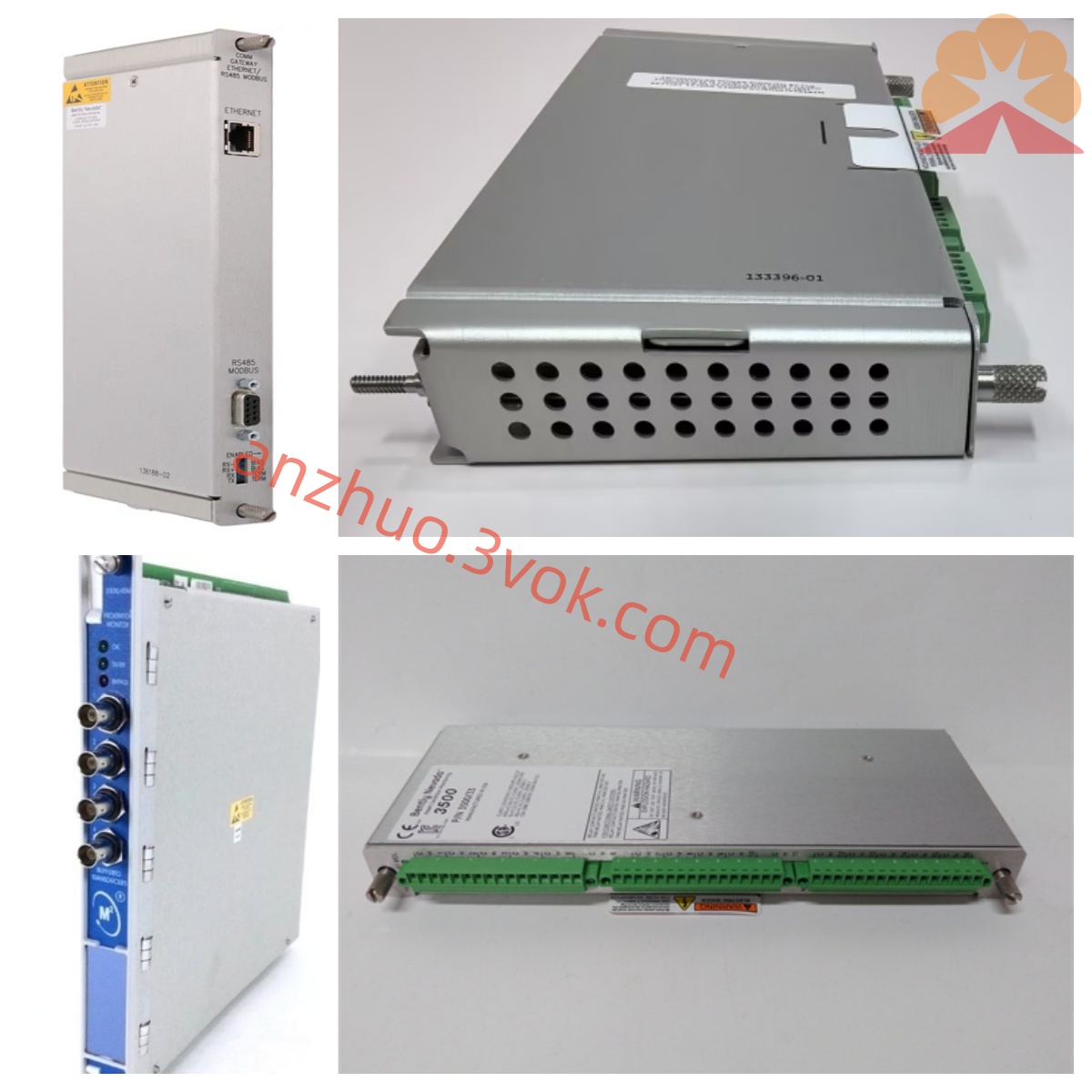
Bently Nevada 330101-02-12-10-02-00 Eddy Current Proximity Probe
Description
Bentley 330101-02-12-10-02-00 Eddy Current Probe Detailed Description
I. Product Introduction
330101-02-12-10-02-00 is a 8mm standard non-armored eddy current probe of the 3300 XL series of Bentley Nevada, under the Beckhusey brand. It is the front-end sensing unit of the turbine TSI condition monitoring system. This probe must be combined with the same series extension cable and preamplifier to form a complete measurement circuit. It realizes non-contact detection based on the eddy current principle and is mainly used for radial shaft vibration, axial displacement, shaft eccentricity, key phase, and rotational speed monitoring of industrial rotating machinery. The overall structure of the product is compact and suitable for various shallow holes and extremely narrow installation spaces. The performance complies with API 670 industry standards, with high measurement accuracy, stable operation, excellent electromagnetic anti-interference ability, and is widely used in large-scale turbine condition monitoring in conventional industrial areas of power, petrochemical, metallurgy, and coal chemical industries.
II. Basic Information
This product model belongs to the 330101 series and is a standard non-armored probe, different from the 330102 armored version. The standard installation thread adopts the industry-standard 3/8-24 UNF metric fine-threaded screw, with strong universality. Model segmentation interpretation: 02 represents that the probe's non-threaded section length is 0.2 inches; 12 represents that the probe's shell total length is 1.2 inches, belonging to an ultra-short shell structure; 10 represents that the probe comes with a cable length of 1 meter; 02 represents the configuration of a miniature ClickLoc coaxial connector and standard non-armored cable; 00 represents no special explosion-proof certification, being a conventional industrial configuration.
The probe shell is made of AISI 303/304 stainless steel material, and the sensing end uses high-temperature resistant PPS material. The overall workmanship is solid. The cable is a non-armored flexible structure, with flexible wiring. It adopts the patented TipLoc one-piece molding process, with the probe end tightly combined with the shell, capable of withstanding equipment operation vibration, and not prone to loosening and falling off. It is equipped with a miniature ClickLoc quick connector, supporting tool-free plug-in connection. The product has passed CE, UL industrial safety and electromagnetic compatibility certifications, without explosion-proof qualifications, only applicable to ordinary non-flammable and non-explosive working conditions. The probe body protection level is IP54, capable of adapting to dry, less dust, and non-corrosive medium on-site environments. The entire machine is fully compatible with the Bentley 3300 XL full series preamplifiers, extension cables, and 3300, 3500 full series TSI monitoring cards, and can be connected to mainstream PLC, DCS data acquisition equipment.
III. Electrical Parameters
The standard measurement sensitivity of the probe is 7.87V/mm, corresponding to the imperial unit 200mV/mil. The full-scale linear error is no more than ±1%. The effective linear measurement range is 2.0mm, and the standard effective working range is 0.25mm to 2.3mm. The overall system frequency response range is 0Hz to 10kHz, capable of fully covering various conventional vibration frequencies of rotating machinery. When working with the preamplifier, the system outputs a standard DC voltage signal, with the output range being - 1VDC to - 17VDC.
The probe comes with 1 meter of cable, and the standard value of the entire machine's DC resistance is 7.59Ω, with a deviation of ±0.50Ω. The minimum diameter of the measured metal target surface is 8.9mm. In engineering practical applications, it is recommended that the measured shaft diameter be no less than 50.8mm to ensure stable and reliable measurement data. The product's electromagnetic compatibility performance meets the standard, capable of effectively resisting electromagnetic interference generated by frequency converters, high-power motors, AC contactors, etc., and the signal transmission is not distorted. The entire sensing link must ensure that the total electrical length is consistent with the factory calibration of the preamplifier. It is strictly prohibited to randomly cut the cables.
IV. Environmental and Mechanical Parameters
Environmental Parameters
The standard working temperature range of the probe is -52°C to +177°C, and it can withstand a maximum temperature of +218°C for short periods. The storage temperature range of the equipment is -52°C to +260°C. The relative humidity requirement of the operating environment is 5% to 95%. The use environment must not have condensation, water accumulation, or strong corrosive gases. The product is only applicable to conventional non-explosion-proof industrial areas and cannot be used in flammable and explosive hazardous locations.
Mechanical Parameters
The length of the probe without threaded sections is 0.2 inches, the total length of the housing is 1.2 inches, and it is a typical ultra-short housing design, specifically designed for shallow holes, equipment surfaces, and space-constrained measurement points. The built-in cable length is 1 meter, and it is a standard non-armored flexible cable with oil-resistant and aging-resistant properties. The recommended tightening torque for on-site installation and fixation is between 1.1N・m and 1.4N・m. Excessive torque can cause thread slippage and shell deformation. The minimum bending radius of the non-armored cable should be no less than 3 times the outer diameter of the cable, and sharp-angle bending, dragging, and crushing of the cable are prohibited to avoid damaging the internal wires.
V. Core Functions
1. Non-contact Precision Detection
The probe is equipped with an induction coil that receives the 0.5 MHz to 2 MHz high-frequency excitation signal output by the preamplifier and generates an alternating magnetic field. When the probe approaches a rotating metal shaft, the surface of the shaft will induce an eddy current, and the reverse magnetic field generated by the eddy current will change the inductance and impedance of the probe coil. The electrical parameter changes of the probe are transmitted to the preamplifier, converted into a linear voltage signal, and used to accurately convert the gap value between the probe and the shaft, completing the collection of static displacement and dynamic vibration signals simultaneously. There is no mechanical contact throughout the process, and there are no wear issues.
2. Ultra-short Structure for Narrow Spaces
The 0.2-inch short optical rod combined with the 1.2-inch ultra-short housing is an ideal solution for measurement points in limited spaces, suitable for shallow holes, equipment sidewalls, and compact supports that conventional probes cannot install. The stainless steel housing has good rigidity, resistance to vibration, and slight deformation, and the installation position is unlikely to shift over the long term.
3. Wide Temperature Operation and Temperature Compensation
The probe uses high-temperature coils and insulating materials, and is combined with the automatic temperature compensation circuit of the entire system. In the entire working temperature range, the sensitivity fluctuation does not exceed ±1.5%, which can effectively suppress measurement drift caused by temperature changes and ensure the continuity and accuracy of long-term online monitoring data.
4. Flexible Wiring and Quick Assembly and Disassembly
The 1-meter non-armored flexible cable has good bending performance and is easy to run through conduits and route, suitable for medium-distance signal transmission. The standard micro ClickLoc quick connector can be plugged and unplugged without special tools, and the disassembly and assembly are convenient. The same specification probes, extension cables, and preamplifiers have good interchangeability, and after replacing spare parts on-site, there is no need to recalibrate the equipment, significantly reducing the downtime for equipment maintenance.
5. Fault Detection and Self-Check联动
It can be coordinated with the accompanying preamplifier to achieve line fault detection, accurately identifying fault states such as probe breakage, line short circuit, cable damage, and poor contact of the connector, and outputting dedicated fault voltage signals. The rear-end TSI system and automatic control equipment can respond by emitting audible and visual alarms or remote prompts, helping maintenance personnel quickly locate the fault point and avoid the failure of monitoring functions.
VI. Working Principle
After the induction coil inside the probe is supplied with high-frequency alternating current, a stable electromagnetic field is formed. The electromagnetic field penetrates the air gap and acts on the measured metal shaft. An enclosed eddy current is induced on the metal surface. The intensity of the eddy current will change with the gap between the probe and the shaft, thereby inversely affecting the electrical parameters of the probe coil, such as inductance and impedance. The probe transmits the changing signals to the preamplifier, which converts the gap measurement into a continuous DC voltage at a fixed ratio of 7.87V/mm. The greater the gap between the probe and the shaft, the closer the output voltage is to -17VDC; the smaller the gap, the closer the output voltage is to -1VDC. The upper-level system parses the voltage values and converts them into operating parameters such as shaft vibration amplitude, axial displacement, rotational speed, and phase, enabling online monitoring and safety protection of the equipment.
Seven. Installation and Wiring Specifications
When installing, screw the probe into the dedicated installation base to ensure that the end face of the probe is parallel to the surface of the measured shaft, preventing installation tilt from causing measurement errors. It is recommended to set the initial installation gap at the midpoint of the linear range, corresponding to an output voltage of approximately -9VDC, to achieve the best linear measurement performance of the equipment.
When tightening the threads, strictly follow the recommended torque and avoid over-tightening with brute force. During cable laying, separate the cables from high-voltage cables and power cables to reduce electromagnetic interference; strictly adhere to the minimum bending radius requirements to avoid cable damage. When connecting the connectors, insert them into the slots and listen for the locking sound of the clips to indicate a proper connection. Regularly perform dust protection on the connectors. This probe is only used for external measurement points on the equipment and must not be immersed in oil or water for a long time. The cables should maintain the original factory length and must not be cut or spliced.
Eight. Typical Application Scenarios
In the power industry, it is mainly applied to shallow-hole measurement points of auxiliary equipment such as steam turbine generators, boiler feed pumps, induced draft fans, and supply fans, to monitor shaft vibration and axial displacement, and to issue early warnings for shaft bearing wear, rotor friction, etc. In the petrochemical field, it is suitable for centrifugal compressors, process pumps, and mixing units in conventional non-explosion-proof factory areas, to complete vibration and displacement monitoring and ensure long-term stable operation of the equipment. In the metallurgical industry, it is used for high-temperature blast furnace fans, large transmission motors, and rolling mill supporting rotating mechanisms, to avoid safety hazards caused by abnormal vibration and equipment overload.
It can also be used for phase phase measurement, rotational speed measurement, and eccentricity analysis of various large rotating machinery, providing raw data for equipment dynamic balance correction, fault diagnosis, and condition-based maintenance. As a standard front-end component of the 3300 XL system, it is widely combined with TSI cards to build a unit safety monitoring system.
Nine. Product Advantages
The overall size is compact, and the ultra-short housing perfectly fits shallow holes and narrow installation spaces, with flexible application scenarios. The non-armored flexible cable wiring is convenient, and the overall usage cost is low. The measurement stability in the entire temperature range is strong, the linear accuracy is excellent, and it fully meets the API 670 heavy industrial equipment monitoring standards. The standard threads and universal connector design ensure strong product interchangeability, simple spare part management and on-site maintenance. Industrial-grade component selection ensures resistance to aging, vibration, and supports 7×24-hour continuous operation, with a long service life. It has complete industrial certifications and can be directly applied to the majority of conventional industrial production sites.
Get a Quote