
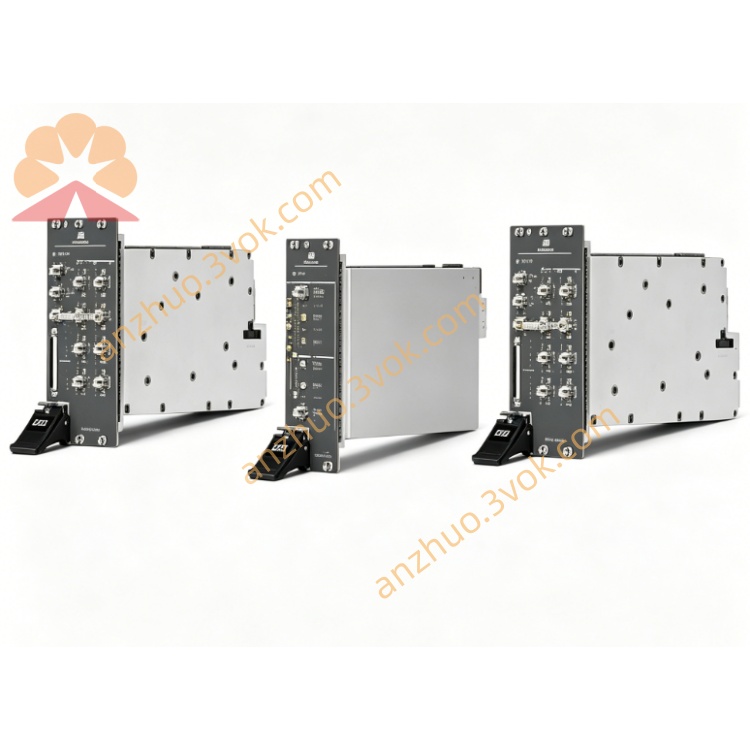
NI SCXI-1120D 8-Channel Wide Band Isolated Analog Input Amplifier Module
Description
I. Product Introduction
The NI SCXI-1120D is an eight-channel isolated differential input module of the SCXI series. It focuses on electrical isolation, precise signal conditioning, and high-frequency response capabilities. It is mainly used for the acquisition and processing of millivolt-level weak signals, thermocouple signals, industrial standard current signals, and low-voltage voltage signals. The module features high isolation between channels and can effectively eliminate ground loop interference, making it suitable for industrial environments with strong electromagnetic interference. This model is a classic legacy product. It has been discontinued and existing equipment can receive maintenance services. Alternatively, inventory or second-hand equipment can be selected for continued use.
II. Model Interpretation
SCXI is the identifier of the instrument signal conditioning expansion series. 1120 is the basic model of this series, representing an eight-channel isolated differential input module. The suffix D indicates a special configuration version, equipped with a fixed preamplifier circuit and high-frequency filter unit, different from the standard SCXI-1120. The standard component number of the product is 776572-20D.
III. Technical Parameters
The module includes eight differential isolated input channels. The channels can withstand a continuous isolation voltage of 250 volts RMS between each other and to ground. It complies with the double insulation safety standard. The input voltage range covers from positive and negative 5 millivolts to positive and negative 10 volts. The differential input impedance is greater than 10 megohms, and the common-mode rejection ratio in the DC to 60 Hz frequency band is no less than one decibel. The module has a fixed preamplifier of 0.5 times gain and can be selected with multi-stage gain levels via software or jumpers. The overall gain can be set to 0.5 times, 1 times, 2.5 times, 5 times, 10 times, or 20 times. Each channel supports jumpers for switching between two filter settings: 4.5 kHz and 22.5 kHz low-pass filtering. The input reference noise at 22.5 kHz bandwidth is less than one microvolt RMS. The module has a maximum scanning rate of 333,000 samples per second. It adopts a 12-bit analog-to-digital conversion design, with a full-scale non-linearity of no more than ±0.01%, and the gain error after calibration does not exceed 0.5% of the reading. The temperature drift is controlled within 10 ppm per degree Celsius. The module is powered by the SCXI chassis backplane, with a 5V power supply circuit current not exceeding 30 mA and a ±15V power supply circuit current not exceeding 200 mA. The standard operating temperature range is 0°C to 50°C, and the storage temperature range is -40°C to 85°C. The operating environment humidity requirement is 5% to 95% without condensation. The entire unit is a standard 1U SCXI module structure, weighing approximately 0.8 kilograms.
IV. Interface and Communication Configuration
The front of the module is equipped with a 96-pin DIN C-type male connector for external connection of wiring terminals and various on-site signal lines. The back uses a 50-pin ribbon cable male connector to connect to the internal backplane bus of the SCXI chassis, relying on the backplane to complete data transmission, timing synchronization, and power supply. This module can be used with multiple dedicated terminals. SCXI-1320 is a dedicated terminal for thermocouple measurement, equipped with cold junction compensation function. SCXI-1305 is a general BNC terminal that supports AC and DC signal coupling input. The module supports two signal input methods: floating ground and grounding. It is compatible with different types of sensor circuits. The equipment does not require an independent communication line. It establishes communication with the backend DAQ device through the SCXI bus and cooperates with the NI-DAQmx driver software to complete parameter configuration and data reading.
V. Core Functions
It has high-level electrical isolation capability. The 250V RMS isolation design can block ground loops, significantly improving measurement stability in complex industrial environments. It has multi-stage programmable gain combinations, combined with a wide input range, capable of amplifying and collecting millivolt-level weak signals and 10V voltage signals, suitable for various sensor outputs. Dual-gear high-frequency low-pass filter is optional. The maximum signal bandwidth supported is 22,500 Hz, which can precisely capture dynamic transient signals such as vibration and shock. It is compatible with thermocouples, industrial current circuits from 4 to 20 mA, and conventional voltage signals, enabling one module to serve multiple purposes. Multiple modules can be combined and installed in a single chassis, and cascading of multiple chassis can be used to flexibly expand the total number of acquisition channels and build large-scale testing systems.
Six. Application Scenarios
Suitable for high-precision temperature monitoring of industrial furnaces, heat treatment equipment, power devices, etc. with thermocouples. Complete cold-end compensation and signal isolation can be achieved by connecting dedicated terminals. It can collect millivolt-level signals output by strain sensors, pressure sensors, and dynamic signals such as vibration and shock generated by equipment operation. It is widely used in the chemical and water treatment industries, isolating and collecting signals from 4 to 20 mA current transmitters at the site and performing process monitoring. In environments with different ground potentials and high common-mode voltages, it can complete the measurement of various low-voltage signals and avoid measurement errors caused by ground loops.
Seven. Usage and Maintenance Instructions
Usage Instructions
Before installing the module, make sure to cut off the power supply of the SCXI chassis, insert the module smoothly into the chassis slot, and tighten the fixing screws. This module supports hot swapping and can be directly replaced during system operation. When connecting external lines, ensure that the isolation terminals are securely connected, take insulation protection measures, and strictly prohibit mixing high and low voltage lines. Adjust the onboard jumpers according to the signal type, select the corresponding filtering gear, and set the gain parameters through the accompanying software; when using thermocouples for measurement, an external dedicated terminal must be connected and the cold-end compensation function must be enabled. After the entire system is set up, connect the SCXI chassis and DAQ equipment with standard 68-pin cables. When cascading multiple chassis, set a unique address for each device to avoid address conflicts.
Maintenance Instructions
During daily use, keep the working environment dry, and strictly prevent condensation on the equipment surface and connection terminals. Regularly inspect connection terminals, connectors, and external cables for any looseness, oxidation, or damaged outer skin. It is recommended to conduct a complete machine calibration once a year, focusing on calibrating gain and linearity indicators. For equipment used for thermocouple measurement, the calibration frequency can be appropriately increased. If the measurement data shows significant drift, re-perform the calibration operation promptly; if the signal frequently jumps, check the grounding of the lines, shielding effect, and terminal tightening status. Before the equipment is left unused for a long time, disconnect all power sources and external lines, clean the surface dust, and store it in a cool and dry environment.
Get a Quote