
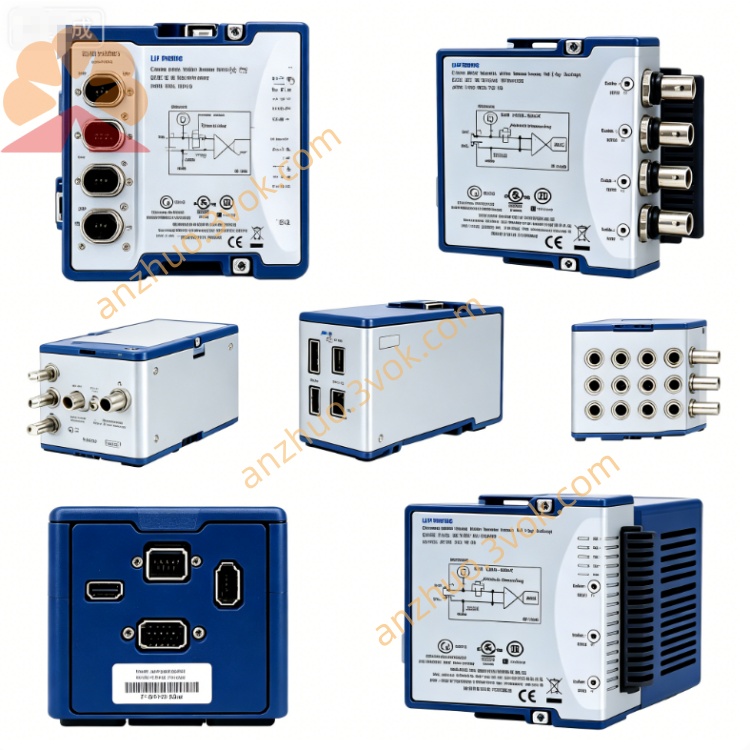
NI SCXI-1600 USB SCXI Chassis Controller & Multifunction DAQ Module
Description
Product Introduction
The NI SCXI-1600 is a USB interface-based SCXI chassis master control / data acquisition module that integrates a 16-bit ADC. It can directly convert any SCXI chassis into a plug-and-play USB data acquisition system. As the controller and digitizer within the chassis, it is responsible for receiving the conditioning signals from each SCXI module, performing amplification, sampling, and digitization, and then uploading the results via USB to the computer. At the same time, it provides clock, trigger, and calibration control for the entire chassis, and supports unified management of analog input/output, digital I/O, and switch modules. The part number is 776572-1600. It has no hardware jumpers or dip switches and is fully configured through software.
Model Explanation
SCXI: Signal Conditioning eXtensions for Instrumentation, the NI instrument signal conditioning extension platform.
1600: The USB master control / DAQ module in the SCXI series, distinct from the front-end terminal board (13xx) and signal conditioning module (11xx), with the core being 16-bit acquisition + USB bus. Technical Specifications
Core acquisition parameters
Digital-to-Analog Converter: 16-bit ADC.
Maximum sampling rate: 200 kS/s (single channel).
Analog input channels: 32 channels (single-ended), up to 352 channels can be scanned through chassis expansion.
Input voltage range: ±0.05 V to ±10 V, programmable gain 0.5, 1, 10, 100.
Input impedance: 1 GΩ.
Bandwidth: 10 kHz.
Bus and control
Communication bus: USB 2.0 Full-Speed, supports hot plugging (only USB end).
System control: Provides shared clock, external digital trigger, internal and external calibration sources for the chassis.
Driver support: NI-DAQmx, compatible with LabVIEW, C/C++, LabWindows/CVI.
Mechanical and environmental
Form: Standard SCXI single-slot module.
Operating temperature: 0 ℃ to 50 ℃.
Storage temperature: -20 ℃ to 70 ℃.
Relative humidity: 10% to 90%, no condensation.
Calibration cycle: Recommended 1 year.
Interface and communication configuration
Front panel: USB 2.0 interface, BNC interface (digital start trigger, external clock, external calibration, internal calibration source).
Backplane interface: SCXI chassis-specific connector, slot access after connecting the chassis, communicates with other modules through the chassis backplane.
Communication characteristics: USB plug-and-play, no additional power supply required (USB bus power supply); no hardware address switch, automatically identified and configured by software.
Operating systems: Windows, Linux, NI real-time system.
Core functions
Chassis master control and data acquisition: Unified control of all modules in the SCXI chassis to achieve high-precision acquisition and digitization of multi-channel analog signals.
Signal compatibility and expansion: Directly receives signals after being conditioned by SCXI modules such as thermocouples, RTDs, strain gauges, voltage/current sources, up to 352 channels can be expanded.
System synchronization and calibration: Provides global clock, trigger signal to ensure synchronous acquisition of multiple modules; integrated calibration source, supports system-level calibration to ensure measurement accuracy.
Quick deployment via USB connection: Connects to a computer via USB, no complex configuration required, quickly builds a high-channel-count, multi-type signal acquisition system.
Multi-module collaborative control: Manages analog output, digital I/O, switch modules in the chassis to achieve integration of acquisition, control, and switching. Applicable scenarios
High-channel-count mixed signal acquisition: Synchronous monitoring of temperature, pressure, strain, voltage/current at multiple measurement points in industrial sites.
Precise laboratory measurement: Thermocouple/RTD temperature acquisition, strain testing, high-precision measurement of low-level signals.
Portable test system: Based on USB bus power supply and plug-and-play characteristics, a portable and quickly deployable acquisition system is constructed.
Upgrade of old systems: Replace traditional PCI/PCIe DAQ cards, retain the existing SCXI signal conditioning modules, and upgrade to USB interface.
Integration of multiple types of sensors: Unified access to signals from various sensors such as temperature, pressure, vibration, current/voltage.
User and maintenance instructions Instruction Manual
Before installation: Turn off the power of the chassis and the computer. The SCXI module does not support hot plugging.
Module installation: Align the SCXI-1600 with the empty slot of the chassis and push it in smoothly. Tighten the screws on the panel; connect the USB cable to the computer, and the system will automatically recognize it.
Software configuration: Identify the device through NI MAX (Measurement & Automation Explorer), and configure the channels, sampling rate, trigger and calibration parameters using NI-DAQmx.
Signal connection: Connect external sensors/signals to the SCXI conditioning module (such as 1120, 1121) first, and then send them through the backplane to the 1600 acquisition unit to avoid directly connecting to high-voltage signals.
Trigger and clock: When multiple modules are synchronized, prioritize using the global clock and trigger provided by the 1600 to ensure consistent timing.
Maintenance instructions
Environmental requirements: Keep the working environment dry and ventilated, away from strong electromagnetic interference, dust and corrosive gases, and control the temperature and humidity within the rated range.
Regular inspection: Check the looseness and oxidation of the USB cable and BNC connector every quarter, and ensure the normal status of the front panel indicator lights; conduct a calibration once a year to ensure measurement accuracy.
Cleaning operation: Wipe the panel and interface with a dust-free soft cloth while the power is off. Do not use liquid cleaners to directly contact the devices and interfaces.
Long-term storage: When the module is idle, remove the USB cable and backplane connection, and store it in a cool and dry place to avoid moisture, direct sunlight and severe vibration.
Get a Quote