
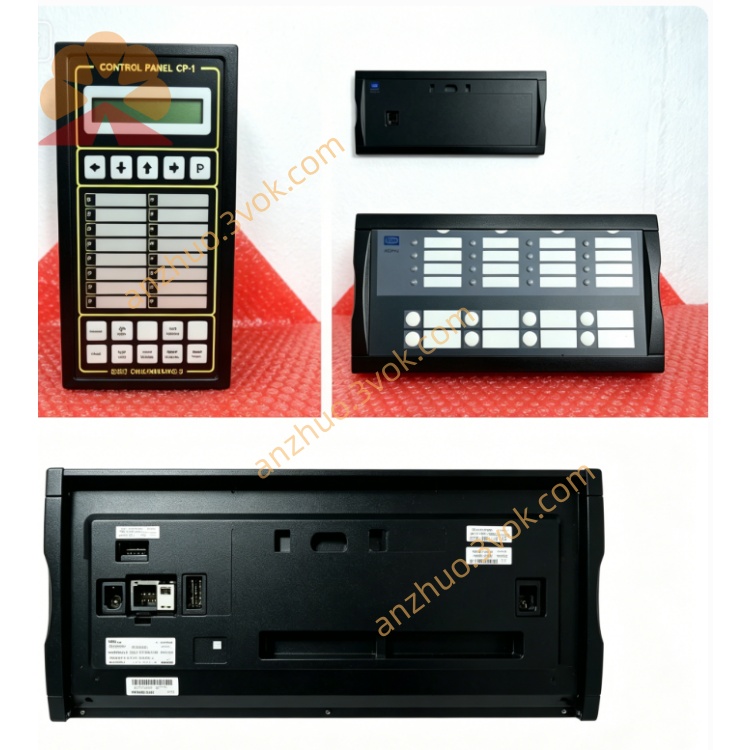
DEIF TAP-210DG/3 Multi-functional Power Transducer
Description
1. Product Overview


2. Key Features
True 3-Phase Power Measurement: Accurate active power (W/kW/MW) calculation for balanced/unbalanced loads.
Dual-Range Output: Configurable 4–12–20 mA or 0–5–10 V analog signal.
High Accuracy: Class 0.5 precision (±0.5% of full scale).
Wide Input Range: Voltage up to 690 VAC; CT selectable 1 A / 5 A secondary.
Multiple Coupling Modes: Supports 1W3, 2W, 2W4, 3W3 system configurations.
Isolated Output: Galvanic isolation between input, output, and power supply.
Marine & Industrial Approved: CE, IEC 60945, DNV/GL, ABS, LR, CCS.
Compact DIN Rail Mount: Standard 35 mm DIN rail enclosure.
3. Technical Specifications
3.1 General
| Parameter | Specification |
|---|---|
| Model | TAP-210DG/3 |
| Manufacturer | DEIF A/S |
| Type | 3-phase active power transducer |
| Accuracy Class | 0.5 (±0.5% FS @ 25 °C) |
| Linearity | ≤ ±0.2% FS |
| Response Time | ≤ 40 ms (95% of final value) |
| Frequency | 50 / 60 Hz (45–65 Hz range) |
3.2 Input Ratings
| Parameter | Specification |
|---|---|
| Voltage Input (Vn) | 100 / 110 / 230 / 400 / 440 / 690 VAC (L-L) |
| Current Input (In) | 1 A or 5 A (CT secondary, selectable) |
| Overload (Continuous) | 120% Vn / 120% In |
| Overload (1 sec) | 200% Vn / 500% In |
3.3 Output Ratings
| Parameter | Specification |
|---|---|
| Analog Output | 4–20 mA (default) or 0–10 V (configurable) |
| Output Load (Current) | ≤ 750 Ω |
| Output Load (Voltage) | ≥ 500 Ω |
| Ripple | ≤ 0.2% FS |
| Isolation | 2.5 kVAC (input/output/supply) |
3.4 Power Supply
| Parameter | Specification |
|---|---|
| Auxiliary Supply | 24 VDC ±20% / 110–230 VAC ±10% (50/60 Hz) |
| Power Consumption | ≤ 5 VA |
3.5 Environmental & Mechanical
| Parameter | Specification |
|---|---|
| Operating Temperature | –20 °C to +60 °C (marine: –30 °C to +60 °C) |
| Storage Temperature | –40 °C to +85 °C |
| Humidity | 5–95% RH non-condensing |
| Protection Class | IP20 (front) |
| Dimensions (W×H×D) | 72 × 90 × 110 mm |
| Weight | Approx. 460–470 g |
| Mounting | 35 mm DIN rail |
4. Application Scope
Marine Genset Monitoring: Active power measurement for shipboard generators.
Industrial Power Monitoring: Power consumption monitoring in factories and substations.
Generator Paralleling: Load sharing and power balance control in parallel genset systems.
Energy Management: Data acquisition for energy billing and efficiency analysis.
Protection Systems: Overpower/underpower detection for generator protection.
DEIF System Integration: Compatible with DM-4, AGC, and other DEIF control systems.
5. Installation & Wiring
5.1 Installation Requirements
Mounting: Install vertically on a 35 mm DIN rail.
Clearance: Allow ≥25 mm clearance above/below for ventilation.
Environment: Avoid direct sunlight, dust, moisture, and corrosive gases.
ESD Protection: Discharge static before handling (PCB is ESD-sensitive).
5.2 Terminal Wiring
5.2.1 Input Terminals (Voltage & Current)
| Terminal | Description |
|---|---|
| L1/L2/L3 | 3-phase voltage input (Vn) |
| N | Neutral (for 4-wire systems) |
| CT1/CT2/CT3 | Current transformer inputs (1 A / 5 A) |
5.2.2 Output Terminals
| Terminal | Description |
|---|---|
| +OUT / –OUT | Analog output (4–20 mA or 0–10 V) |
5.2.3 Power Supply
| Terminal | Description |
|---|---|
| +24V / GND | 24 VDC supply |
| L / N | 110–230 VAC supply |
5.2.4 Configuration Jumpers
CT Ratio: Jumper select 1 A or 5 A secondary.
Output Mode: Jumper select 4–20 mA or 0–10 V.
Coupling: Jumper select 1W3 / 2W / 2W4 / 3W3.
5.3 Wiring Notes
CT Wiring: Never open-circuit CT terminals (risk of high voltage).
Voltage Input: Use fused voltage inputs (gG-type fuse, 2 A).
Cable Size: 1.5 mm² (all circuits).
Terminal Torque: Tighten to 0.8–1.0 Nm.
Shielding: Use shielded cable for analog output; ground shield at one end only.
6. Operation & Configuration
6.1 Front Panel Indicators
PWR: Solid green = power supply OK.
RUN: Flashing green (1 Hz) = normal operation.
FAULT: Solid red = input overload / wiring error / config fault.
6.2 Configuration Steps
CT Ratio Setting: Set jumper to 1 A or 5 A to match CT secondary.
Output Mode: Set jumper to 4–20 mA (default) or 0–10 V.
Coupling Mode: Set jumper to match system type (1W3/2W/2W4/3W3).
Range Selection: Set DIP switches for kW/MW range (e.g., 0–1000 kW).
Power On: Apply supply; PWR LED ON; RUN LED flashing.
Calibration (Factory Default): Pre-calibrated; no user adjustment required.
6.3 Normal Operation
Measurement: Transducer computes true active power from voltage and current inputs.
Output Signal: Proportional analog output (4 mA = 0 kW, 20 mA = full scale).
Fault Condition: FAULT LED ON; output holds last valid value or goes to 0 mA.
7. Safety Precautions
High Voltage Hazard: Only qualified electricians may install/service. Disconnect all power before wiring.
CT Hazard: Never open-circuit CT terminals (lethal high voltage risk).
Overload: Do not exceed 120% of rated input voltage/current.
Isolation: Do not remove or modify internal isolation barriers.
Environmental Limits: Operate only within –20 °C to +60 °C.
No Unauthorised Modification: Do not open the enclosure; voids warranty.
8. Maintenance
8.1 Regular Maintenance (Every 12 Months)
Visual Inspection: Check for loose terminals, damaged wiring, or discolouration.
Cleaning: Wipe front panel with dry cloth; remove dust from vents.
Terminal Tightness: Retorque to 0.8–1.0 Nm.
Function Test: Inject known voltage/current; verify output accuracy.
Insulation Resistance: Measure ≥1 MΩ @ 500 VDC between input/output and ground.
9. Troubleshooting
| Fault Phenomenon | Possible Cause | Solution |
|---|---|---|
| PWR LED Off | No supply / wrong voltage | Check wiring; verify supply voltage. |
| FAULT LED On | Input overload / CT open / wiring error | Reduce input; check CT wiring; verify connections. |
| No Output | Output wiring error / overload | Check output wiring; reduce load resistance. |
| Inaccurate Reading | CT ratio wrong / coupling mode wrong | Correct jumper settings; verify system configuration. |
| Output Fluctuates | Unstable input / loose terminals | Stabilise input; retighten terminals. |
10. Warranty & Disclaimer
Model: TAP-210DG/3 Inwatt Transducer.
Warranty Period: 24 months from delivery (normal installation/use per manual).
Warranty Exclusions: Misuse, overvoltage, lightning, water ingress, unauthorised modification, or CT open-circuit.
Specifications Subject to Change: Manufacturer reserves the right to update specifications without notice.
Documentation Version: 1.0 (2026); latest manual available at www.deif.com.
Get a Quote