
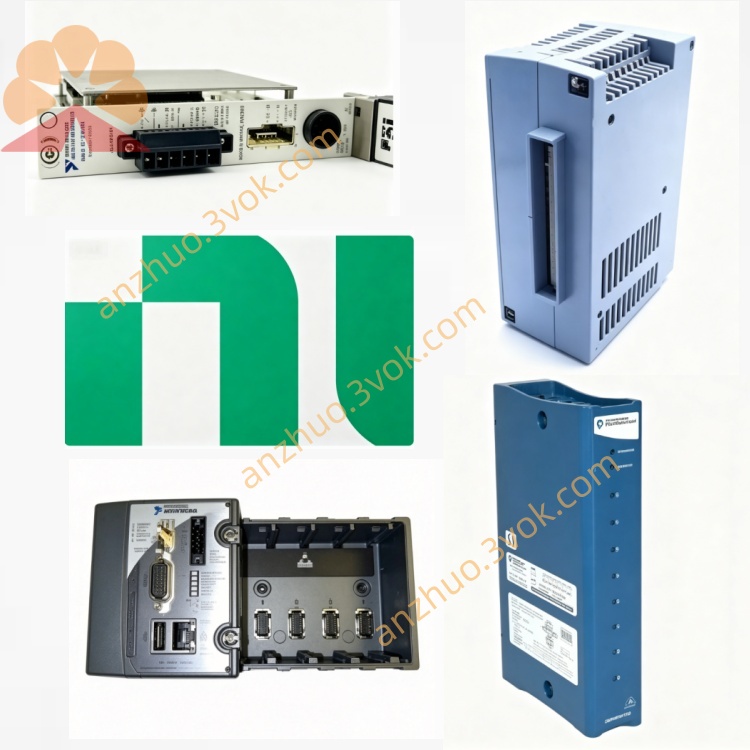
NI PXI‑2540 6.6‑GHz 50‑Ohm Solid‑State Quad SPDT RF Module
Description
Model Explanation
PXI: PXI bus platform (modular instrument standard)
2540: Product serial number, representing a 350 MHz 8×9 RF matrix switch
Alias: NI-2540, PXI-2540 (RF 8×9 matrix)
Function Positioning: 8 rows × 9 columns RF matrix, reed relays, high isolation, cascading expansion possible
Technical Parameters
Topology: 8×9 single-line matrix (72 cross points), no blocking
Relay Type: Reed relay (Reed), magnetic retention
Frequency Range: DC to 350 MHz (–3 dB)
Characteristic Impedance: 50 Ω
Maximum Switching Voltage: 60 VDC
Maximum Switching Current: 500 mA/channel
Maximum Switching Power: 10 W (DC)
RF Power (350 MHz): Typical + 20 dBm
Insertion Loss: Typical < 0.3 dB (100 MHz)
Channel Isolation: Typical > 60 dB (350 MHz)
Return Loss: Typical > 20 dB (350 MHz)
Switching Time: Typical < 1 ms
Relay Lifespan: Typical 10⁸ times (resistive load)
I/O Connector: 17×MCX female (8 rows + 9 columns)
Size: 3U PXI single slot (216 × 20 × 130 mm)
Weight: Approximately 300 g
Operating Temperature: 0–55 °C
Interface and Communication Configuration
PXI Bus Interface: Standard 3U PXI backplane, power supply, trigger, clock, communication
Front-end I/O: 17 MCX female (8 rows R0–R7, 9 columns C0–C8), high-density RF connection
Adapter Cable: MCX-MCX direct connection; optional MCX to BNC/SMB/SMA
Control Software: Compatible with NI-SWITCH, MAX, LabVIEW, TestStand
Trigger Synchronization: 2 channels of PXI hardware trigger, support for scan synchronization and event handshake
Expansion Capability: Multi-module cascading (8×24, 8×36…), requires dedicated cascading cable
Core Function
8×9 Unblocked RF Matrix: 72 cross points, any row/column can be simultaneously conductive, high test flexibility.
DC to 350 MHz Wideband: Covers low-frequency RF, analog and digital mixed signals, wide applicability.
High Isolation and Low Loss: > 60 dB isolation, < 0.3 dB insertion loss, ensuring signal integrity.
Magnetic Retaining Reed Relay: Low contact resistance (< 2.1 Ω), long lifespan (10⁸ times), low power consumption.
Hardware Trigger and Scan: Nanosecond-level synchronization, supports high-speed sequence scanning, improves test throughput.
Onboard Relay Counting: Real-time record of switching times, predicts maintenance cycle, reduces downtime risk. Applicable scenarios
Consumer electronics RF testing: Testing of low and medium frequency RF functions such as Bluetooth, WiFi, NFC, FM, etc.
Semiconductor / chip testing: Parameter testing and aging screening of RF chips and mixed-signal ICs.
Communication equipment manufacturing: Calibration and functional verification of base station and terminal RF modules.
ATE automated testing system: Multi-channel RF signal routing, instrument reusability, cost reduction.
Research and development and laboratory: RF signal switching, instrument interconnection, signal distribution and routing.
User and maintenance instructions
Key usage points
Installation: Standard 3U PXI chassis single slot, lock the panel, ensure reliable contact of the backplane.
Configuration: NI-SWITCH/MAX set channel mapping, trigger parameters, scanning sequence.
Cabling: MCX connection, pay attention to alignment, gently insert and remove; avoid overvoltage (60 VDC), overcurrent (500 mA), and overpower (10 W).
RF considerations: 50 Ω impedance matching; avoid strong electromagnetic interference, ensure good grounding.
Environment: 0–55 °C, dust-proof, moisture-proof, condensation-proof; keep away from vibration sources.
Maintenance instructions
Regular inspection: Check the tightness of MCX connectors and for any looseness/oxidation every quarter; clean surface dust.
Life management: Monitor the relay count, evaluate replacement when approaching 10⁸ times; avoid long-term high power/high frequency switching.
Troubleshooting: First check MCX connection and grounding for abnormal signals; use software to diagnose relay status; electrostatic protection.
Storage: Power off when not in use, store in a dry, dust-proof, and moisture-proof environment; cover connectors with dust caps and prevent moisture and oxidation.
Get a Quote