
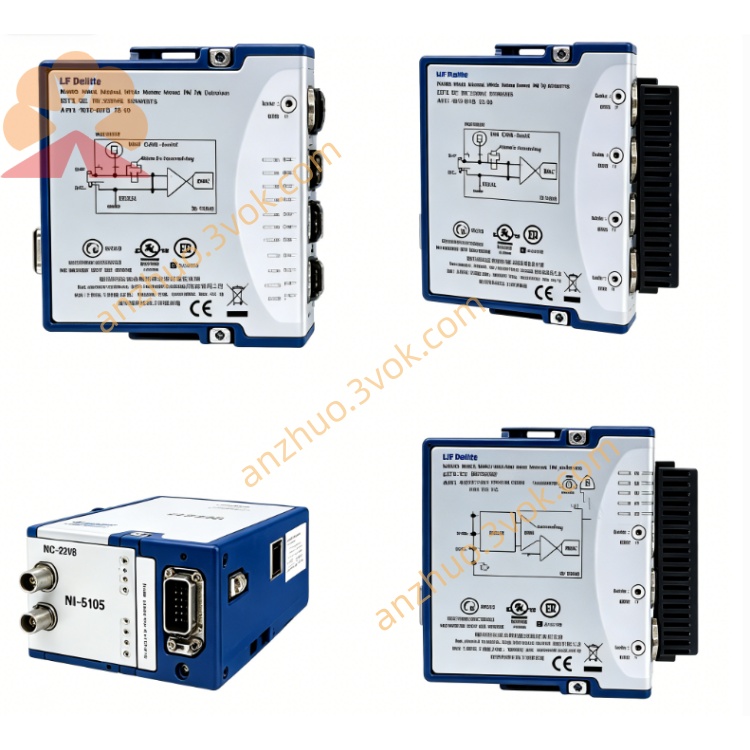
NI PXI‑4065 6½‑Digit ±300 V PXI Digital Multimeter Module
Description
Model Explanation
PXI: Compliant with the PXI bus specification, 3U size, single-slot installation, compatible with PXI/PXIe mixed chassis.
4065: The serial number of the NI DMM series, representing 6½ digit resolution, 300V/3A range, basic high precision.
Full Name: PXI-4065 6½ digit multi-function digital multimeter module.
Position: High-performance precision DMM, replacing bench 6½ digit meters, suitable for automation system integration.
III. Technical Parameters
(1) Measurement Functions and Ranges (25℃ ± 1℃, calibration cycle of 1 year)
DC Voltage (DCV)
Range: 100 mV / 1 V / 10 V / 100 V / 300 V
2-year accuracy: 90 ppm reading + 12 ppm (10 V range)
Temperature coefficient: 0.5 ppm/℃ + 0.1 μV/℃
AC Voltage (True RMS ACV)
Range: 100 mV / 1 V / 10 V / 100 V / 300 V
Bandwidth: 10 Hz~100 kHz
Accuracy: 0.02% reading + 50 μV (1 V range, 1 kHz)
DC Current (DCI)
Range: 10 mA / 100 mA / 500 mA / 3 A
Accuracy: 0.05% reading + 50 nA (1 A range)
AC Current (True RMS ACI)
Range: 10 mA / 100 mA / 500 mA / 3 A
Bandwidth: 10 Hz~100 kHz
Accuracy: 0.1% reading + 500 nA (1 A range, 1 kHz)
Resistance (Ω)
Mode: 2-wire / 4-wire
2-wire range: 100 Ω~100 MΩ
4-wire range: 100 Ω~1 MΩ
Accuracy: 0.02% reading + 10 mΩ (1 kΩ range, 4-wire)
Diode Testing: 10 V@100 μA, 3.5 V@1 mA
Resolution: 6½ digit (up to 21 bit), software can be reduced to 5½/4½ digit
Reading Rate: Up to 3,000 times/second (3½ digit); approximately 10 times/second for 6½ digit
(2) Electrical and Physical Characteristics
Power Supply: PXI backplane + 5 V; typical 300 mA, maximum 400 mA
Connector: 4 front-end safety banana sockets (VΩ, I, LO, ground) + 1 9-pin circular DIN trigger interface
Size: 3U PXI single slot, 10 mm × 160 mm × 216 mm
Weight: Approximately 0.45 kg
Safety Level: Compliant with IEC 61010-1, UL 61010-1, CSA 61010-1 (CAT II)
(3) Environmental Parameters
Operating Temperature: 0 ℃~55 ℃ (accuracy guaranteed within 15 ℃~35 ℃)
Storage Temperature: –40 ℃~70 ℃
Humidity: 10%~90% (operation), 5%~95% (storage), no condensation
Preheating Time: 30 minutes (to ensure accuracy)
Vibration: 5 Hz~500 Hz, 0.3 g RMS (operation) Ground: Shielded Ground
9 Circular-shaped DIN Interface: Trigger and Synchronization (PXI Trigger, PFI)
(II) Bus and Software Communication
Bus Interface: Standard PXI bus, compatible with PXI/PXIe mixed slots
Driver: NI-DMM (conforming to IVI specification)
Software Support: LabVIEW, TestStand, LabWindows/CVI, Python, C/C++, .NET
Configuration Tool: NI MAX (hardware identification, calibration, trigger settings)
Trigger Function: Supports PXI Trigger, PFI Trigger, multi-module synchronization
Calibration: Recommended calibration cycle of 1 year, supports internal self-calibration and external NIST traceable calibration
VII. Core Functions
6½ digit ultra-high precision: DC voltage accuracy up to ppm level, suitable for precision power supplies, sensors, semiconductor testing.
6-in-1 multi-function: DCV/ACV/DCI/ACI/resistance/diode testing, covering all scenarios of precise measurement.
300 V/3 A wide range: High-voltage high-current measurement, suitable for industrial equipment, power module testing.
True RMS AC measurement: Accurately measure non-sinusoidal waveforms (frequency converters, switching power supplies), without average value error.
4-wire resistance measurement: Eliminates lead resistance, suitable for low-resistance precision resistors, RTD (platinum resistors).
Programmable resolution and rate: 6½ digit (high precision)/4½ digit (balanced)/3½ digit (high speed) adjustable.
Multi-channel expansion: Combined with PXI-2501/2503 switch module, can be expanded to thousands of channels for batch testing.
Built-in sequencer: Independently executes multi-step tests, without requiring real-time control by the host computer.
VIII. Application Scenarios
Automated production testing: High-precision voltage/current/resistance batch testing for PCB, power supplies, semiconductors, sensors.
Education and research: Precision measurement in university laboratories, research projects, low-cost 6½ digit solution.
OEM and embedded testing: Integrated testing systems for industrial equipment, medical instruments, communication equipment.
Laboratory research and verification: Precise circuit debugging, device characteristic analysis, power ripple testing, sensor calibration.
Data acquisition and monitoring: Thermocouples, RTD, 4-20 mA current loop signal acquisition, environmental and equipment monitoring.
IX. Installation and Maintenance Instructions
(I) Installation and Power On
Disconnect power before installation, insert a single slot of the PXI chassis, tighten the panel screws.
After power on, preheat for 30 minutes to ensure accuracy (reducing temperature drift).
Confirm the device is normal and without errors in NI MAX, complete driver installation and self-check.
(II) Wiring and Operation
High-voltage/high-current safety: Use safety banana plugs when ≥100 V or ≥1 A, to avoid electric shock.
4-wire resistance wiring: I+ and I- (current lines) and V+ and V- (voltage lines) are separated to eliminate lead errors.
Fuse replacement: Replace 3.15 A fast-acting fuse when the current range is overloaded.
Trigger synchronization: When multi-modules are synchronized, configure through PXI Trigger/PFI to ensure consistent timing.
(III) Maintenance and Calibration
Regular calibration: Calibrate once a year using a NIST traceable standard source.
Cleaning and maintenance: Use a soft brush to remove dust, keep interfaces dry, cover with a dust cap when not in use for a long time.
Environmental control: Working temperature 0 ℃ to 55 ℃, avoid high temperature and high humidity to extend lifespan.
Avoid overload: Do not exceed the range (e.g., 300 V range input > 300 V), to prevent circuit damage.
Get a Quote