
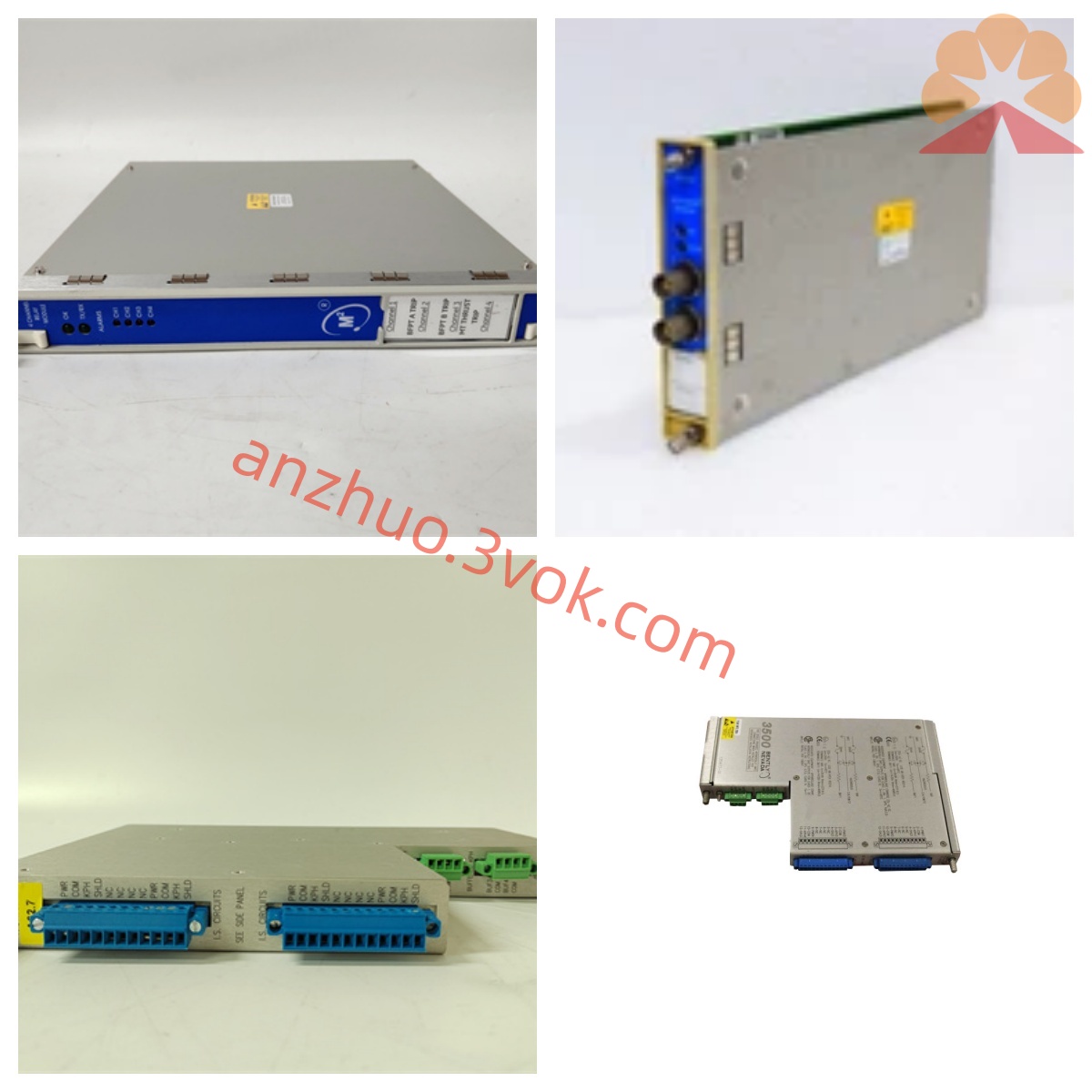
Bently Nevada 19195BH Monitoring Control Module Product Specification
19195BH is a plug-in printed circuit control module developed and manufactured by Bently Nevada (Baker Hughes Group, USA), specially designed for legacy 7200 and early 9000 series rack-mounted TSI (Turbine Supervisory Instrumentation) machinery protection systems, which always operates in combination with matched terminal base 19196L as a complete signal processing assembly. As a core analog monitoring board inside system cabinet racks, this module receives standard negative DC output signals from 20928 and 20929 series eddy-current proximitor modules, processes raw vibration and displacement signals from non-contact proximity probes, implements signal conditioning, linear correction, threshold comparison and fault diagnosis functions for critical rotating equipment parameter monitoring. Originated from US factory production, it adopts conformal coated PCB design to strengthen circuit protection against industrial dust, moisture and trace corrosive gas, targeting long-term continuous running monitoring on heavy-duty rotating machinery across power generation, petrochemical refining, metallurgy and large fan processing industries. The board follows classic European plug-in mechanical specification for fixed slot installation inside standard system rack chassis, and has been widely deployed on steam turbines, gas turbines, centrifugal compressors, boiler induced draft fans and high-pressure feed pumps for online condition monitoring and safety interlock control.
Description
Bently Nevada 19195BH Monitoring Control Module Product Specification
1. General Product Overview
19195BH is a plug-in printed circuit control module developed and manufactured by Bently Nevada (Baker Hughes Group, USA), specially designed for legacy 7200 and early 9000 series rack-mounted TSI (Turbine Supervisory Instrumentation) machinery protection systems, which always operates in combination with matched terminal base 19196L as a complete signal processing assembly. As a core analog monitoring board inside system cabinet racks, this module receives standard negative DC output signals from 20928 and 20929 series eddy-current proximitor modules, processes raw vibration and displacement signals from non-contact proximity probes, implements signal conditioning, linear correction, threshold comparison and fault diagnosis functions for critical rotating equipment parameter monitoring. Originated from US factory production, it adopts conformal coated PCB design to strengthen circuit protection against industrial dust, moisture and trace corrosive gas, targeting long-term continuous running monitoring on heavy-duty rotating machinery across power generation, petrochemical refining, metallurgy and large fan processing industries. The board follows classic European plug-in mechanical specification for fixed slot installation inside standard system rack chassis, and has been widely deployed on steam turbines, gas turbines, centrifugal compressors, boiler induced draft fans and high-pressure feed pumps for online condition monitoring and safety interlock control.
2. Core Application Scope
This control module forms a full closed-loop measurement chain together with 5mm or 8mm diameter eddy current proximity probes, extension cables and discrete proximitor units from Bently’s classic 20928/20929 lineup. It mainly measures four core mechanical parameters of rotating shafts including radial shaft vibration, axial thrust displacement, rotor eccentricity and Keyphasor rotational speed signal. After multi-stage internal filtering, amplification and signal calibration, the module converts processed physical quantity signals into two types of available outputs: standard analog transmission signal for DCS or local field indicator meter access, and dry contact relay switching signal for pre-set alarm and emergency trip interlock logic. Besides conventional thermal power and chemical process industries, the module also serves continuous production line rotating equipment of steel mills and large-scale water treatment plants, delivering real-time equipment health data and over-limit protection trigger signal to upper control systems to avoid unexpected unit shutdown caused by abnormal mechanical failure. Its internal circuit supports signal input from DC static clearance measurement up to 10kHz dynamic vibration sampling, compatible with both static offset reading and high-frequency transient rotor motion capture without mechanical abrasion compared with contact-type displacement transducers.
3. Detailed Electrical Performance Specifications
3.1 Power Supply Requirements
The module gets centralized DC power feed from system rack backplane with dual standard rated input of +24VDC and -24VDC regulated industrial direct current, built-in reverse polarity protection and transient surge suppression circuit at power input pins to prevent PCB component burnout from wrong field wiring during installation and routine maintenance. Optimized low power consumption circuit layout limits continuous operational heat generation to fit 24/7 non-stop running requirement of critical industrial monitoring cabinets.
3.2 Signal Input Parameters
Primary analog input accepts standard 0VDC ~ -24VDC linear negative voltage signal sourced from matched proximitors, following factory calibrated scale factor of 200mV per mil (equivalent to 7.87V per millimeter) based on AISI4140 alloy steel target benchmark material. Additional dedicated pulse input channel is reserved for Keyphasor pickup signal to achieve non-contact rotational speed and phase measurement. Internal high-frequency EMI suppression filter circuit effectively eliminates electromagnetic interference generated by surrounding variable frequency drives, high-voltage distribution cabinets and large AC driving motors to guarantee stable measuring precision under complex industrial electromagnetic environments. Users can adjust internal trim potentiometers and configuration jumpers on PCB surface to modify measuring range and alarm threshold according to on-site equipment setup demands.
3.3 Signal Output Configuration
Two major output forms are integrated on the module for field interconnection. First, configurable analog transmission output supports either 0~-24VDC voltage signal or industry-standard 4~20mA current signal for seamless connection to distributed control system and local site display instruments. Second, independent passive mechanical relay contact output for high and low level alarm plus equipment emergency trip interlock; rated contact capacity reaches AC250V, 5A to directly drive external intermediate relay or safety trip loop without extra signal isolation amplifier.
3.4 Built-in Self-Diagnosis Function
The analog-type module features passive circuit fault detection without digital communication bus interface. It judges abnormal loop conditions by tracking abnormal deviation of input and output voltage values. Detectable typical field faults cover open-circuit of probe inner conductor, broken extension cable core wire, terminal short-circuit failure and probe clearance exceeding calibrated linear measuring range; all abnormal working status will lead to obvious output signal drift for maintenance technicians to quickly locate defective component inside measurement loop without additional external testing equipment.
4. Mechanical Structure and Environmental Operating Ratings
4.1 Mechanical Installation Specifications
Adopting standard vertical European plug-in card structure, the main 19195BH PCB card is inserted into fixed slot of 19196L terminal base, and the base is pre-fixed inside system rack via screw mounting. Total assembled dimension for combined 19195BH plus 19196L unit is approximately 330mm × 180mm × 35mm with gross weight around 0.5kg, compact outline effectively saves limited cabinet inner layout space. The 19196L base is equipped with multiple screw-type terminal blocks for field wiring access of power supply, input signal and output loop, replacing fragile coaxial connector design to improve connection stability under long-term cabinet mechanical vibration from surrounding running equipment. All internal PCB components are fixed with anti-loosening soldering process to resist on-site vibration impact during long-term service cycle.
4.2 Ambient Working Condition Limits
Rated continuous operational ambient temperature ranges from -29°C to +66°C for stable long-term cabinet installation; allowable transportation and spare part storage temperature spans from -40°C to +85°C to adapt diverse seasonal climate and cross-region global spare inventory logistics. Permitted working relative humidity is controlled within 5% to 95% non-condensing environment to prevent PCB short-circuit damage caused by cabinet internal dew formation and accumulated moisture. The whole assembly meets general industrial dustproof standard for indoor control cabinet application, not recommended for direct outdoor open-air mounting without extra sealed protection enclosure.
5. Product Core Advantages
First, mature analog circuit design with decades of global on-site industrial verification ensures outstanding operational stability and extended service life under uninterrupted heavy-load production environment, well compatible with all legacy Bently 7200 series rack system accessories for convenient spare part replacement and on-site retrofit maintenance. Second, modular split structure of main control card and independent terminal base greatly simplifies field wiring and single-card replacement work without reworking whole terminal wiring layout during component maintenance. Third, adjustable onboard calibration potentiometers and configuration jumpers enable flexible measuring range modification to match different specification proximity probes and varied equipment monitoring requirement, improving product field adaptability across multiple industrial application scenarios. Fourth, integrated multi-level surge protection and reverse power protection reduce component damage risk from field misoperation and instantaneous power grid fluctuation, lowering subsequent equipment maintenance cost and unexpected spare replacement expense for end users.
6. Quality Certification and Warranty Regulation
19195BH complete set module with 19196L base is original US-manufactured product complying with internal Bently Nevada industrial component quality control standards and CE electrical safety certification for global industrial automation market supply. When applied strictly within specified rated electrical and environmental parameters without artificial physical damage, improper power wiring or overvoltage misuse, the product enjoys standard twelve-month limited factory warranty covering inherent original manufacturing defects counted from formal goods delivery date.
Get a Quote