
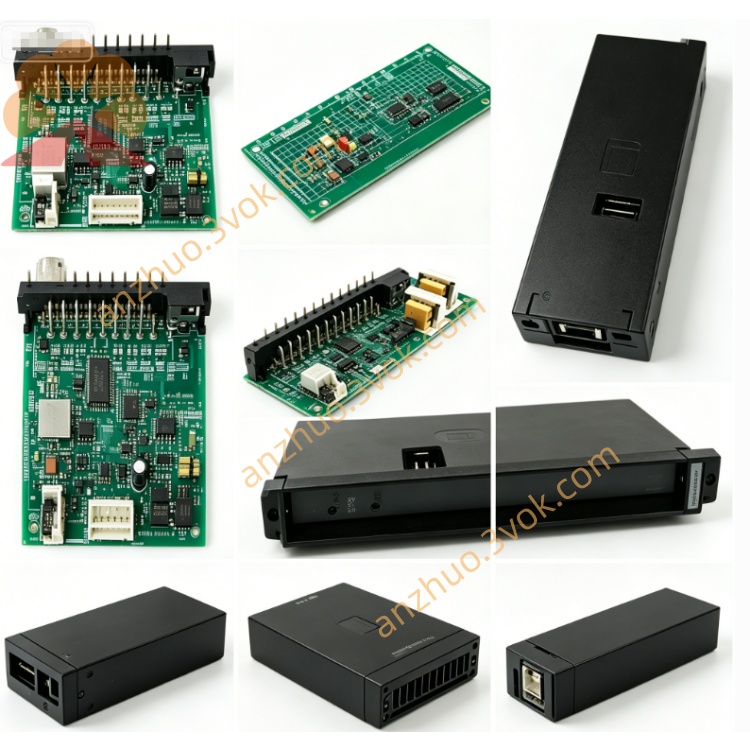
Reliance 57C423 common memory / remote I/O communication module
Description
Product Brief Introduction
Model Definition
57C: Denotes Reliance’s 57C series rack-mounted modular platform for AutoMax control systems, focusing on communication, memory, and I/O modules.
423: Functional identifier for the common memory / remote I/O communication module, distinguishing it from other 57C series modules (e.g., 57C422B motion modules).
No suffix (e.g., A/B) indicates the standard production version with fixed hardware and firmware for general-purpose AutoMax system integration.
Technical Specifications
Memory Capacity: 128KB shared dual-port RAM for inter-processor data exchange and system configuration storage.
Backplane Interface: Multibus P1 bus, 5V TTL logic, supports high-speed parallel data transfer up to 2MB/s.
Remote I/O Ports: Four dedicated communication ports (0–3) for distributed I/O nodes, supporting differential signaling.
Serial Debug Port: RS-232 interface for local configuration, diagnostics, and firmware updates.
Power Supply: 5V DC (±5%) from rack backplane; 600mA typical current consumption.
Operating Temperature: 0°C to 60°C (industrial grade); storage temperature -20°C to 70°C.
Humidity: 5%–95% non-condensing, compliant with NEMA and IEC industrial standards.
Protection: Onboard hardware watchdog, overvoltage/overcurrent protection, and ESD shielding for harsh environments.
Indicators: Front-panel LEDs for POWER, RUN, FAULT, and COMM status for real-time monitoring.
Interface and Communication Configuration
Backplane Communication: Gold-finger connector to AutoMax Multibus backplane, using Reliance proprietary protocol for seamless data exchange with host processors, motion modules, and other I/O modules in the same rack.
Remote I/O Interfaces: Four isolated communication ports (0–3) on the front panel for connecting remote I/O nodes via shielded twisted-pair cables, supporting master-slave communication topology.
RS-232 Debug Port: 9-pin D-Sub connector for local parameter setting, fault logging, and firmware upgrades via PC-based tools.
No Onboard Fieldbus: Relies on backplane bus or additional 57C series communication modules (e.g., 57C404C) for upper-layer network connectivity (e.g., Modbus, Ethernet).
Core Functions
Shared Memory Management: Provides 128KB dual-port RAM for real-time data sharing between multiple AutoMax processors, eliminating redundant data storage and ensuring synchronization.
Inter-Processor Communication: Facilitates high-speed message passing and task coordination between rack-mounted processors via Multibus P1 bus.
Remote I/O Master Control: Manages up to four remote I/O nodes, handling data polling, command transmission, and fault detection for distributed I/O systems.
System Configuration Storage: Stores AutoMax OS files, system parameters, and motion control configurations to reduce host processor load.
Fault Diagnosis & Protection: Monitors communication integrity, power supply stability, and module health; triggers alarms and logs fault codes for troubleshooting.
Data Synchronization: Ensures consistent data exchange between local and remote I/O, supporting coordinated motion and process control across the system.
Application Scenarios
Legacy AutoMax System Upgrades: Replaces aging communication modules in existing AutoMax PLC and motion control racks to restore inter-processor and remote I/O communication capabilities.
Distributed Industrial Automation: Used in production lines requiring remote I/O expansion, such as automotive assembly, packaging, and material handling systems.
Multi-Processor Coordination: Applied in complex control systems with multiple AutoMax processors (e.g., CNC machinery, robotics, and process plants) needing synchronized data exchange.
Retrofit Projects: Ideal for modernizing old Reliance Electric equipment, integrating new I/O nodes with legacy AutoMax systems without full rack replacement.
Operation and Maintenance Instructions
Installation: Power off the AutoMax rack before insertion; align with chassis rails, fully seat backplane gold fingers, and secure with faceplate screws to ensure stable contact.
Wiring: Use shielded twisted-pair cables for remote I/O and RS-232 connections; separate signal cables from high-voltage power cables to minimize EMI.
Routine Maintenance: Every 3–6 months (depending on environment), power down the system and clean the module surface and rack vents with dry compressed air; avoid liquid cleaners.
Fault Diagnosis: Check front-panel LEDs (POWER/RUN/FAULT/COMM) for status; verify backplane connections if communication errors occur; use RS-232 port for local diagnostics and fault log retrieval.
Replacement: Replace with a standard 57C423 module if persistent faults occur; reload system configuration and verify communication with all nodes.
Storage: Keep spare modules in a dry, temperature-controlled environment (0°C–40°C) away from corrosive gases and strong electromagnetic fields.
Modification: Do not alter onboard circuits or components without factory authorization, as this voids warranty and may cause system instability
.
Get a Quote