
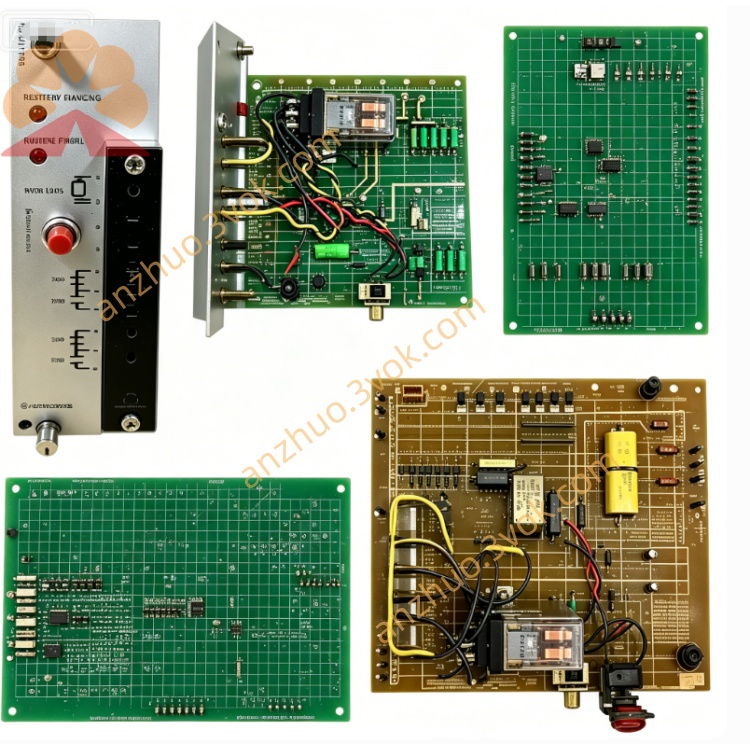
RELIANCE 57C330 remote I/O head module
The RELIANCE 57C330 is a remote I/O head module designed exclusively for the AutoMax DCS and PLC control systems. It serves as a key connection unit between the main control rack and distributed remote I/O nodes, supporting data transmission over coaxial cable or fiber optic links. With industrial-grade circuit design and strong anti-interference capability, it delivers stable long-distance communication performance for large-scale distributed industrial control systems.
Description
Product Overview
The RELIANCE 57C330 is a remote I/O head module designed exclusively for the AutoMax DCS and PLC control systems. It serves as a key connection unit between the main control rack and distributed remote I/O nodes, supporting data transmission over coaxial cable or fiber optic links. With industrial-grade circuit design and strong anti-interference capability, it delivers stable long-distance communication performance for large-scale distributed industrial control systems.
Model Definition
RELIANCE is the brand of this industrial control product. 57C represents the product family of AutoMax I/O and communication modules. 330 is the model code for standard remote I/O head modules, which defines the core function, power specification and network interface type of the device.
Technical Parameters
This module operates with 120/240 VAC input power at 50 and 60 hertz, and its total power consumption is less than 50 watts. It is fitted with a 2 ampere fuse rated at 250 volts for circuit protection. It adopts the proprietary AutoMax remote I/O protocol based on RS-485 physical layer. The operating temperature ranges from 0 degrees Celsius to 60 degrees Celsius. It is manufactured with metal enclosure and designed for single-slot installation in AutoMax racks. Multiple LED indicators are equipped to display power status, network operation and fault alarms.
Interface and Communication Configuration
The module connects to the AutoMax rack through the dedicated backplane interface to complete internal data interaction. It provides BNC ports for coaxial cable connection and standard ports for dual fiber optic links to adapt to different transmission media. All node addresses and operating modes are configured through upper control software without physical setting switches. It has no independent external communication ports, and all remote data is transmitted via the built-in network interface.
Core Functions
It establishes communication links between the main controller and multiple remote I/O racks, and supports access to up to 31 remote nodes. It realizes bidirectional transmission of discrete and analog I/O data between field equipment and the central control system. It conducts real-time network monitoring, error detection and fault isolation to ensure data transmission reliability. The fiber optic interface supports redundant links to improve system operation stability. It completes protocol adaptation and signal conversion for different transmission media.
Application Scenarios
This module is widely used in distributed automation control projects equipped with AutoMax systems. It is commonly deployed in steel production, pulp and paper industry, power plants and chemical processing facilities. It is suitable for application environments that require long-distance signal transmission and geographically separated I/O racks. It can also be used for equipment renovation and replacement of old-generation remote I/O modules in existing control systems.
Operation and Maintenance Instructions
Cut off the system power before installation, then insert the module into the designated rack slot and make sure the backplane connection is firm. Select coaxial cable or fiber optic cable according to on-site requirements and complete wiring in standard specifications. Keep the installation area well ventilated, and keep away from strong electromagnetic interference, dust and corrosive substances during operation. Regularly check the tightness and integrity of all connecting cables and ports. When fault indicators light up, power off the system first to inspect lines and network nodes. Do not disassemble the module internally without permission. Replace it with the same model if permanent failure occurs to guarantee normal system operation.
Get a Quote