
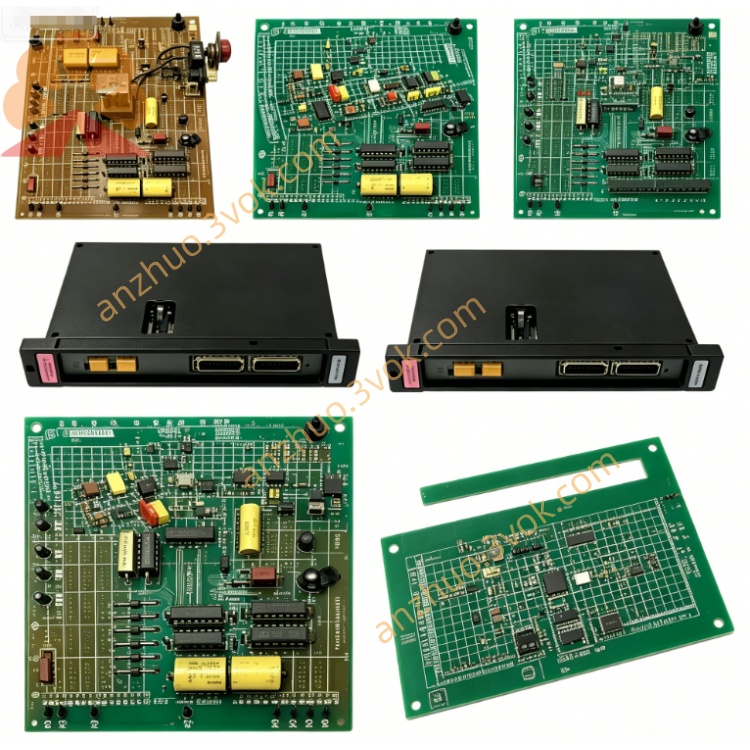
RELIANCE 57552-4A RELIANCE 57552-4A
Description
Product Overview
Model Definition
Technical Parameters
Power Supply: +5VDC (logic) and +24VDC (I/O network) from rack backplane.
Control Capacity: Controls 1 or 2 AC/DC drives; up to 10 modules per rack (20 drives total).
Memory: 256KB non‑volatile flash, 512KB SRAM, 4KB dual‑port SRAM.
Indicators: 6 LEDs: CARD OK, OS OK, COMM A OK, DRV A FLT, COMM B OK, DRV B FLT.
Operating Temperature: 0°C to +60°C; industrial grade for harsh conditions.
Mounting: Single‑slot AutoMax rack mount; metal enclosure with shielding.
Protection: Overvoltage, overcurrent, short‑circuit, and drive fault detection; enhanced EMC immunity.
Interface and Communication Configuration
Backplane Interface: Multibus connector for high‑speed data exchange with AutoMax processors.
Drive Communication: Dual fiber‑optic links (COMM A/B, XMT/RCV ports) for isolated, noise‑immune drive communication.
Front Panel: Status LEDs, test switch, meter ports, and a reset button for on‑site diagnostics.
Configuration: Software‑configured via AutoMax tools; no user‑set hardware switches.
Core Functions
Executes advanced motion control algorithms for speed, torque, and position regulation on 1–2 drives.
Enables high‑speed data exchange with system processors via dual‑port memory and fiber links.
Retains programs and parameters in non‑volatile flash to prevent data loss during power outages.
Provides real‑time monitoring and fault reporting for drives, communication channels, and internal circuits.
Supports multi‑drive coordination and synchronized motion in automated production lines.
Offers improved firmware stability and compatibility with newer AutoMax system software versions.
Application Scenarios
Heavy‑duty industrial automation using AutoMax DCS/PLC platforms.
Motion control in steel, pulp and paper, material handling, and manufacturing.
Centralized drive control cabinets and remote I/O racks requiring high‑precision coordination.
System upgrades or retrofits replacing legacy drive controllers in existing AutoMax installations.
Applications requiring enhanced reliability and firmware compatibility compared to 57552‑4.
Operation and Maintenance Instructions
Installation: Power off the rack before inserting into a single AutoMax slot; ensure secure backplane connection.
Wiring: Connect fiber‑optic cables to COMM A/B ports; verify drive wiring matches software configuration.
Operation: Maintain 0°C to +60°C ambient temperature; ensure adequate ventilation and avoid dust, moisture, and corrosive gases.
Maintenance: Regularly inspect fiber cables for damage; check LED status indicators for faults; clean module surface periodically.
Troubleshooting: If DRV FLT LED illuminates, power off and inspect drive wiring and connections; use AutoMax diagnostic software for fault analysis.
Replacement: Replace only with the same model (57552‑4A) or compatible revision to ensure system compatibility.
Get a Quote