
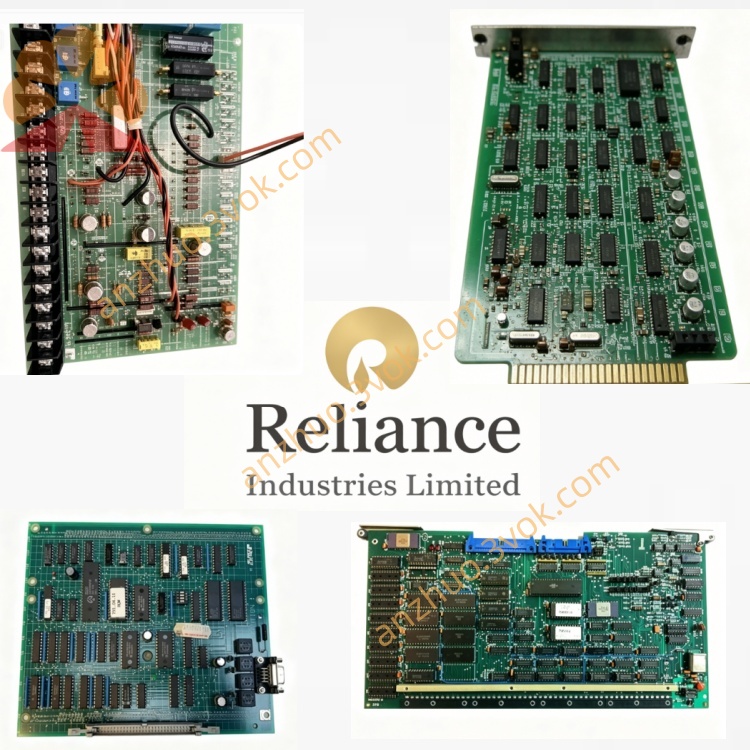
RELIANCE 57442-1C Allen‑Bradley Data Highway Interface Module
Description
Product Overview
Model Definition
RELIANCE: Brand (now part of ABB/Baldor).
57442: Core series for A‑B Data Highway Interface Modules in AutoMax systems.
1C: Revision identifier, indicating an upgraded variant with optimized signal integrity and compatibility.
Alternative Part Numbers: 0-57442-1C (full OEM number), 57C442 (industry shorthand).
Technical Parameters
Backplane Power: 5VDC, 650mA (3.25W).
Network Protocol: Allen‑Bradley Data Highway (DH).
Network Speed: 8Mbps maximum.
Memory: 32K dual‑port RAM (shared between backplane and network).
Node Capacity: Supports up to 32 nodes on the DH network.
Operating Temperature: 0°C to +60°C; storage -40°C to +85°C.
Diagnostics: 7‑segment LED (fault codes), green “OK” LED, red “FAULT” LED.
Form Factor: Single‑slot AutoMax rack; industrial‑grade, IP20.
Certifications: UL, CE; ESD/surge protected.
Interface & Communication Configuration
Backplane Interface: Connects to AutoMax DCS 5000 backplane for power and internal data exchange.
Data Highway Port: Isolated DB9 or terminal‑block connector for A‑B DH network; supports daisy‑chain topology.
Front‑Panel Indicators:
OK (Green): Module powered and operational.
FAULT (Red): Communication error or hardware fault.
7‑Segment Display: Shows fault codes (e.g., “E01” for network timeout).
Core Functions
Protocol Conversion: Translates AutoMax backplane protocol to A‑B Data Highway, enabling seamless integration with Rockwell Automation devices.
Data Routing: Exchanges I/O data, control commands, and status information between AutoMax and A‑B systems.
Network Management: Manages DH network traffic, ensuring deterministic data delivery and collision avoidance.
Diagnostic Monitoring: Real‑time fault reporting via LEDs and 7‑segment display for quick troubleshooting.
System Expansion: Facilitates integration of A‑B I/O racks and HMIs into AutoMax‑based DCS.
Application Scenarios
Operation & Maintenance Instructions
Installation: Power off the rack before insertion. Seat firmly in a single slot and secure. Connect DH network wiring per terminal labeling; set node address via module switches.
Operation: Keep the rack area dry, ventilated, and free of dust/corrosive gases. Monitor front‑panel LEDs and 7‑segment display for status/faults.
Maintenance: Periodically check connectors for tightness/aging; clean indicators and ports. Avoid static electricity when handling.
Troubleshooting: If fault codes appear, power off, re‑seat the module, and inspect DH wiring. Do not disassemble the housing. Replace only with 57442-1C or compatible 57C442 to ensure network compatibility.
Get a Quote