
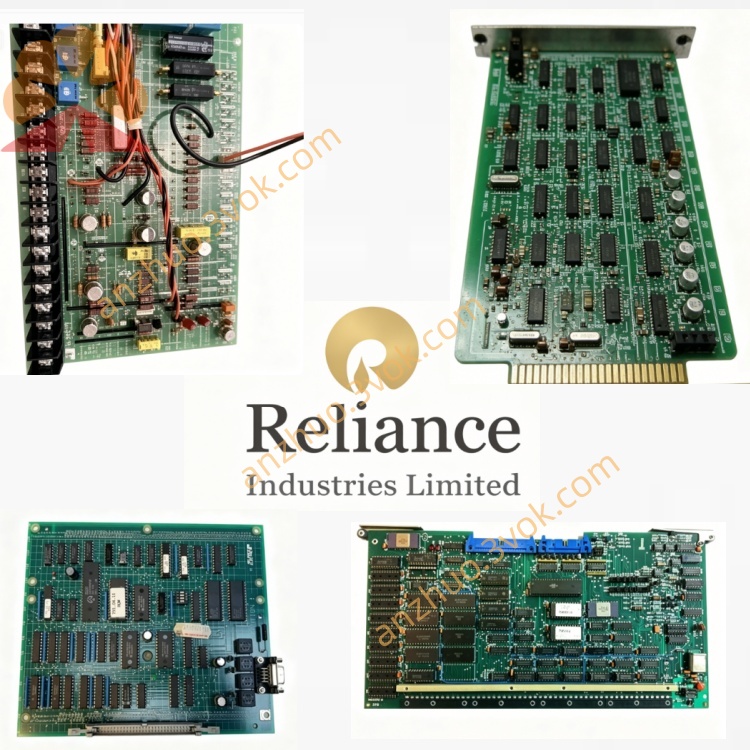
Reliance 086466-60R (86466-60R)
Description
Product Description
Model Definition
086466: Base part number for Reliance three‑phase rectifier stack family
60: Specific current rating and hardware revision (60A class, standard duty)
R: Standard revision, non‑coated, no RC snubber variant.
Technical Specifications
Input: Three‑phase AC, 230/460 VAC, 50/60 Hz
Output: Adjustable DC, up to 60A continuous, voltage matched to drive rating
Power Devices: Press‑pak thyristor pairs (three legs, six SCRs)
Heat Sinks: Dual two‑section aluminum heat sinks, forced‑air cooled
Gate Interface: Two 0‑51378‑19 PC gate coupling boards (per side), with transformers, resistors, diodes
Protection: Fuse‑protected legs, MOV transient suppression (optional), no RC snubber
Operating Temperature: 0 °C to +60 °C, storage −40 °C to +85 °C
Coating: Non‑conformal coated (standard industrial finish)
Mounting: Three metal brackets for chassis installation
Certifications: CE compliant, meets industrial safety standards.
Interface and Communication Configuration
AC Input: Three‑phase line terminals (L1/L2/L3) for grid connection
DC Output: Positive/negative bus terminals to drive DC link and motor armature
Control Interface: Gate drive connectors to 0‑51378‑19 coupling boards, receiving firing signals from drive control board
Communication: No independent data link; operates as power stage under drive system control
Diagnostics: Thermistor for overheat detection; fuse status indicators for fault monitoring.
Core Functions
Converts three‑phase AC to variable DC output via phase‑angle control for precise DC motor speed/torque regulation.
Delivers up to 60A continuous DC for medium‑horsepower motor loads in industrial drives.
Isolates control logic from high‑power AC lines via gate coupling boards, enhancing electrical safety.
Dissipates heat via dual heat sinks to maintain thermal stability during continuous operation.
Application Scenarios
Reliance MaxPak and MaxPak Plus DC drive systems.
Heavy industries: steel, paper, mining, cement, oil/gas processing.
Medium‑horsepower DC motors (20–100 HP) for conveyors, extruders, winders, cranes.
Environments with moderate electrical noise and contamination (non‑coated design).
Usage and Maintenance Instructions
Usage
Mount the rectifier stack securely in the drive cabinet using the three brackets, ensuring unobstructed airflow to heat sinks.
Connect three‑phase AC input to L1/L2/L3 terminals and DC output to drive DC link, verifying polarity and torque specifications.
Attach gate drive cables to control connectors and confirm firing signal compatibility with the drive controller.
Before power‑on, inspect all connections for tightness and short circuits; power on and monitor via drive diagnostics.
Maintenance
Keep cabinet clean and dry; inspect heat sinks quarterly for dust buildup and clean with compressed air if needed.
Check power terminals and connectors annually for corrosion, looseness, or overheating; retorque as required.
Monitor thermistor and fuse status indicators regularly to detect overheat/overcurrent faults early.
Store spare units in anti‑static bags in cool, dry location; repairs only by qualified personnel.
Replace with identical non‑coated units to maintain thermal and electrical compatibility.
Get a Quote