
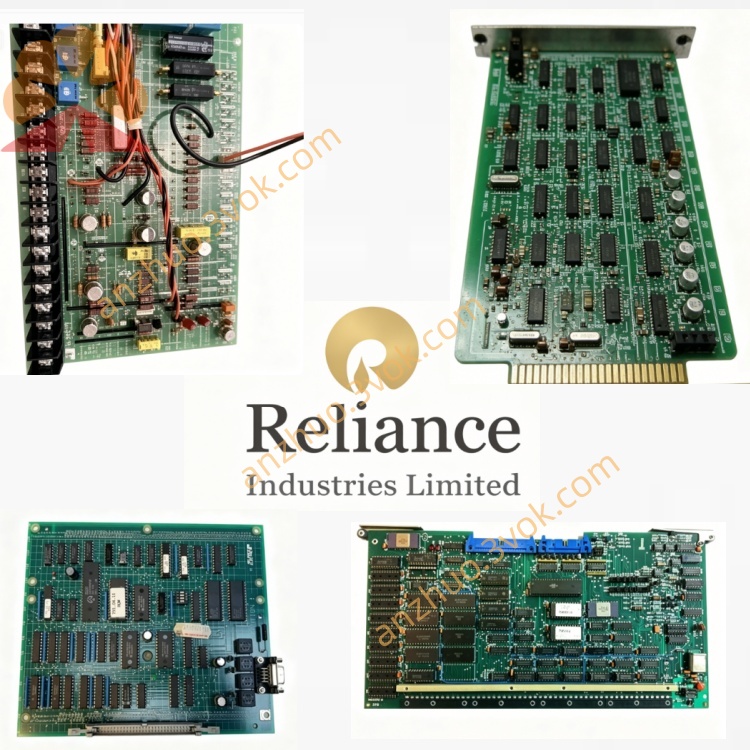
Reliance 11C85K (Minpak Plus DC Driver)
Description
Product Introduction
11C85K is a compact single-phase DC driver from Reliance Electric (now part of Rockwell Automation) in the Minpak Plus series, designed for speed and torque control of small to medium power DC motors. This model features a full-wave thyristor rectification structure, integrates armature and magnetic field regulation circuits, and is suitable for light industry and OEM equipment. It has a compact structure, is easy to debug, and operates stably. The product has been discontinued and is currently available only in refurbished, disassembled, or inventory spare parts.
Model Interpretation
11: Series code, representing the Minpak Plus single-phase DC drive platform
C: Product category, indicating a DC Drive (DC Drive)
85: Power and voltage specification code, corresponding to 5HP, 230VAC input level
K: Configuration version, specifically referring to the standard configuration with dynamic braking interface and enhanced protection, without any special customization options. Technical Specifications
Manufacturer: Reliance Electric (Rockwell Automation)
Product Type: Minpak Plus Single-phase Full-wave SCR DC Driver
Rated Power: 5HP
Input Voltage: 230VAC, single phase, 50/60Hz (wiring harness optional)
Voltage Fluctuation: ±10% of Rated Value
Armature Output: 240VDC, 20A (average)
Magnetic Field Output: 100VDC, 3A (maximum)
Control Mode: Phase angle SCR rectification, analog current inner loop + voltage/velocity outer loop
Speed Regulation Range: 10:1 (potentiometer), optional speed feedback extension to 50:1
Overload Capacity: 150% of Rated Armature Current, lasting 1 minute
Efficiency: Driver approximately 97%, complete machine (including motor) approximately 85%
Protection Level: NEMA 1 (indoor universal type)
Operating Environment: 0℃~+40℃, relative humidity 5%~95% (no condensation)
Installation Method: Wall-mounted / Panel-mounted
Status:停产.
Interface and Communication Configuration
Power Input: Terminal block connects 230VAC single phase (L, N, ground)
Motor Connection: Independent terminals connect DC armature (+/-) and magnetic field (+/-) windings
Control Input: Local potentiometer interface; supports 0~10VDC or 4~20mA analog remote setpoint
Feedback Interface: Reserved tachometer feedback terminal (optional)
Status Indication: LED displays power, operation, fault, and braking status
Communication Capability: No built-in industrial communication ports, only analog quantity and dry contact control
Auxiliary Interface: Dry contact output (fault alarm / operation status); dedicated terminal for dynamic braking resistor.
Core Functions
Closed-loop Speed Regulation: Maintains stable speed under load fluctuations, basic accuracy ±1% (speed feedback can reach ±0.1%)
Armature/Magnetic Field Independent Control: Adjusts armature voltage and excitation current separately, optimizes low-speed torque and high-speed constant power characteristics
Soft Start/Soft Stop: Adjustable acceleration/deceleration time, suppresses inrush current and mechanical stress
Multiple Protection: Overcurrent, short circuit, overheat, demagnetization, undervoltage protection, fault detection and automatic shutdown with locking
Dynamic Braking: External braking resistor for rapid and smooth stopping (non-mechanical brake)
Speed Calibration: Local potentiometer fine-tuning, supports remote analog signal control.
Application Scenarios
Light industrial equipment: conveyors, packaging machines, mixers, fans, pumps
OEM Accessories: machine tools, textile machinery, printing equipment, small production lines
Legacy System Upgrade: Upgrade of old DC motor equipment, no need to replace the motor
Independent Single Machine Control: No network communication required, pursuit of simple and reliable single motor application
General Indoor Environment: Suitable for factories with slight dust and vibration.
Usage and Maintenance Instructions Use
Before installation, cut off all power supplies to prevent electric shock.
Fix the drive to a flat and rigid wall / panel, leaving sufficient space for heat dissipation.
Wiring: Connect the 230VAC input, armature wire, and magnetic field wire in sequence. Tighten all terminals to prevent overheating.
Control wiring: Connect the local potentiometer or remote analog signal and ensure reliable grounding.
Power-on debugging: Set the potentiometer to the minimum, start the machine, and slowly increase the speed to check the smoothness of motor operation and speed regulation.
Fault handling: When the indicator light alarms, cut off the power supply to troubleshoot the wiring, motor insulation, and load conditions. Maintenance
Regular inspection: Check the casing, terminal blocks, and indicator lights every 3 to 6 months.
Cleaning and dust removal: After power off, use a dry soft brush / anti-static cloth to clean the dust from the radiator, circuit board, and terminals. Do not use water-soluble cleaners.
Terminal tightening: Tighten all power and control terminals annually to prevent loosening and overheating.
Component inspection: Check for any leakage, bulging, or wear of SCR, capacitors, and potentiometers.
Anti-static operation: When opening the cover for maintenance, wear an anti-static wrist strap to avoid damaging components due to static electricity.
Storage of spare parts: Place the spare driver in a cool, dry, and anti-static environment to prevent moisture and dust.
Do not disassemble the machine privately. Maintenance should be carried out by professional personnel.
Get a Quote