
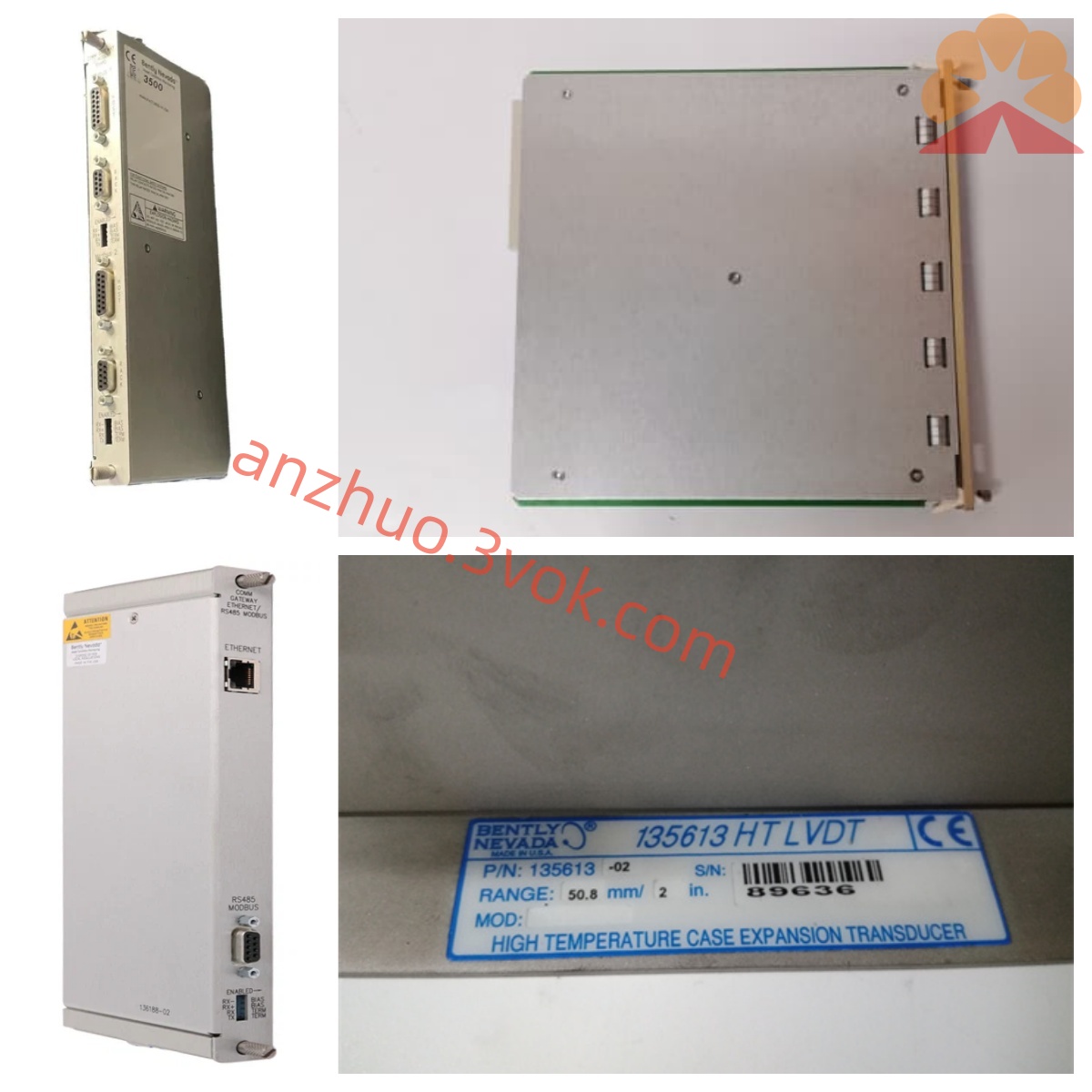
Bentley Nevada 72471-B Control I/O Module for 3500 Monitoring Rack
Description
Technical Specifications
Power Supply: -24VDC (range -17.5VDC to -26VDC)
Input: Compatible with 7200 series 5mm/8mm eddy current probes, dual-channel independent acquisition
Measurement Range: Standard 0–2mm (customizable), sensitivity 3.94V/mm (100mV/mil)
Output: 4–20mA analog quantity, two relays for alarm contacts (warning / danger)
Accuracy: Linear error ≤ ±5%, repeatability ≤ 0.1%
Environment: Working temperature **-20℃ to 60℃**, storage -40℃ to 85℃, dust-proof and shock-proof
Installation: Standard 35mm rail-mounted, installation in cabinet
Difference from 72471-BC
72471-B: Bare board module, without metal casing and front panel, requires a cabinet/frame for installation
72471-BC: With casing and front panel, can be directly rail-mounted, better protection, more intuitive debugging
Installation and Wiring
Installation: Snap onto the standard rail of the cabinet, away from strong electromagnetic interference sources such as frequency converters and high-power motors; separate the sensing wire and power wire, with a spacing of ≥300mm.
Wiring:
Power: Connect to the power supply terminals, reliable grounding.
Probe: Connect two eddy current probes to CH1 and CH2 signal terminals respectively, single-ended grounding of the shielding layer.
Output: Connect to the central control system for 4–20mA, alarm contacts connected to the interlock circuit.
Calibration: After power-on, calibrate the probe gap (standard 1.27mm, corresponding voltage 10V ± 0.2V), set the alarm / danger threshold.
Maintenance and Care
Daily: Check the casing for no damage, no dust accumulation, observe the display value stable, no abnormal fluctuations.
Regularly: Tighten the wiring terminals quarterly, check the insulation layer of the cables for no aging or damage; calibrate the measurement accuracy and alarm action reliability every six months.
Prohibited: Do not plug or unplug the probe cable while powered on, avoid static interference; do not operate in high-temperature and humid environments.
Storage: When idle, place in a dry and ventilated environment, temperature -40℃ to 85℃, moisture-proof and dust-proof. Fault diagnosis
No display / No signal: Check if the power supply is normal and if the fuse has blown; Investigate if the probe cable is broken, short-circuited or connected incorrectly; Replace the spare module to confirm if it is a hardware fault.
Value fluctuation / Large deviation: Check if the installation gap of the probe is compliant and if the fixation is loose; Investigate external electromagnetic interference, and check if the cable shielding and grounding are good.
Alarm malfunction / Inaction: Verify if the alarm threshold setting is correct; Check if the relay contacts are oxidized or stuck; Test the stability of the probe signal, and calibrate or replace the probe if necessary.
Get a Quote