
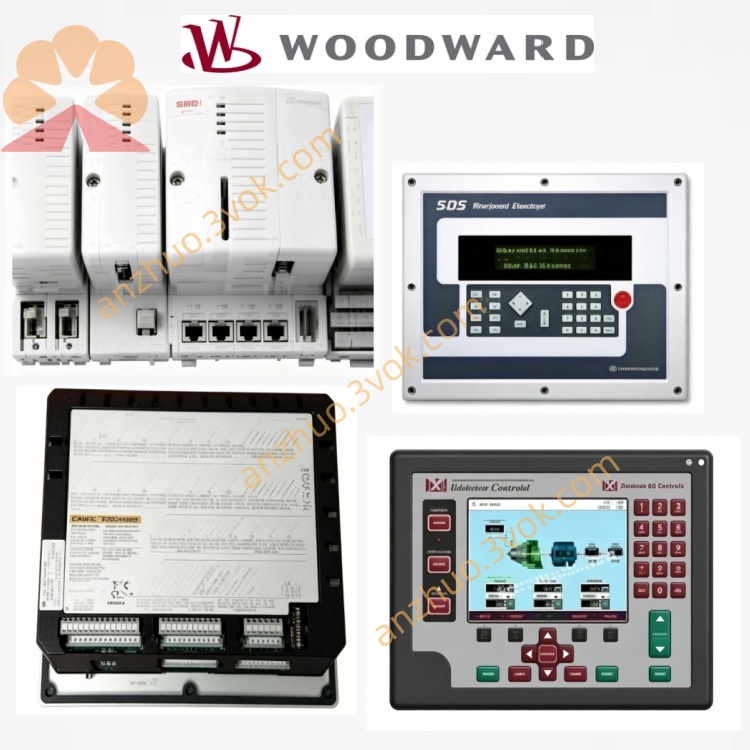
WOODWARD 5460-840 Turbine Controller
Description
Woodward (5460-840) Pressure Reference Module Product Manual
I. Product Overview
Woodward 5460-840 is a pressure reference module (Pressure Reference Module) launched by the American company Woodward. It belongs to the 5460 series of industrial control modules and is specifically designed for industrial engines, turbines, and power generation control systems. Its core function is to provide precise and stable pressure signal references and adjustments, ensuring the accuracy and reliability of pressure closed-loop control in power equipment.
1.1 Basic Positioning
It belongs to the 5460 modular control component and is positioned as a pressure control signal reference unit. It works in conjunction with the 5460-735 (speed control), 5460-836 (speed sensor) and other modules to form a complete speed / pressure control system.
It is compatible with rotating machinery such as diesel engines, gas engines, steam turbines, gas turbines, compressors, etc., meeting the control requirements for industrial-level pressure regulation, load matching, and stable operation.
1.2 Core Value
It provides high-precision pressure reference signals, enabling precise regulation of equipment pressure in closed-loop control.
It is compatible with analog/digital signals and is compatible with various industrial control protocols, with strong system integration.
It has industrial-level protection design, capable of withstanding high temperatures, vibrations, and electromagnetic interference, etc., in harsh working conditions.
It supports remote debugging and data recording, reducing operation and maintenance costs.
II. Technical Specifications Parameters
2.1 Electrical Parameters
Power Input: 18–32 Vdc (standard 24 Vdc), supports reverse polarity protection
Power Consumption: Maximum 32 W Signal input
Analog quantity: 4–20 mA, 1–5 Vdc (pressure feedback signal)
Digital quantity: RS-232, RS-422 dual independent serial ports Signal output
Simulation pressure reference signal: 0–5 Vdc, 4–20 mA
PWM pulse output (low current): suitable for synchronizers, actuator drives
Communication interface
Redundant Ethernet ports (10/100 Mbps)
Optional Modbus RTU/ASCII protocols
Control accuracy: pressure regulation accuracy ±0.25%
2.2 Physical and environmental parameters
Size: 200 mm × 150 mm × 50 mm
Weight: approximately 425 g
Operating temperature: -40°C to +85°C
Storage temperature: -40°C to +125°C
Protection class: Class 1, Div 2 (explosion-proof certification)
EMC compatibility: complies with EN 61000-6-2 (anti-interference), EN 61000-6-4 (radiation) standards
Reliability: MTTF (mean time between failures) ≥ 20,000 hours (confidence level > 95%)
2.3 Functional parameters
Regulation mode
No-difference regulation (constant pressure control): suitable for single-unit operation, isolated grid voltage stabilization.
With-difference regulation (proportional regulation): suitable for multi-unit parallel operation, load distribution.
Core function
Pressure signal acquisition, filtering, calibration
Pressure reference value setting, remote adjustment
Overvoltage/undervoltage protection, fault alarm output
Adaptive pressure sensing algorithm, suitable for different sensors
Data recording (pressure curve, fault log)
Applicable equipment: three-phase AC generators, industrial diesel engines, gas turbines, steam turbines, compressors
III. Product Function Details
3.1 Precise pressure reference output
Built-in high-precision ADC/DAC conversion circuit, digitizes the analog signal from the external pressure sensor, outputs stable 0–5 Vdc or 4–20 mA reference signal, serving as the pressure reference for the control system.
Supports manual/remote setting of pressure values, can be remotely adjusted via RS-232/422, Ethernet or Modbus protocols, suitable for integration into automated control systems.
3.2 Dual-mode pressure regulation
No-difference regulation mode
Eliminates static pressure deviation, maintains output pressure constant, unaffected by load fluctuations.
Applicable scenarios: independent power generation units, single compressor pressure stabilization control.
With-difference regulation mode
Responds proportionally to pressure changes, realizes automatic load distribution in multi-unit parallel operation.
Applicable scenarios: multi-engine/turbine parallel power supply, multi-compressor coordinated gas supply.
3.3 Signal compatibility and communication capabilities
Compatible with mainstream industrial sensor signals such as 4–20 mA, 1–5 Vdc, suitable for Woodward and third-party pressure sensors.
Dual serial ports (RS-232/RS-422) + redundant Ethernet design, supports real-time communication with PLC, DCS, and upper computer, enabling remote monitoring, parameter configuration, and fault diagnosis.
Optional Modbus protocol, seamlessly integrates into industrial automation networks, supports data acquisition and remote control.
3.4 Protection and diagnostic functions
Pressure protection: Built-in overvoltage and undervoltage threshold settings, outputs alarm signals when exceeding the range, cuts off actuator control, protecting equipment safety.
Fault diagnosis: Real-time monitoring of sensor breakage, communication abnormalities, power failures, outputs fault codes (LED indicator lights + communication messages).
Data recording: Automatically records pressure history curves, fault events, supports export for analysis, assisting in maintenance troubleshooting.
IV. Application Scenarios
4.1 Industrial power generation system
Diesel / gas generator sets: Cooperate with engine speed regulators to achieve precise control of intake pressure, fuel pressure, and exhaust pressure, ensuring stable power generation frequency and voltage. Combined heat and power unit: Adjust steam pressure and gas pressure to match the thermal load and electrical load demands.
4.2 Turbine Control
Steam turbine: Adjust the inlet pressure of steam and control the turbine speed and output power.
Gas turbine: Monitor the fuel gas pressure and combustion chamber pressure to prevent overpressure / underpressure that could cause flameout or damage.
4.3 Compressors and Fluid Machinery
Natural gas compressor: Adjust the inlet / outlet pressure to ensure stable gas transmission pressure.
Industrial air compressor: Control the exhaust pressure to adapt to different gas usage loads.
4.4 Multi-unit Parallel System
Multiple engines / turbines in parallel: Achieve automatic load balancing distribution through differential regulation mode to avoid overload of a single unit.
V. Product Advantages
High Precision Control
Pressure regulation accuracy reaches ±0.25%, meeting industrial-level precise control requirements, reducing the impact of pressure fluctuations on equipment efficiency.
High Reliability
Industrial-grade wide temperature, explosion-proof, and anti-interference design, MTTF ≥ 20,000 hours, suitable for harsh conditions in oil, chemical, power, etc.
High Compatibility
Compatible with various signals, protocols, and Woodward 505/505T and other control systems, modular design for easy installation and expansion.
Intelligent Operation and Maintenance
Support remote debugging, fault diagnosis, data recording, reducing on-site operation costs, and improving equipment availability.
Redundant Design
Dual Ethernet ports redundancy to avoid system失控 due to single communication failure, ensuring continuous operation.
VI. Installation and Usage Tips
6.1 Installation
Use panel installation or guide rail installation, fixed in the control cabinet, avoiding strong vibration and direct exposure to high-temperature environments.
Power supply connection: Strictly distinguish positive and negative poles, connect to a stable 18–32 Vdc power supply.
Signal wiring: Pressure sensor signals are connected to the analog input port, communication lines are connected to RS-232/422 or Ethernet ports.
6.2 Debugging
Power-on self-check: LED indicators light up normally, no fault alarms.
Pressure calibration: Calibrate the sensor zero point and range through the upper computer or module buttons.
Mode selection: Set the no-difference / differential regulation mode according to the application scenario.
Threshold setting: Configure overpressure and underpressure protection values, enable fault alarm function.
6.3 Maintenance
Regularly check wiring terminals, power voltage, and signal stability.
When there is a fault, use communication messages or LED codes to troubleshoot, prioritize checking sensors, power supply, and communication lines.
Modules support hot swapping (compatible with the system), no need for overall power-off when replacing.
VII. Model Association and Accessories
7.1 Associated Models of the Same Series
5460-735: Speed Control Module
5460-836: Speed Sensor Module
5460-837: Speed Reference Module
5460-838: Frequency Control Module
5460-839: Auxiliary Module
5460-841: Auxiliary Module
7.2 Common Accessories
Pressure Sensor (compatible with 4–20 mA/1–5 Vdc output)
RS-232/422 Communication Cables, Ethernet Cables
Installation Rails, Fixing Supports
Woodward 505 Control System Supporting Software
VIII. Summary
The Woodward 5460-840 Pressure Reference Module is a high-precision, high-reliability pressure signal reference unit in the field of industrial power control. With precise regulation, wide temperature compatibility, multi-protocol compatibility, and redundant communication advantages, it is widely used in power generation, turbines, compressors, etc., providing stable and safe core support for pressure closed-loop control, and is a key component of industrial automation control systems.
Get a Quote