
Description
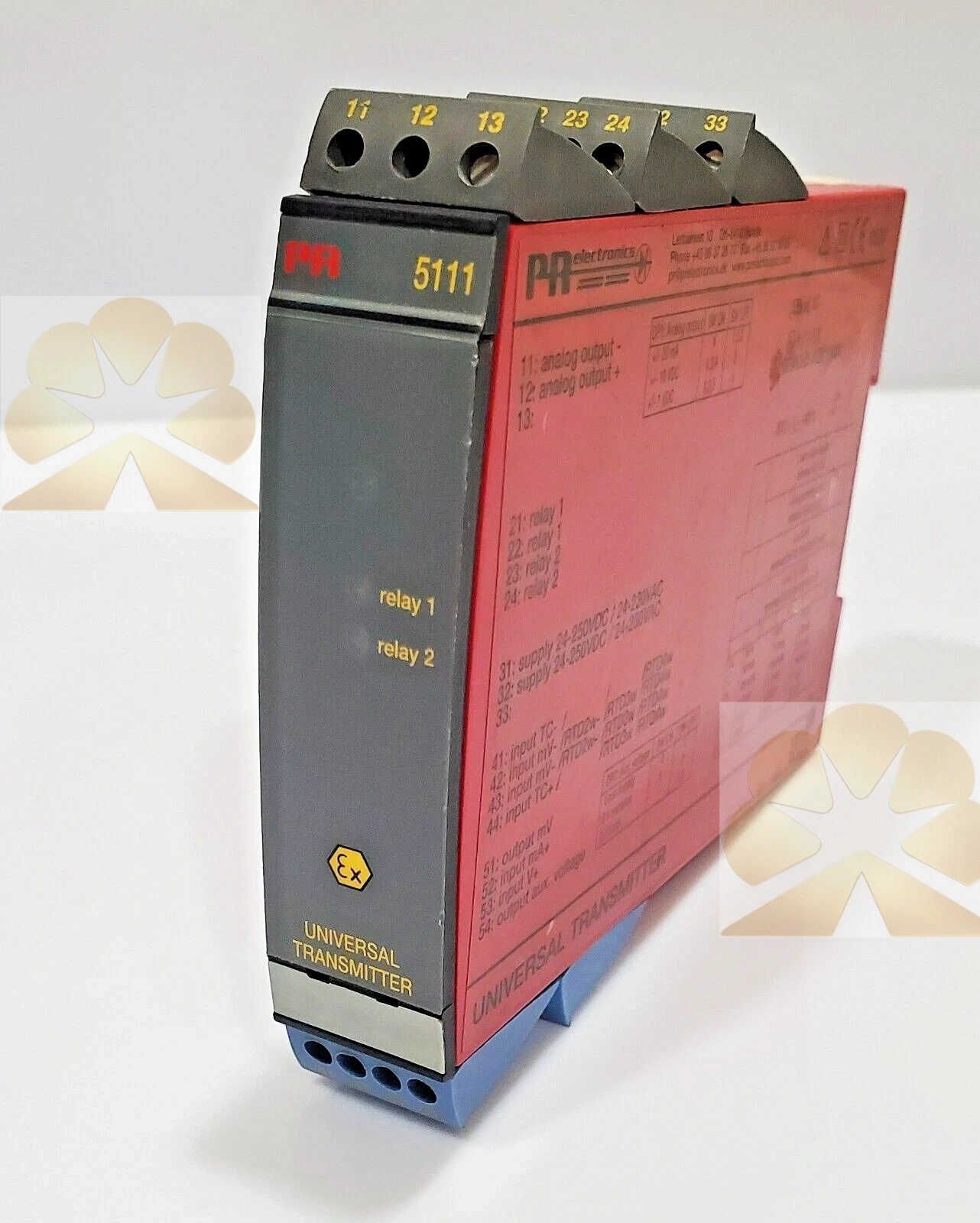
PR 5111B2: PR electronics 5111 Universal Transmitter Product Description
Brand and Product Identification
The PR 5111B2 is a universal transmitter or signal conditioner from the PR electronics 5111 product family, an older Denmark-based process signal conditioning platform. The PR 5111 is listed as an obsolete or discontinued amplifier and universal transmitter, with replacement alternatives such as the PR 5116A, PR 5116B or PR 2261 series depending on the required input, output and supply configuration. The B2 suffix identifies a specific hardware or configuration variant within the 5111 family; exact input range, output type, supply voltage and relay option should be confirmed from the unit label or the original PR 5111 manual, because public datasheets for the obsolete 5111 platform are limited.
Product Function and System Role
The PR 5111 universal transmitter conditions analog process sensor signals and converts them into a standardized output for a PLC, DCS, indicator or control loop. It accepts a broad range of field inputs and provides linearized or scaled analog signal conversion for temperature, resistance, voltage, current or potentiometric measurement. The module is installed in a DIN-rail control cabinet or interface rack and acts as an isolated signal interface between field instrumentation and the safe-area control system. It is a signal transmitter and conditioner, not a complete controller, power supply, field sensor or alarm relay by itself.
Input Signal Types
The PR 5111 family is described as a universal transmitter supporting RTD resistance temperature detectors, thermocouples, mV signals, linear resistance, potentiometer, current and voltage inputs according to the manual connection diagrams. Related current PR electronics 5114 and 5116 transmitters accept RTD, TC, mV, Ohm, linear resistance, mA and V inputs. The 5111B2 variant may be configured for one specific input combination, so the connected sensor type and wiring must match the ordered model code and terminal diagram.
Output and Control Signals
Related PR 5111 manual wiring diagrams cover supply voltage, analog output and output relay connections. Typical PR universal transmitters provide a current output such as 0 to 20 mA or 4 to 20 mA, a voltage output such as 0 to 10 V or 1 to 5 V, and optional relay outputs for alarm or status indication. The 5111B2 output range, source or sink behavior, relay contact rating and fault signal should be verified from the manual or product label before commissioning.
Supply and Isolation
PR electronics universal transmitters in this generation typically operate from an AC or DC universal supply or a 24 V DC supply depending on model, and provide galvanic isolation between input, output and supply circuits. Related newer PR 5114A offers 3-port 3.75 kVAC galvanic isolation and universal voltage supply. The obsolete 5111B2 insulation rating, supply range and power consumption must be checked against the original 5111 manual rather than assumed from the replacement 5114 or 5116 datasheet.
Configuration and Operating Features
The PR 5111 is configured for sensor type, measuring range, output range and scaling according to the application. Universal transmitter functions commonly include RTD linearization, thermocouple cold junction compensation, resistance or potentiometer scaling, sensor breakage or short-circuit detection, and output fault signaling. Configuration may use front DIP switches, pushbuttons or a PR programming interface depending on the 5111 variant. Related PR electronics transmitters are now configured through dedicated software or displays, but the older 5111 platform should be checked against its original operating instructions.
Typical Application Scenarios
Typical PR 5111 uses include temperature measurement from RTD or thermocouple sensors, conversion of potentiometric position feedback to analog output, resistance or mV signal conditioning, two-wire transmitter signal isolation, and process measurement interface for PLC or DCS analog inputs. Common industries include process control, chemical, petrochemical, pharmaceutical, water and wastewater, food and beverage, energy and general manufacturing. Because the 5111 is obsolete, it is most often encountered in legacy equipment replacement, spare part retention or retrofit assessment.
Installation and Wiring Notes
Installation should follow the PR electronics 5111 manual, local electrical codes and the terminal wiring diagram. Confirm supply voltage, input sensor type, output signal, relay wiring and grounding before power-up. Field sensor cables should be routed away from high-power wiring, and shielded or twisted pair should be used according to EMC practice. If replacing a PR 5111B2, record the original model suffix, terminal assignment, sensor range and output configuration before removal. Verify output reading and fault detection after installation.
Advantages and Selection Notes
The PR 5111 family provides a compact universal signal conditioner for legacy PR electronics systems, with support for multiple analog input types and analog or relay output options. Its main limitation today is discontinued status: spare units should be tested for condition and compatibility before installation in running equipment. When selecting a replacement, compare input type and range, output current or voltage, supply voltage, isolation rating, relay requirement, SIL or hazardous-area approval, and DIN-rail mounting dimensions against the PR 5116A, PR 5116B or PR 2261 alternatives. The PR 5111B2 is an analog transmitter interface, not a power supply, controller, sensor or field actuator; its role is to condition and transmit a field measurement signal to the control system.
Get a Quote