
Description
ADVANTECH ADAM-4520: Isolated RS-232 to RS-422/485 Converter Product Description
Brand and Product Identification
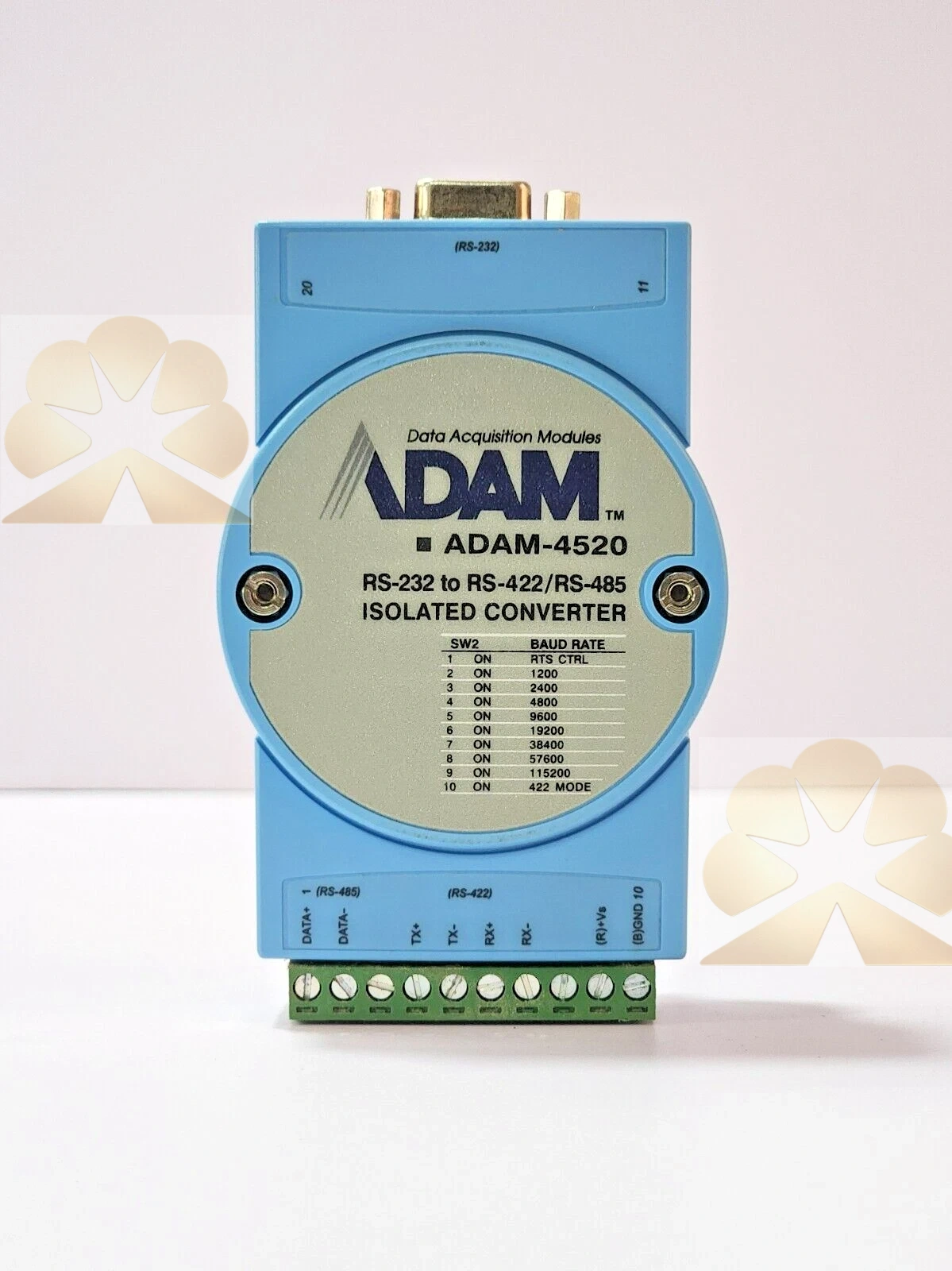
The ADVANTECH ADAM-4520 is an isolated serial communication converter from the Advantech ADAM-4000 module family. The ADAM-4520 model transparently converts RS-232 signals into RS-422 or RS-485 signals for industrial serial networking. It is designed to extend serial communication distance, connect an RS-232 host to a multi-drop RS-485 or RS-422 device network, and provide opto-isolation between the host side and the field bus side. Related ADAM models include the ADAM-4510 and ADAM-4510S RS-422/485 repeaters, but the ADAM-4520 specifically performs RS-232 to RS-422/485 conversion.
Product Function and System Role
The ADAM-4520 connects a host computer, PLC, serial controller or other RS-232 device to an RS-485 two-wire or RS-422 four-wire serial network. It translates the RS-232 serial interface into the differential signaling used by RS-422 and RS-485, allowing data exchange with remote ADAM I/O modules, serial instruments, drives, sensors or other field devices. The module supervises the internal RS-485 bus and does not require external flow control signals for RS-485 operation, simplifying half-duplex network wiring.
Serial Communication Specifications
The ADAM-4520 supports switchable baud rates of 1200, 2400, 4800, 9600, 19.2 kbps, 38.4 kbps, 57.6 kbps and 115.2 kbps. The default baud rate is 9600 bps. The module supports RTS control and switchable RS-422 mode. Networking distance is up to 4000 feet, or 1200 m. The RS-232 interface uses a female DB-9 connector, while the RS-422/RS-485 interface uses a plug-in screw terminal block. Transient suppression is provided on RS-485 data lines.
Isolation and Electrical Protection
The ADAM-4520 provides opto-isolation with a minimum isolation voltage of 3000 V DC. This isolation protects the host computer or controller from ground loops, voltage spikes and bus-side transients that can occur in industrial serial networks. The isolated converter separates the RS-232 host side from the RS-422 or RS-485 field bus, reducing noise-induced communication faults in long or electrically noisy installations.
Power Supply and Consumption
The module operates from an unregulated DC supply of plus 10 to plus 30 V DC. Power ripple must be limited to 200 mV peak to peak, while supply voltage remains within the plus 10 to plus 30 V DC range at the module connector. Typical power consumption is 0.8 W at 24 V DC, and maximum power consumption is 1 W at 24 V DC. Power wiring uses red for plus Vs and black for GND, according to the standard ADAM color convention.
Mechanical Construction and Mounting
The ADAM-4520 housing is ABS and PC with captive mounting hardware. It is supplied with a DIN-rail mounting adapter and a panel mounting bracket. The plug-in screw terminal accepts AWG 12 to 22, or 0.5 to 2.5 mm², wire. The compact module mounts on a standard DIN rail or inside a control panel, making it suitable for cabinet-mounted serial communication links in industrial automation and building control systems.
Environmental Ratings
Operating temperature ranges from minus 10 to plus 70 degrees Celsius, equivalent to 14 to 158 degrees Fahrenheit. Storage temperature ranges from minus 25 to plus 85 degrees Celsius, or minus 13 to 185 degrees Fahrenheit. Humidity is 5 to 95 percent, non-condensing. These ratings support general industrial and commercial control cabinet installations where the module is protected from direct weather exposure.
LEDs and Diagnostics
The ADAM-4520 provides power and data flow indicator LEDs for troubleshooting. In RS-485 mode, green indicates idle, dark indicates RS-232 to RS-485 direction, and red indicates RS-485 to RS-232 direction. In RS-422 mode, dark indicates idle, green indicates RS-232 to RS-422 direction, and red indicates RS-422 to RS-232 direction. The LEDs help verify communication direction, link activity and basic serial connection status during commissioning or fault diagnosis.
Typical Application Scenarios
Typical applications include connecting an RS-232 PC or PLC to an ADAM-4000 remote I/O network, linking serial instruments, drives, meters or sensors over RS-485, extending serial communication beyond RS-232 distance limits, building multi-drop RS-485 or RS-422 networks, and isolating host serial ports from field bus noise. Common industries include factory automation, process control, material handling, energy management, building automation and retrofit serial communication installations.
Installation and Wiring Notes
Install the ADAM-4520 on the DIN rail or panel bracket, connect the 10 to 30 V DC supply, wire the RS-232 host to the DB-9 connector, and connect the RS-422 or RS-485 field bus to the screw terminals. Use shielded twisted-pair cable complying with the EIA RS-485 standard to reduce interference. Standard communication colors are DATA plus yellow and DATA minus green. Termination resistor jumpers should be set according to RS-485 or RS-422 network requirements; default jumper settings are pin 2 to 3 short. Verify baud rate, RTS control, RS-422 or RS-485 mode and termination before commissioning.
Advantages and Selection Notes
The ADAM-4520 offers transparent RS-232 to RS-422/485 conversion, 3000 V DC isolation, up to 115.2 kbps baud rate, 1200 m network distance, DIN-rail or panel mounting, LED direction indication, transient suppression and no external RS-485 flow control requirement. When selecting a converter, confirm whether the network requires RS-485 two-wire or RS-422 four-wire operation, verify supply voltage and cable type, and match isolation and termination requirements. The ADAM-4520 is a serial communication converter, not an I/O module, controller, power supply or field sensor; its role is to interface and isolate an RS-232 host with an RS-422 or RS-485 serial bus.
Get a Quote