
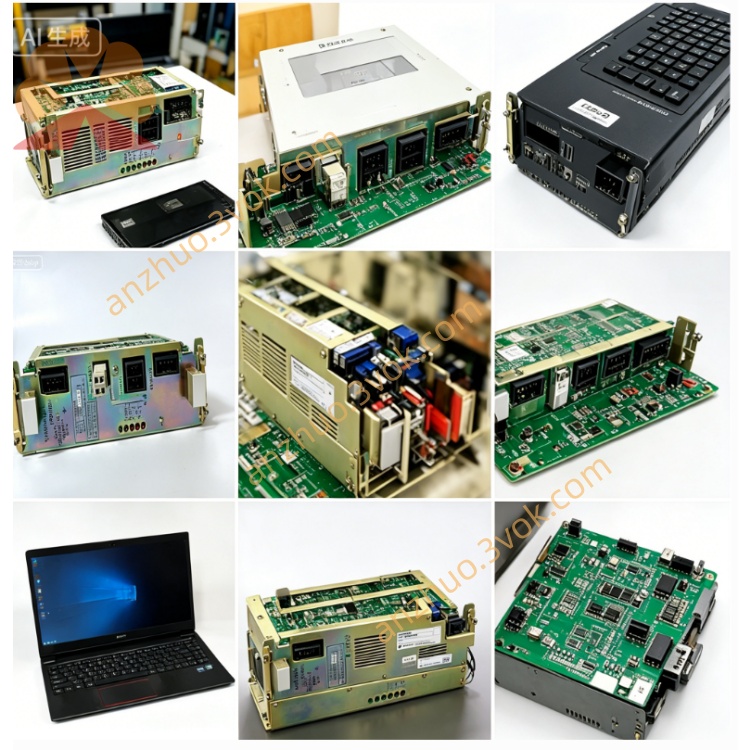
SGDK-3030AEA
Description
1. Model Definition & Product Overview
SGDK = Special CNC dedicated Servopack series (Yaskawa & Siemens joint production for 810D/840DI CNC system)
3030 = Dual independent 3.0kW (3kW+3kW) two-axis integrated drive
A = Input specification: 3-phase AC200~230V 50/60Hz
E = Multi-control mode unit: Pulse position / Analog speed / Analog torque 3 modes switchable by parameter
A = Standard factory standard option (no custom terminal modification, standard CN1 connector layout)
2. Basic Electrical Specifications
2.1 Power Ratings
2.2 Control Hardware & Interface
CN1 (50pin standard control connector): Dual-axis shared control terminal, receive CNC pulse command/±10V analog speed reference, servo enable, fault output, digital IN/OUT for both Axis1 & Axis2, differential/open-collector pulse input, max pulse frequency 500kpps, electronic gear ratio programmable separately per axis.
CN2 / CN3 Dual encoder ports: CN2 for Axis1 serial encoder, CN3 for Axis2 serial encoder; compatible 17bit incremental serial encoder, optional battery-powered absolute encoder for CNC zero-point retention.
Built-in RS485 serial communication: Connect SigmaWin+ parameter software for parameter upload/download, auto-tuning, real-time axis monitoring, fault history check.
Independent dual-axis closed-loop control: Axis1 and Axis2 operate fully independently, separate parameter group, separate overcurrent/overload/overheat protection for each channel.
2.3 Working Control Modes (Parameter configurable)
Position Control: Pulse command from CNC controller (differential line driver / open collector input), widely used for CNC feed axis positioning
Analog Speed Control: ±10VDC analog voltage from CNC spindle/axis board for continuous speed regulation
Analog Torque Control: ±10VDC torque reference for tension control or special CNC rigid tapping application
3. Installation & Environmental Requirements
4. Wiring Safety & Wiring Rules
Important Safety Warning
Main power terminals R/S/T: Connect 3-phase AC200~230V main input power; PE protective ground terminal must reliably connect equipment earth ground.
Axis1 motor terminals U1/V1/W1 → 3kW Axis1 servo motor power leads; Axis2 U2/V2/W2 → Axis2 servo motor power leads, strictly no cross connection between two axes.
CN2 encoder cable → Axis1 motor encoder; CN3 encoder cable → Axis2 motor encoder; all signal cables use shielded wire with single-side grounding for shielding layer.
CN1 control cable connect CNC system control signal per standard SGDK-AEA pin definition (no customized pinout for suffix A version).
Separate high-current power cable and low-voltage control/encoder cable routing to avoid electromagnetic interference causing position drift or random servo alarm.
5. Commissioning Step-by-Step Guide
Pre-power check: Double-check main power, dual motor power, dual encoder, CN1 control wiring correctness, confirm no short circuit between terminals.
Power on the unit, complete internal self-diagnosis; confirm no hardware fault alarm codes displayed on front panel LED.
Execute Axis1 no-load auto-tuning first: automatically identify motor resistance, inductance, optimize servo gain parameters; repeat same auto-tuning operation for Axis2 separately.
Set control mode and related motion parameters (electronic gear ratio, speed limit, acceleration/deceleration value) respectively for Axis1 & Axis2 per CNC machine specification.
Low-speed jog test without mechanical load for each axis individually, verify smooth rotation without abnormal noise/vibration; after jog test pass, install mechanical load and complete formal CNC linkage running test.
6. Standard Alarm Codes & Troubleshooting Guide
| Alarm Code | Fault Description | Root Cause & Solution |
|---|---|---|
| A.10 | Overcurrent per axis | Motor winding short, U/V/W wiring wrong, IGBT module damage; power off inspect cable insulation and power module |
| A.20 | Encoder fault (Axis1/Axis2) | Loose CN2/CN3 connector, broken encoder wire, encoder damage; replace defective cable |
| A.30 | Main circuit undervoltage | AC input voltage insufficient, unstable power supply, loose main terminal screw |
| A.40 | Overheat protection | Long-time continuous overload, fan failure, poor cabinet ventilation; clean fan dust or improve cooling |
| A.02 | EEPROM parameter error | Internal memory data corruption; reset factory parameter and redo auto-tuning |
7. Periodic Maintenance Specification
Every 3 months: Clean cooling fan and internal accumulated dust inside chassis, check terminal screw tightness to avoid loose contact overheating failure.
Every 6 months: Check encoder cable aging and shielding grounding status, inspect fan running noise for abnormal wear.
Long-term storage over 12 months: Pre-power on no-load running for 40min before formal machine installation to activate internal capacitor.
Get a Quote