
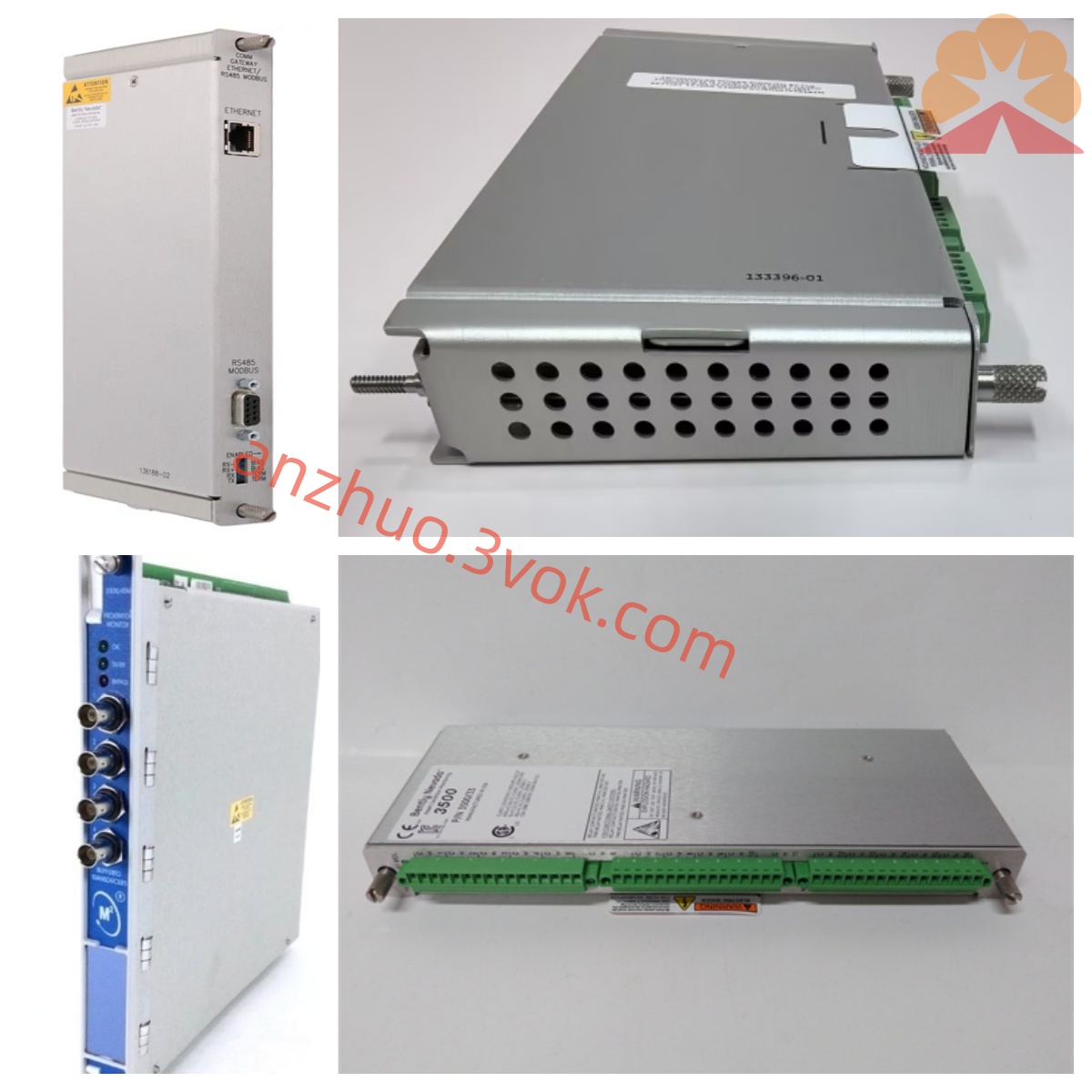
Bentley 3300/16-05-02-00-00-00-00 Dual-channel Vibration Monitor Detailed Product Description
Description
Bentley 3300/16-05-02-00-00-00-00 Dual-channel Vibration Monitor Detailed Product Description
I. Product Overview
The Bentley 3300/16 is a standard rack-mounted monitoring module within the Bentley Nevada 3300 series of rotating machinery protection system. 3300/16-05-02-00-00-00-00 is the dedicated configuration version of this model, and the product fully complies with the API 670 rotating machinery protection industry standard. The equipment adopts a 19-inch standard cabinet single-slot plug-in modular design, which can be directly installed on the 3300 series dedicated system rack, and can be seamlessly compatible and integrated with the same series eddy current probes, preamplifiers, high-frequency extension cables, and DC power supply modules. This equipment is widely used in power, petrochemical, metallurgy, coal chemical, and other fields, mainly targeting key rotating equipment such as steam turbines, gas turbines, centrifugal compressors, large fans, industrial pump sets, and medium/large-sized motors, to achieve real-time monitoring, status alarm, and safety interlock protection of two paths of vibration. It is the core device for shaft system, bearing condition management, and equipment safety protection.
II. Model Code Interpretation
3300/16 is the main product model, representing a dual-channel vibration monitoring module. The model suffix consists of seven two-digit digit codes, which define the channel type, measurement range, analog output, alarm logic, sensor diagnosis, hardware version, certification, and additional functions. The specific meanings of each section of this model are as follows.
The first section code 05 represents the channel configuration type, which is a basic dual-channel radial vibration input configuration. The two channels are independent and can collect radial vibration signals in the X and Y directions of the rotating shaft. It is suitable for the conventional dual-probe vibration monitoring layout.
The second section code 02 represents the standard measurement range of the equipment. The vibration measurement range is 0 to 2 millimeters peak-to-peak, suitable for medium-sized and large-sized rotating equipment with high vibration amplitudes and low-speed heavy-load units.
The third section code 00 represents the analog output configuration. This model does not have an external analog output function and only retains local display and relay switch output.
The fourth section code 00 represents the alarm logic setting. It adopts the factory default general alarm logic and has no customized channel voting, special interlocks, delay actions, etc. expansion functions.
The fifth section code 00 represents the sensor circuit diagnosis configuration. The original factory standard full circuit fault diagnosis function is enabled, which can monitor the operation status of the probe, extension cable, and preamplifier in real time.
The sixth section code 00 represents the hardware version. It is the original factory general standard hardware version, without special structural modification and customized hardware design.
The seventh section code 00 represents certification and additional functions. It is equipped with CE, UL, CSA international universal safety regulations certifications, without additional expansion functions and industry-specific customization requirements.
III. Core Functions
1. Dual-channel Independent Vibration Monitoring
The equipment is equipped with two completely independent measurement channels. It can be externally connected with two vertically arranged eddy current probes to collect radial vibration data in two directions of the shaft. The two channels do not interfere with each other in signal acquisition, processing, and logic output. If one channel fails, it will not affect the normal operation of the other channel. The redundant design of the dual channels enhances the operational reliability of the entire monitoring system.
2. Equipment Fault Prediction and Condition Monitoring
The equipment continuously collects and analyzes the amplitude changes of the shaft's radial vibration and can effectively identify typical rotating machinery faults such as rotor imbalance, shaft misalignment, bearing wear and aging, oil film vortexing, foundation loosening, and shaft bending. It can promptly capture abnormal operating conditions of the equipment and issue early warnings to avoid vibration exceeding limits, which may cause shaft friction, bearing burnout, and equipment shutdown, etc., major safety accidents.
3. Graded Alarm and Interlock Protection Each channel is independently equipped with one warning relay and one danger relay. The warning threshold and danger trip threshold can be independently set through local operation buttons. The rated specifications of the relay contacts are 250VAC and 3A. The contact mode supports on-site switching between normally open and normally closed, and can be configured to build interlock control circuits such as graded alarms and emergency shutdown according to the protection requirements of the unit operation.
4. Self-diagnosis of sensing circuit faults
An all-weather circuit detection program is built-in, and the entire sensing system composed of eddy current probes, high-frequency extension cables, and preamplifiers is monitored in real time. When faults such as open circuit, short circuit, signal beyond the measurement range, or abnormal power supply occur in the circuit, the equipment will immediately trigger a sensor fault alarm, mark the abnormal channel, and shield invalid signals to prevent false alarms and false trips caused by sensor faults.
5. On-site display and parameter configuration
The body is equipped with an LED digital display and physical operation buttons. Maintenance personnel can directly view real-time vibration values, probe gap voltage, channel operation status, alarm and fault information on-site. The equipment supports on-site setting of all parameters such as vibration range, alarm threshold, frequency response range, relay working mode, and fault determination rules. All parameter settings are automatically saved after completion, and the data will not be lost after power failure. No external upper-level software is required to complete all on-site debugging.
6. Programmable frequency response
The equipment provides two frequency response modes for on-site switching. The low-frequency mode is suitable for low-speed and heavy-load rotating equipment, while the high-frequency mode is suitable for high-speed turbine units. It can match the vibration frequency characteristics of different rotational speed equipment to ensure measurement accuracy under different working conditions.
IV. Working Principle
This module operates based on the mature non-contact eddy current measurement principle. High-frequency alternating current is introduced into the eddy current probe, and when the probe approaches the surface of the metal shaft, the metal layer will induce eddy current. During the shaft rotation process, radial vibration will occur, causing the gap between the probe and the shaft to change dynamically, thereby changing the eddy current intensity and the equivalent impedance of the probe. The changed signal is transmitted through the high-frequency coaxial extension cable to the preamplifier, which completes signal amplification, shaping, temperature compensation, etc., and outputs a linear DC voltage signal sent to the 3300/16 monitoring module.
The internal circuit of the module analyzes and processes the input signal, extracts the dynamic vibration component, and converts it into the peak value of vibration. The system compares the measured vibration values with the preset warning and danger thresholds. When the conditions are met, it drives the corresponding relay to act and outputs a switch quantity interlock signal. This model has no analog output. All monitoring data is displayed only on the local display screen. The two channels independently complete signal processing and logic determination, combined with the circuit diagnosis function, to achieve stable and continuous vibration monitoring and equipment protection.
V. Main Technical Parameters
1. Input and Adaptation System
The entire machine is equipped with two independent eddy current signal input interfaces, fully compatible with the eddy current probes of the 3300XL series of Bechtel, the preamplifiers of the 330180 series, and the high-frequency extension cables of the 330130 series. The input impedance of the equipment is 10kΩ, which can perfectly match the output characteristics of the accompanying sensing equipment. The standard working gap voltage range is - 4VDC to - 20VDC, and the standard working point is - 12VDC.
2. Measurement Performance Parameters
The standard vibration measurement range of the equipment is 0 to 2 millimeters peak-to-peak, and it supports small-scale range adjustment in the field. Under normal temperature conditions, the full-scale measurement error of the equipment is no more than ±1%, and the measurement resolution can reach 0.001 millimeters, meeting the accuracy requirements of industrial equipment vibration monitoring. The frequency response is divided into two ranges, 1 to 600 Hz and 4 to 4000 Hz, covering the usage requirements of low-speed, medium-speed, and high-speed rotating equipment.
3. Output Electrical Parameters This model does not have an analog output interface. The relay output is 1 channel for warning and 1 channel for danger. The contact has an AC withstand voltage of 250VAC and a rated current of 3A. The normally open and normally closed modes can be switched on-site through programming.
4. Power Supply and Power Consumption
The equipment is powered by -24VDC DC supply. The allowable voltage fluctuation range is ±10% of the rated value. The power consumption of the entire machine under normal operating conditions is approximately 6W.
5. Environmental Parameters
The normal operating temperature range of the equipment is 0℃ to 60℃, and the storage temperature range is -40℃ to 85℃. The relative humidity of the working environment does not exceed 95%. The usage environment requires no condensation, no corrosive gases, and no large amounts of dust. The product has passed CE, UL, and CSA certifications, and the overall design and performance indicators comply with API 670 standard specifications.
6. Mechanical Structure Parameters
It adopts a 19-inch standard cabinet adapter structure. The single-slot plug-in installation design ensures that the entire machine weighs approximately 1.5 kilograms. The body is designed with industrial-grade anti-vibration and anti-electromagnetic interference, capable of adapting to the complex mechanical and electromagnetic environment of industrial sites.
Six. Installation and System Configuration
1. Rack Installation
The module is of plug-in structure. It can be directly inserted into the idle slot of the 3300 series dedicated system rack to complete fixation. The installation and disassembly operations are simple and convenient, and the layout is regular, fully meeting the standards for industrial control room cabinet installation.
2. Sensor Installation
Two eddy current probes are arranged perpendicularly in the outer side of the measured shaft, adjusting the probe installation gap to make the gap voltage stable at around -12VDC, ensuring that the probes always work within the linear measurement range. After installation, lock the probe fixing device to prevent the probe from moving during equipment operation.
3. On-site Wiring
The equipment wiring is divided into -24VDC power supply wiring, two sensor signal wiring, and relay interlock wiring. During the wiring process, strictly distinguish the polarity and signal type of the lines according to the terminal markings on the body. After wiring, check the tightness of the connections one by one to prevent false connections and incorrect connections.
4. Parameter Configuration
After the equipment is powered on, enter the configuration menu through the panel operation buttons, and complete the settings of vibration range, warning threshold, danger threshold, frequency response gear, relay contact mode, and fault alarm rules. All parameters are automatically saved and will not be lost upon power off. All debugging work can be completed on-site.
Seven. Typical Application Scenarios
In the power industry, it is mainly applied to steam turbine generator sets, gas turbine generator sets, large cooling fans, etc., for monitoring the radial vibration of the shaft system, protecting the main shaft and support bearings, and ensuring the long-term stable operation of the unit. In the petrochemical industry, it is widely used in centrifugal compressors, process turbines, large oil pumps, etc., effectively preventing rotor and stator scraping and blade damage caused by vibration exceeding the limit. In the metallurgical and general industrial fields, it is adapted to large exhaust fans, blowers, heavy-duty industrial pumps, and medium-sized motors, etc., for real-time monitoring of the shaft system operation status and early detection of bearing damage and shaft instability. It is also applicable to various medium and low-speed, heavy-load rotating machinery, providing vibration monitoring and safety interlock protection during the entire cycle of equipment startup, load regulation, and steady operation.
Eight. Product Features and Advantages
First, the range adaptation is strong. The 0 to 2mm peak-to-peak range is designed for medium-sized and low-speed heavy-load equipment, matching the conventional vibration amplitude range of such equipment, with a wider applicability. Second, the structure is simple and reliable. Without analog output, it focuses on vibration monitoring and switch quantity interlock functions. The hardware structure is simple, with fewer fault points, and lower operation and maintenance costs. Third, the protection capability is complete. The dual-channel independent operation is combined with the full-loop fault diagnosis function, which can quickly identify various faults in the sensing circuit and effectively reduce the probability of false alarms and false trips. Fourth, excellent measurement performance. It adopts non-contact eddy current measurement technology, with no mechanical wear on the probe. Combined with high-precision signal processing circuits, the measurement values are stable, and the parameter drift is small during long-term operation. Fifth, strong environmental adaptability. It features industrial-level hardware design, with a wide temperature and humidity operating range, and possesses anti-vibration and anti-electromagnetic interference capabilities. It can operate continuously in dusty and vibration-intensive harsh industrial sites for a long time. Sixth, convenient operation and maintenance. It has complete local display and configuration functions. On-site, one can quickly view the status, troubleshoot faults, and modify parameters. The modular plug-in design supports rapid replacement of spare parts, effectively shortening the equipment downtime. Seventh, high interface universality. The relay contacts are of industry-standard specifications, which can directly connect to the original interlock circuits of various units. The on-site logic setup is simple.
IX. Complementary Components
This monitoring module needs to be combined with components of the same series to form a complete monitoring system. The core complementary components include the 3300XL series eddy current probes, which are selected based on the measured shaft diameter, on-site installation space, and working conditions; the 330180 series preamplifiers, which are responsible for powering the probes and completing pre-processing such as original signal amplification and compensation; the 330130 series high-frequency coaxial extension cables, which are used to extend the signal transmission distance and are suitable for the spacing between on-site equipment and control room cabinets. The entire system also requires the 3300 series standard installation racks and -24VDC dedicated power supply modules to provide installation support and stable working power for the monitoring module and sensing components.
Get a Quote