
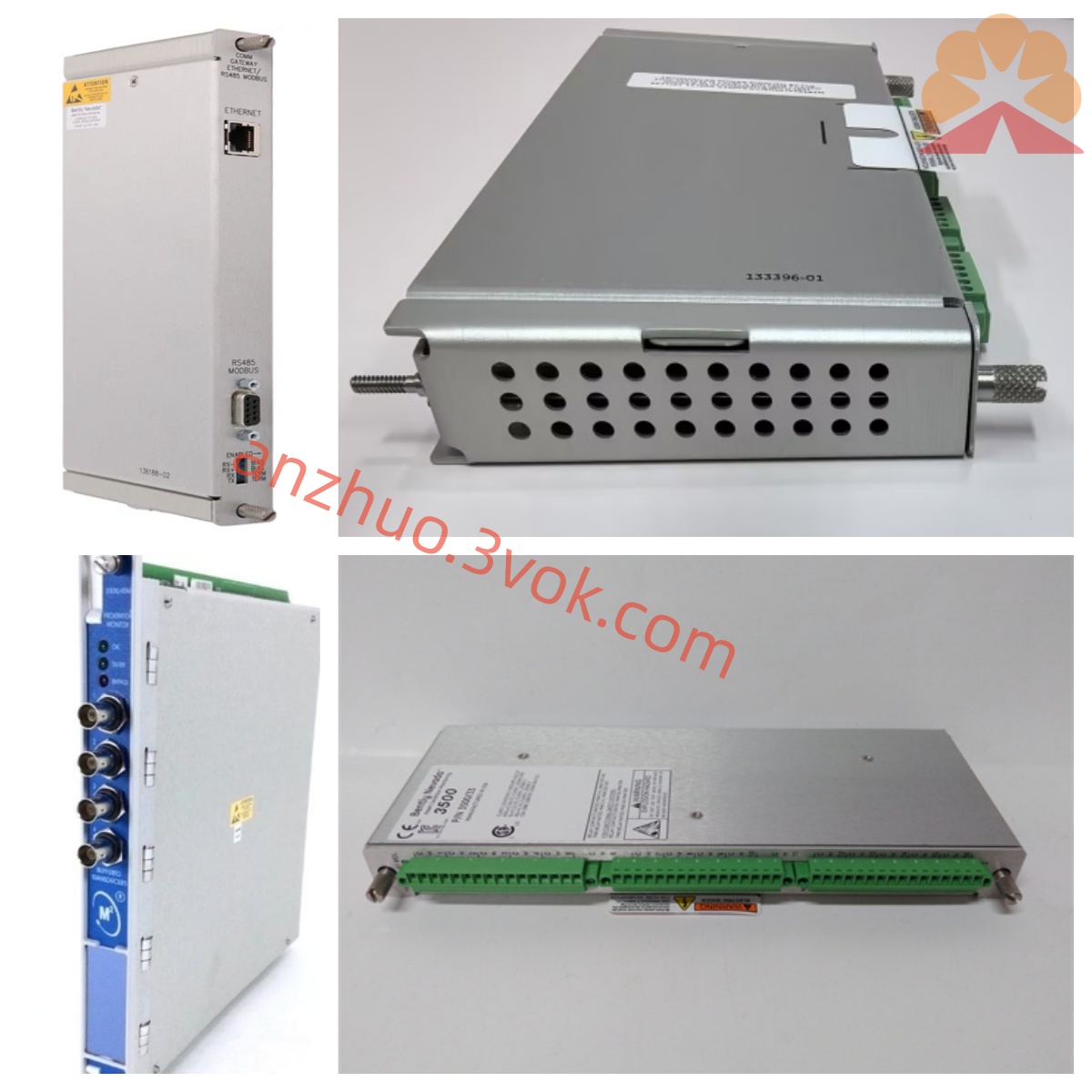
Bently Nevada 3300/36-03-11-01-00 Relay Output Module
Description
Bentley 3300/36-03-11-01-00-00 Temperature Monitoring Module Detailed Product Description
I. Product Overview
The Bentley 3300/36-03-11-01-00 is a dual-channel temperature monitoring module within the 3300 series TSI (Turbo Generator Instrumentation) system of Baker Hughes (formerly GE Bentley Nevada). It is specifically designed for the temperature monitoring of key components such as bearings, stator temperatures, and winding temperatures of large rotating machinery (such as steam turbines, generators, gas turbines, compressors, etc.) in industries such as thermal power, nuclear power, petrochemicals, and metallurgy. The module adopts a 19-inch standard rack structure, supports hot swapping, and can be installed together with other monitoring modules of the 3300 series, sharing the backplane - 24V DC power supply and system bus; it is compatible with RTD (Platinum Resistance Pt100) temperature sensors, providing high-precision temperature measurement, dual-level alarms, isolated analog output, and comprehensive self-diagnosis functions, in accordance with API 670 standards, and is the core equipment for thermal protection of rotating machinery.
II. Model Coding Rules (3300/36-AA-BB-CC-DD-EE)
3300: The 3300 series modular TSI system of Bently, featuring a unified rack, centralized power supply, and hot-swappable architecture.
36: Function code, representing a dual-channel temperature monitoring module, independently monitoring 2 temperature signals.
03: Range code, corresponding to a measurement range of **0–200℃**, suitable for common bearing / equipment temperature monitoring scenarios.
11: Sensor type and wiring code, compatible with Pt100 platinum resistance, 3-wire wiring, and industrial standard temperature sensor configuration.
01: Relay configuration code, equipped with dual-channel SPDT relays, corresponding to two levels of alarms (ALERT and DANGER), providing early warnings for faults (short circuit, poor contact, etc.).
00: Certification level code, representing general industrial-grade certification, suitable for common industrial environments.
00: Safety barrier configuration code, representing no built-in safety barrier, only applicable to non-explosion-proof areas.
III. Core Functions
1. Dual-channel High-Precision Temperature Measurement
Independent 2-channel temperature input, each channel compatible with Pt100 platinum resistance (3-wire wiring), measurement range 0–200℃, covering normal operation and abnormal temperature intervals of rotating machinery bearings, stators, etc.; high-precision signal conditioning circuit, measurement accuracy ≤ ±0.5% full scale (25℃), resolution 0.1℃, capable of accurately capturing minor temperature changes; supports 3-wire wiring, effectively eliminating cable resistance errors, ensuring long-term measurement stability; real-time monitoring of sensor circuit status, providing early warnings for broken wires, short circuits, poor contact, etc.
2. Dual-level Alarm and Relay Output
Each channel independently configures **ALERT (warning) and DANGER (danger)** two-level alarm thresholds, which can be set locally on the panel or remotely, suitable for different equipment temperature protection requirements; equipped with 2 epoxy resin-sealed SPDT relays, contact specifications 250V AC/5A, 30V DC/5A, capable of directly driving audible and visual alarms, DCS/PLC interlock circuits, or shutdown protection devices; alarm delay adjustable from 0 to 10 seconds, filtering instantaneous temperature fluctuations, avoiding false alarms; relay status and module operation status are linked, automatically triggering alarms when faults occur, ensuring timely response to abnormalities.
3. On-site Display and Convenient Configuration
The front panel is equipped with an LCD digital display window and multiple status LED indicators, capable of real-time display of 2 temperature measurement values, sensor circuit resistance, alarm thresholds, and fault codes; OK, ALERT, DANGER, BYPASS four groups of LEDs, corresponding to normal operation, warning alarm, danger alarm, and module bypass status, the operating status is clearly visible; supports button-based on-site configuration, without the need for an upper computer to complete range calibration, alarm threshold setting, delay parameter adjustment, sensor type matching, wiring method configuration, etc., debugging is efficient and convenient.
4. Isolated Analog Signal Output
Provides 2 isolated buffered analog outputs (1 per channel), configurable to select 4–20mA current signal or 0–10V voltage signal, output signal and power supply, input signal are electrically isolated with a strength of ≥2500V AC, effectively suppressing industrial site electromagnetic interference; output content is the real-time temperature value, can be connected to recorders, DCS systems or data acquisition platforms, for temperature trend analysis, fault traceability, and data archiving, supporting equipment status assessment and preventive maintenance.
5. Comprehensive Self-Diagnosis and Fault Identification The 24-hour uninterrupted monitoring module continuously monitors its own hardware, sensor circuits, power supply status, and signal integrity, accurately identifying issues such as sensor breakage / short circuit, wiring errors, circuit resistance exceeding limits, power fluctuations, and module circuit faults; distinguishing between real temperature anomalies and sensor / circuit faults, with the panel LED clearly indicating the fault type, combined with local display of fault codes, facilitating rapid troubleshooting and maintenance, and reducing the risk of equipment downtime.
6. System Integration and Anti-interference Capability
Metal shielding shell design, multiple electrical isolation between input, output, and power circuits, suitable for industrial environments with strong electromagnetic interference from thermal power, nuclear power, petrochemicals, etc.; compatible with the 3300 series system bus (Type A), capable of connecting to the Bently System 1 equipment status monitoring platform to achieve remote configuration, real-time data transmission, historical trend query, fault warning analysis, etc., integrating into the enterprise equipment management system; supports seamless connection with DCS, PLC, etc., meeting factory automation integration requirements.
IV. Detailed Technical Parameters
Measurement Parameters
Monitoring Channels: 2 independent temperature measurements (compatible with Pt100 platinum resistance)
Sensor Type: Pt100 platinum resistance (3-wire system, 0.00385 temperature coefficient)
Measurement Range: 0–200℃
Measurement Accuracy: ≤±0.5% of full scale (25℃, typical value)
Resolution: 0.1℃
Input Impedance: ≥1MΩ (per channel)
Circuit Resistance: ≤50Ω (3-wire system, single cable)
Electrical Parameters
Operating Power Supply: -24V DC (±10%), backplane power supply; supports short-circuit switching - 18V DC
Power Consumption: Typical 1.5W, maximum ≤3W
Relay Output: 2 SPDT (ALERT+DANGER), 250V AC/5A, 30V DC/5A
Analog Output: 2 isolated, 4–20mA or 0–10V selectable
Isolation Strength: Input / Output / Power Supply ≥2500V AC
Sensor Power Supply: Constant current excitation, suitable for Pt100 measurement requirements
Environmental and Mechanical Parameters
Operating Temperature: 0℃~+65℃ (standard industrial grade)
Storage Temperature: -40℃~+85℃
Relative Humidity: 5%–95% (no condensation)
Installation Method: 19-inch standard rack slot, supports hot swapping
Dimensions: 203mm (height) × 330mm (depth) × 51mm (width)
Weight: Approximately 1kg
Protection Grade: IP20 (suitable for installation in control cabinets)
Certifications and Compliance
Industry Standards: Compliant with API 670 Rotating Machinery Monitoring Protection Standard
Electromagnetic Compatibility: CE Certification, complies with EN 61000‑6‑2/4
Safety Certification: UL Certification
Environmental Compliance: RoHS Directive Compliance
V. Typical Application Scenarios
Power Industry (Thermal Power / Nuclear Power Turbines / Generators): Monitoring bearing temperatures, stator winding temperatures, core temperatures, preventing overheating that leads to bearing burnout, insulation aging, and equipment damage; temperature protection during startup acceleration, normal operation, and shutdown rotation, triggering alarms or interlocks for overtemperature.
Petrochemical Industry (Large-scale Process Compressors / Turbines): Monitoring sliding bearing temperatures, sealing chamber temperatures, suitable for high-temperature, high-pressure, and corrosive industrial environments, preventing overheating that causes bearing wear, seal failure, and medium leakage, ensuring continuous production.
Metallurgical Industry (Large-scale Transmission Turbines / Generator Sets): Monitoring key bearings and equipment shell temperatures, dual-level alarm linkage for equipment operation interlocks, timely warning of overheating faults, reducing unplanned downtime risks, ensuring stable operation of the metallurgical process.
VI. Installation and Commissioning Specifications Installation Requirements
Rack Installation: Push the 3300 series rack slot smoothly and ensure that the rear connectors are fully engaged. Tighten the panel fixing screws to avoid loose connections that cause poor contact.
Sensor Wiring: Connect the Pt100 platinum resistance according to the 3-wire system as indicated by the module terminals. Use high-temperature-resistant shielded cables with the shielded layer grounded at one end (on the control cabinet side) to avoid circulating interference; distinguish between power lines and signal lines during wiring to prevent incorrect connections and damage to the sensor or module.
Alarm and Output Wiring: Distinguish between ALERT and DANGER relay contacts and connect them to the alarm/interlock circuit; connect the analog output terminals according to the DCS/record仪 interface requirements and confirm the correct signal polarity.
Sensor Installation: Place the Pt100 probe closely against the surface of the measured equipment (bearing seat, stator core, etc.), fix it with conductive glue to ensure accurate temperature measurement; secure the probe cable firmly to avoid vibration wear or broken wires.
Debugging Steps
Power-on Self-Test: The module will automatically perform self-checking after power-on. A steady OK light indicates normal hardware, while a fault light indicates a problem. Check the wiring or hardware if the fault light is on.
Sensor Calibration: Enter the calibration mode through the panel buttons, select the Pt100 sensor type and 3-wire connection, calibrate the resistance of the calibration circuit and the temperature relationship to ensure measurement accuracy.
Alarm Settings: Set the warning threshold (e.g., 120°C) and danger threshold (e.g., 150°C) according to the equipment operation standards, adjust the alarm delay (e.g., 2 seconds), and save the parameters.
Signal Verification: During equipment operation, observe whether the 2-channel temperature values on the panel are stable without jumps or drifts; check the resistance of the sensor circuit for normality and confirm that the signal is correct before putting it into operation.
Maintenance and Fault Troubleshooting
Daily Maintenance
Regular Inspection: Daily observe the temperature values on the panel, the circuit resistance, and the LED status to confirm no alarms or fault indications; check that the module terminal connections are not loose or oxidized, and that the rack ventilation and heat dissipation are good.
Annual Calibration: Use a standard temperature source to calibrate the temperature measurement accuracy annually, verify the accuracy of the relay alarm action values and delay, and ensure reliable monitoring and protection functions.
Cleaning and Protection: Regularly clean the module surface dust with a dry soft cloth to avoid dust accumulation affecting heat dissipation; strictly prohibit liquids and metal debris from entering the module interior.
Common Fault Troubleshooting
OK Light Goes Out (Module Failure): Check if the backplane power supply is normal (-24V DC), reinsert the module, and if the problem persists, replace the module.
Temperature Display Abnormal (Jumps / Drifts): Check if the Pt100 sensor wiring is loose or disconnected, if the circuit resistance is beyond the limit, and rewire or replace the sensor; check if the environmental temperature is outside the working range or if there is strong electromagnetic interference.
No Temperature Display: Check if the sensor is damaged, if the wiring is incorrect (3-wire connection error), if the sensor's excitation output is normal, and troubleshoot and replace the faulty component.
Alarm Mis-triggered: Re-calibrate the alarm threshold and delay parameters, check if the temperature signal is affected by interference, and optimize the sensor installation and wiring shielding measures.
VIII. Usage Notes
This model is not designed for explosion-proof use; it is strictly prohibited to install and use it in flammable and explosive hazardous areas.
It must be equipped with **Pt100 platinum resistance (3-wire system)** temperature sensors; do not mix with other types of sensors (such as thermocouples, Cu50), otherwise it will cause measurement errors or equipment damage.
It is only suitable for routine industrial environment temperature monitoring; for ultra-high temperatures (>200°C) or ultra-low temperatures (<0°C) scenarios, select the corresponding range module.
Do not disassemble the module, modify the internal circuitry, or replace non-original accessories without authorization; illegal operations will result in the invalidation of equipment warranty and may cause safety hazards.
Before connecting or inspecting the module, cut off the total power supply of the rack to prevent short circuits and electric shock accidents; Do not plug or unplug the module while it is energized.
When the equipment is to be shut down for a long time, it is recommended to remove the module from the rack and store it in a dry and cool environment to prevent damage to performance due to moisture or dust accumulation.
Get a Quote