
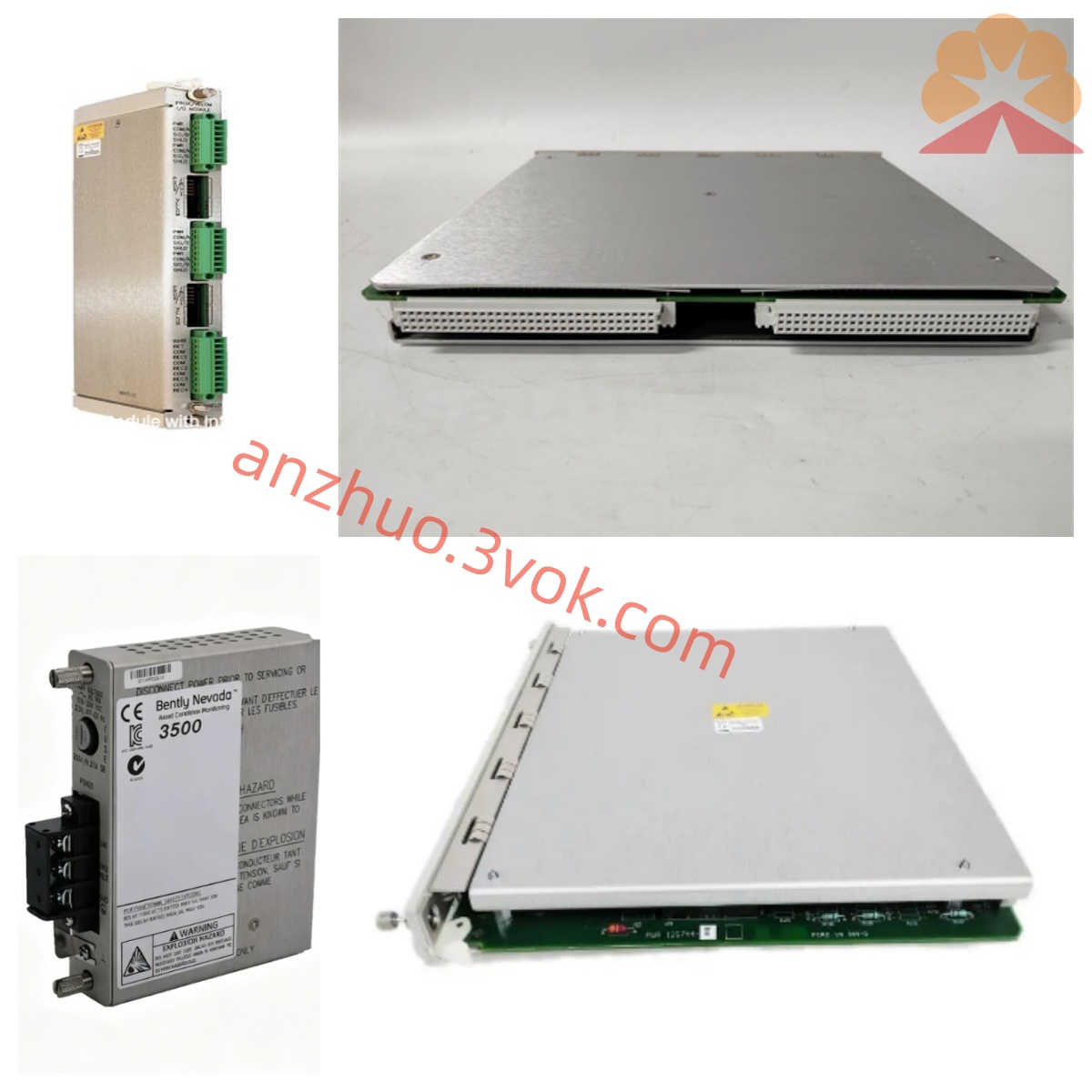
Bently Nevada 3300/48-03-02-01-00 Rack Chassis Module
Description
Bentley 3300/48-03-02-01-00 Shell Expansion Monitoring Module Detailed Product Description
I. Product Overview
The Bentley 3300/48-03-02-01-00 is a dual-channel shell expansion monitoring module (Case Expansion Monitor) of the 3300 series TSI (Turbo Generator Monitoring Instrument) system from Baker Hughes (formerly GE Bentley Nevada), specifically designed for precise online monitoring of the thermal expansion / thermal elongation of the shell of large rotating machinery (especially steam turbines) relative to the foundation, to prevent serious faults such as dynamic friction, misalignment, and excessive vibration of the unit caused by uneven thermal expansion, jamming, or blocked expansion.
This module adopts a 19-inch standard rack design, supports hot-swapping, and can be installed together with 3300 series vibration, shaft displacement, speed, temperature, etc. modules, sharing the backplane - 24V DC power supply and system bus. It is compatible with DC LVDT (Linear Variable Differential Transformer) displacement sensors, with dual-channel independent acquisition, supporting differential and independent monitoring modes, and includes dual-level alarm relays and hardware voting logic, suitable for industrial environments with high temperatures, high pressure, and strong electromagnetic interference. It is widely used in key equipment in the power, petrochemical, metallurgical, and other industries such as steam turbines, gas turbines, and large compressors, monitoring the axial and lateral thermal expansion of the cylinder / shell, ensuring uniform and controllable thermal deformation during unit start-up, shutdown, and load increase, and is one of the core modules for steam turbine safety monitoring.
II. Model Coding Rules (3300/48-XX-XX-XX-XX)
3300: Bentley 3300 modular TSI system, unified rack, centralized power supply, hot-swappable, multi-module mixed installation architecture.
48: Function code, shell expansion monitoring module (Case Expansion), monitoring the thermal expansion of the equipment shell.
The 1st position (sensor type / range): 03 = compatible with 3-inch LVDT, range 0–3 inches (0–76.2mm).
The 2nd position (relay configuration): 02 = dual relays (alert ALERT + danger DANGER).
The 3rd position (certification level): 01 = general industrial safety certification (in accordance with API 670).
The 4th position (safety barrier option): 00 = no safety barrier (not applicable in explosion-proof areas).
III. Core Functions
1. Dual-channel LVDT signal acquisition and differential / independent monitoring
Supports the connection of two DC LVDT displacement sensors to monitor the expansion on both sides (or axially / laterally) of the shell; provides two monitoring modes:
Differential mode: calculates the difference between the two signals to monitor the asymmetry of expansion on both sides and jamming, supports alarm threshold setting.
Independent channel mode: independently displays the expansion values of the two channels, used for monitoring the expansion value of a single end (no alarm).
Built-in signal conditioning circuit, compatible with original Bentley LVDT, input signal range ±10V, input impedance 10kΩ, strong anti-interference ability.
2. High-precision thermal expansion measurement
Range: 0–3 inches (0–76.2mm), programmable scaling.
Measurement accuracy: ≤±0.1% full scale (25℃), resolution 0.01mm.
Frequency response: DC–10Hz, compatible with the slow change characteristics of thermal expansion.
Sensor power supply: -24V DC (±10%), backplane unified power supply, supports short-circuit block switching - 18V DC for different LVDT.
3. Dual-level relay alarm output (ALERT + DANGER) Configure two channels of epoxy resin sealed SPDT relays, moisture-proof, dust-proof and anti-interference:
ALERT (Warning): Triggered when the expansion amount approaches the limit, reminding maintenance personnel to pay attention to the thermal expansion trend.
DANGER (Danger): Triggered when the expansion amount exceeds the limit or the differential deviation is too large,联动 interlock protection is activated.
Contact specifications: 250V AC/5A, 30V DC/5A. Can directly drive sound and light alarms, DCS/PLC or interlock circuits.
Alarm threshold and delay: Differential / independent mode thresholds are independently set, with a delay of 0–10 seconds adjustable. Filtering of instantaneous fluctuations is possible.
4. Front panel display and local configuration
Display: Dual analog dials + digital window, real-time display of two expansion values / differential difference values; 4 groups of LED (OK, ALERT, DANGER, BYPASS), intuitively indicating the running, alarm, bypass status.
Configuration: Keypad-based local programming, no need for an upper computer to set the range, alarm threshold, delay, LVDT calibration parameters, monitoring mode (differential / independent).
5. Isolation buffer signal output
The rear terminals provide two isolated analog outputs (4–20mA or 0–10V selectable), electrically isolated from the power supply and input signals ≥ 2500V AC, can send the expansion amount signal to the recorder, DCS, oscilloscope or external system for data recording, trend analysis and fault tracing.
6. Comprehensive self-diagnosis and fault identification
24-hour real-time monitoring: LVDT open circuit / short circuit, signal over-limit, power supply abnormality, module hardware failure, sensor calibration abnormality; can distinguish real expansion abnormalities from sensor / circuit faults, the panel LED clearly indicates the fault type, facilitating rapid troubleshooting.
7. Strong anti-interference and system integration
Metal shielding shell, input/output/power electrical isolation ≥ 2500V AC, anti-common-mode interference, suitable for variable frequency drives, high-voltage cabinets and other strong electromagnetic environments.
Compatible with 3300 series system bus (Type A), can be connected to System 1 status monitoring software, realize remote configuration, data storage, trend analysis, fault recording and remote access.
IV. Technical parameters
Measurement parameters
Monitoring channels: Dual channels (two LVDTs input independently).
Sensor compatibility: Original DC LVDT from Bently (3-inch range, 0–76.2mm).
Measurement range: 0–3 inches (0–76.2mm), programmable scaling.
Measurement accuracy: ≤ ±0.1% full scale (25℃), resolution 0.01mm.
Frequency response: DC–10Hz.
Input impedance: 10kΩ, input voltage ±10V peak.
Monitoring mode: Differential (with alarm), independent (without alarm).
Electrical parameters
Working power supply: -24V DC (±10%), backplane power supply; supports short circuit switching - 18V DC.
Power consumption: Typical 3W, maximum ≤ 4W.
Relay output: 2 SPDT channels, 250V AC/5A, 30V DC/5A.
Buffer output: 2 isolated analog signals (4–20mA/0–10V selectable).
Isolation strength: Input/output/power between ≥ 2500V AC.
Environmental and mechanical parameters
Operating temperature: 0℃~+65℃ (standard type).
Storage temperature: -40℃~+85℃.
Relative humidity: 5%–95% (no condensation).
Installation method: 19-inch standard rack slot, supports hot swapping.
Form size: 203mm (height) × 330mm (depth) × 51mm (width).
Weight: Approximately 1.6kg. Protection level: IP20 (installed inside the control cabinet).
Certification and Compliance
Industry standards: Compliant with API 670 Rotating Machinery Monitoring Protection Standard.
Electromagnetic Compatibility: CE certification, compliant with EN 61000-6-2/4.
Safety and Environmental Protection: UL certification, RoHS compliance.
V. Structural Design
Module: Integrated compact frame structure, divided into front panel, internal circuitry, and rear wiring terminals. The front panel integrates dual analog meters, digital display window, and multiple sets of LED status indicators, along with local operation buttons. It enables real-time viewing of two expansion values, differential differences, and alarm status, as well as parameter configuration, with intuitive and convenient operation. The internal circuitry includes dual LVDT signal conditioning units, differential calculation circuits, alarm comparison circuits, relay drive circuits, and self-diagnosis units. The functional zones are clearly defined, the layout is compact, and the metal shielding layer suppresses internal interference, ensuring long-term stable operation. The wiring terminals at the rear are clearly divided and marked, covering two LVDT inputs, relay outputs, buffer outputs, power supply and communication interfaces. The wiring is convenient and facilitates on-site construction and maintenance. The module and the frame use gold-plated connectors, ensuring reliable contact, wear resistance, and oxidation resistance. The hot-swappable process maintains stable electrical connection, and replacing the module does not require downtime, reducing the impact of maintenance on production.
VI. System Compatibility
Hardware Compatibility
Frame and Power Supply: Compatible with 3300 series 19-inch frames, power modules, and system monitoring modules. Can be installed with vibration, shaft displacement, speed, temperature, and other modules.
Sensors: Fully compatible with the original 3-inch range DC LVDT of Bently, and interchangeable with the same specification.
Output Connection: Relay contacts connected to audible and visual alarms, DCS/PLC, interlock circuits; Buffer outputs connected to recorders, oscilloscopes, external instruments.
Software Compatibility
Configuration Software: Compatible with the 3300 series dedicated configuration software, supporting remote parameter configuration, alarm logic editing, and firmware upgrade.
Monitoring Software: Connected to System 1 platform, achieving real-time data, trend analysis, fault recording, report generation, and remote access.
VII. Typical Application Scenarios
Power Industry: Monitoring of thermal expansion of high-pressure and intermediate-pressure cylinder shells in thermal power plants / gas turbine units, warning of uneven thermal expansion during start-up and shutdown, preventing dynamic friction and exceeding vibration limits, ensuring safe start-up and stable operation of the unit.
Petrochemical Industry: Monitoring of thermal expansion of large-scale process turbines, centrifugal compressors, etc., tracking thermal deformation under high-temperature conditions, alarming for excessive differential deviations, preventing equipment deformation and alignment failure that may cause production interruptions.
Metallurgical Industry: Monitoring of thermal expansion of high-pressure turbines, large transmission turbines, etc., monitoring the thermal expansion trend during start-up and load increase, dual-level alarm linkage interlock, reducing the risk of equipment failure shutdown.
VIII. Installation and Maintenance Specifications
Installation Requirements
Frame Installation: Push the frame smoothly into the vacant slot of the 3300 frame, ensure that the rear connectors are fully engaged, tighten the panel screws, and prevent loosening.
Sensor Wiring: Connect the two LVDT cables according to the channel markings, ground the shield layer at one end, and suppress electromagnetic interference.
Alarm Wiring: Distinguish between ALERT and DANGER contacts, connect to the alarm/interlock circuits, confirm the logic is correct.
Power On Configuration: Confirm normal -24V DC power supply, set the range, alarm threshold, delay, LVDT calibration parameters, monitoring mode, and save through the panel or software.
Sensor Installation: Fix the LVDT between the shell and the foundation, strictly control the installation gap and coaxiality, fix firmly, protect the cables, and avoid vibration wear. Check that the terminals are not loose, oxidized or overheated.
Calibration: Calibrate the accuracy annually using a standard displacement generator, in accordance with API 670 standards; regularly verify the linearity of the LVDT.
Cleaning: Regularly clean the dust on the module and the rack to ensure ventilation and heat dissipation, and avoid short circuits and poor heat dissipation caused by dust accumulation.
Replacement of spare parts: When the module, sensor, or cable is damaged, it is necessary to select the original Bentley components of the same model to ensure compatibility and measurement accuracy.
IX. Usage Precautions
This model is non-explosion-proof. Installation and use are strictly prohibited in flammable and explosive hazardous areas; for explosion-proof conditions, select the model with an intrinsic safety safety barrier.
It is necessary to use the original Bentley 3-inch range DC LVDT as a matching component. Different specifications of sensors cannot be mixed; otherwise, the signals will not match and the measurement will fail.
The installation gap and coaxiality of the LVDT must be strictly set according to the manual. Installation deviations will cause signal distortion and increase measurement errors.
It is prohibited to disassemble the module, modify the internal circuitry, or modify the sensor calibration parameters without authorization. Illegal operations will cause equipment damage and invalid warranty.
Before wiring, maintenance, or replacing the module, the power supply of the rack must be cut off to prevent short circuits and electric shock accidents.
The alarm threshold and delay must be set in combination with the unit's process. Improper parameters will lead to frequent false alarms or failure of warnings.
The installation location should be far away from power frequency converters, transformers, high-voltage cabinets and other strong electromagnetic interference sources to reduce signal interference and ensure stable monitoring.
Get a Quote