
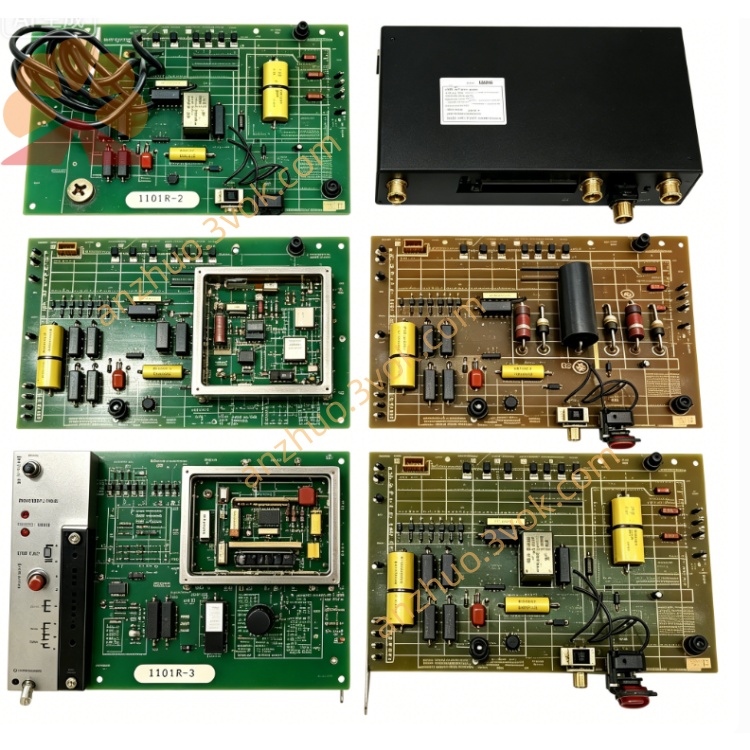
Reliance 410403-38AW
Description
Product Description
Model Number Interpretation
410403: Base part number for Reliance’s high-power thyristor module series, indicating a standard disk-type SCR construction.
38: Denotes 500 A average current rating and 1200 V peak reverse voltage (PRV).
AW: Designates the revision and packaging type, with epoxy encapsulation for enhanced durability and thermal resistance in industrial settings.
Technical Specifications
Device Type: Disk-type (hockey puck) thyristor (SCR), four-layer PNPN semiconductor.
Average On-State Current (It avg): 500 A (continuous, at case temperature 85°C).
Peak Reverse Voltage (Vdrm/Vrrm): 1200 V.
Surge Current (Itsm): 10 kA (non-repetitive, 10 ms half-cycle).
Gate Trigger Voltage (Vgt): 2.5 V (typical).
Gate Trigger Current (Igt): 150 mA (typical).
Operating Frequency: 50/60 Hz (standard industrial).
Thermal Resistance: 0.08°C/W (junction to case, double-sided cooling).
Operating Temperature: -40°C to +125°C (junction).
Mounting: Pressure-mounted between two heat sinks (double-sided heat dissipation).
Enclosure: Epoxy-encapsulated, rugged aluminum alloy and copper construction.
Weight: Approximately 1.8 kg.
Interface and Communication Configuration
Power Terminals: Two main power terminals (anode/cathode) for high-current AC/DC connection; central gate terminal for control signal input.
Control Interface: Gate terminal accepts low-power DC trigger signals (voltage/current) from drive control boards or gate drivers.
Communication: No built-in communication ports; operates as a passive power component controlled by external drive logic (PLC, drive controller) via hardwired gate signals.
Mounting Interface: Standard disk form factor with pressure clamps for secure installation in rectifier stacks or drive assemblies.
Core Functions
High-Power Rectification: Converts three-phase AC input to regulated DC output for DC motors, electrolysis, and power supply systems.
Phase Angle Control: Adjusts conduction angle via gate triggering to regulate output voltage/current, enabling precise speed/torque control in drives.
Bidirectional Heat Dissipation: Disk design allows double-sided cooling between heat sinks, supporting high-current operation with minimal thermal rise.
Surge and Overload Protection: Withstands high surge currents and transient voltages, protecting drive systems from electrical faults.
Legacy System Compatibility: Direct replacement for older Reliance thyristor modules, ensuring seamless integration with existing drive and control infrastructure.
Application Scenarios
Industrial DC Drives: Primary power component in Reliance MaxPak III, FlexPak, and WebPak series DC drives for 40–500 HP motors.
Heavy-Duty Motor Control: Used in conveyors, cranes, hoists, extruders, and rolling mills requiring high torque and precise speed regulation.
Power Conversion Systems: Rectification for industrial power supplies, battery chargers, and electrolysis processes in chemical and metalworking industries.
Legacy Automation Retrofits: Replacement part for aging Reliance drive systems in manufacturing, papermaking, textile, and material handling industries.
High-Current Phase Control: Applications requiring accurate power regulation, such as heating systems and industrial furnace controls.
Usage and Maintenance Instructions
Installation: Mount the module vertically between two clean, flat heat sinks with uniform pressure (torque clamps to manufacturer specifications); ensure proper alignment to avoid mechanical stress.
Wiring: Connect main power terminals to AC input/DC output with high-current copper busbars; use shielded, twisted-pair wires for gate control signals to minimize electrical noise.
Startup: Verify gate trigger voltage/current matches module ratings; test for short circuits between anode/cathode and gate before applying high power.
Routine Maintenance (Quarterly): Inspect heat sinks for dust buildup and clean with compressed air; check terminals for tightness, corrosion, or overheating signs; verify gate signal integrity.
Safety: Disconnect all power sources and wait for DC bus capacitors to fully discharge (minimum 5 minutes) before servicing; never operate the module without proper heat sinking
Get a Quote