
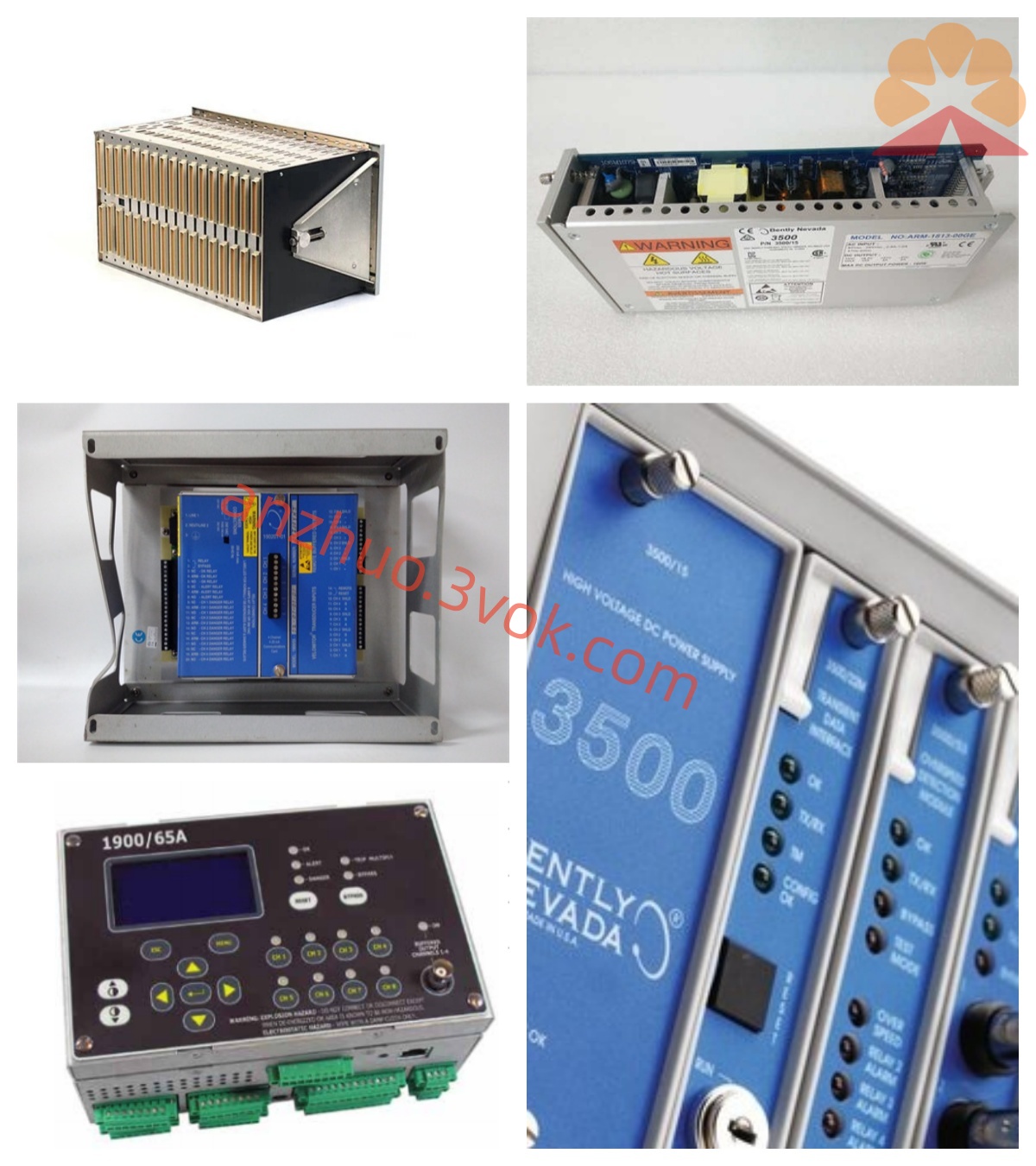
Bently Nevada 3300/80-02-00-00-00 Relay Output Module
Description
Bentley 3300/80-02-00-00-00 Dual-Channel Vibration Monitoring Module Detailed Product Description
I. Product Overview
The Bentley 3300/80-02-00-00-00 is a standard dual-channel vibration monitoring module within the 3300 series TSI turbine monitoring instrument system of Baker Hughes. It is specifically designed for radial shaft vibration monitoring of industrial large-scale rotating machinery. The module adopts a rack-mounted modular structure and supports hot-swappable operation. It is used in conjunction with the 3300 XL 8mm eddy current sensing system to complete the vibration acquisition, condition diagnosis, over-limit alarm, and safety interlock functions for two independent measurement points. The product strictly adheres to the API 670 industry standard, has strong overall anti-interference capability, and operates stably. It is mainly applied in ordinary non-explosion-proof areas of industries such as power, petrochemicals, and metallurgy, and is suitable for key equipment such as steam turbines, gas turbines, centrifugal compressors, generator sets, and large pump sets, enabling online equipment monitoring, fault warning, and shutdown protection.
II. Model Code Interpretation
3300: Represents the classic 3300 series modular TSI system of Bentley Nevada, installed in a standard 19-inch cabinet rack, supporting multi-module combination expansion, centralized power supply, and module hot-swappable replacement.
80: Module function code, defined as a dual-channel pure vibration monitoring module, featuring two completely independent signal input channels, solely used for radial shaft vibration measurement.
02: Input specification code, the module is compatible with 3300 XL series 8mm eddy current probes, extension cables, and preamplifiers, being the most common sensing matching type for this series.
00: Range and sensitivity configuration, the standard vibration measurement range is 0 to 2 millimeters peak-to-peak, corresponding to a sensitivity of 7.87V/mm, meeting the mainstream vibration monitoring range requirements.
00: Frequency response configuration, the effective frequency response range is 1 to 800 hertz, suitable for low-speed and medium-speed rotating units, capable of effectively capturing rotor fundamental frequency, harmonic frequency, and other fault characteristic signals.
00: Output and additional function configuration, this version does not include an external analog output interface, only retaining relay alarm output, status indication, and basic configuration functions, without additional custom expansion functions.
III. Core Functions
Dual-channel independent vibration monitoring, the two input channels' circuits are completely isolated and do not interfere with each other. They can simultaneously perform real-time continuous measurement of the radial vibration at two different positions of the equipment. A single module can achieve dual-measurement-point monitoring, effectively saving rack installation space.
Built-in OK fault self-check circuit, continuously monitoring the working status of the probe, extension cable, and preamplifier throughout the process, capable of accurately identifying abnormal issues such as sensor circuit breakage, short circuit, and signal over-limit, effectively differentiating between real mechanical faults and sensor component faults, significantly reducing the probability of on-site false alarms and false interlocks.
Multi-level alarm and interlock control, each channel can independently set warning and danger two-level alarm thresholds. The alarm delay supports programming adjustment, capable of avoiding false actions caused by instantaneous signal fluctuations. Each channel corresponds to two passive relay contacts, a total of four alarm contacts, which can be directly connected to the unit's audible and visual alarm circuit and safety shutdown interlock circuit.
High-precision signal processing, relying on mature signal conditioning and linearization circuits, ensuring measurement accuracy and linearity, capable of stably capturing typical mechanical problems such as rotor imbalance, shaft misalignment, contact and wear between moving and stationary components, and bearing faults.
Local status display and basic configuration, the module's front panel is equipped with multiple groups of LED status indicators, allowing for intuitive viewing of module operation, channel normality, warning, danger, bypass, etc. Status; supports local buttons to complete basic parameter settings and alarm logic configuration. High anti-interference design, with electromagnetic shielding treatment inside the module. Electrical isolation is achieved between input, output and power supply. It can resist electromagnetic interference generated by frequency converters, high-power motors and high-voltage equipment in industrial sites, ensuring long-term stable signals under complex working conditions.
IV. Technical Parameters
Measurement Parameters
The module contains two independent measurement channels. The standard vibration measurement range is from 0 to 2 millimeters peak-to-peak, matching the standard linear range of 8mm eddy current probes. The overall measurement linear error is no more than ±0.5% of the full scale, and the minimum measurement resolution is 0.01 millimeters. The frequency response range is from 1 to 800 hertz, meeting the monitoring requirements of most medium and low-speed rotating equipment. The alarm delay can be freely programmed and set within the range of 0 to 10 seconds. The factory default delay is 3 seconds. Electrical parameters
Module power supply is negative 24 volts DC, with a voltage fluctuation range of ±10%. The overall operating power consumption does not exceed 2.5 watts. The input circuit is standardly matched with 3300 XL 8mm eddy current preamplifier, and the input impedance complies with the general system standards. This model has no analog voltage or current output. The relay output is in the form of passive dry contacts, with a rated load of 250 volts AC and 3 amperes for a single contact, which can directly drive on-site alarms and interlock equipment. The module supports internal bus communication of the 3300 system and can be connected to the entire system for centralized status management. The input, output, and power supply circuits have high-voltage electrical isolation capabilities, with excellent common-mode interference resistance.
Environmental and mechanical parameters
The normal operating temperature range is from -40 degrees Celsius to +70 degrees Celsius, and the storage temperature range is from -40 degrees Celsius to +85 degrees Celsius. The relative humidity of the working environment is 0% to 95%, and condensation is not allowed. The 3300 series standard rack slot installation method is adopted, supporting hot swapping, and the module can be disassembled, replaced, and installed without power-off of the system. The module shell is made of metal panels combined with flame-retardant engineering plastics, with good seismic resistance, corrosion resistance, and oil resistance. The overall protection level is IP20, suitable for installation in the control cabinet.
Certification and compliance requirements
The product has CE electromagnetic compatibility certification, complying with the industrial site electromagnetic environment usage specifications. The design and manufacture fully follow the API 670 rotating machinery monitoring protection standard. This module has no explosion-proof structure, no built-in safety barrier, and is only allowed to be used in conventional non-flammable and non-explosive industrial areas.
V. Structural Design
The module is overall in a standard rack modular structure, mainly divided into the front panel, internal main circuit, and rear wiring terminals. The front panel integrates various status indicator lights and operation buttons, allowing operators to view the module's operating status, alarm information, and complete basic parameter settings on-site, with intuitive and convenient operation. The internal main circuit is divided into two completely independent signal processing units, corresponding to two measurement channels. Each unit integrates signal conditioning, filtering, fault detection, alarm comparison and other functional circuits, with no signal interference between channels, and high operational reliability. The rear wiring terminals are arranged in a partitioned layout, clearly dividing two probe input terminals, four relay alarm terminals, as well as power and system communication interfaces, with neat wiring, facilitating on-site wiring, troubleshooting, and daily maintenance. The module supports hot-swapping function, and replacing the module does not require shutting down the entire monitoring system, reducing the impact of equipment maintenance on the unit's operation.
VI. System Compatibility
At the hardware level, this module can perfectly adapt to the 3300 series standard rack, system power module, and system monitoring module. Different functional modules of the same series can be installed in the same rack for collaborative work. It is fully compatible with 3300 XL series 8mm eddy current probes, extension cables, and preamplifiers. Components of the same specification can be directly interchanged without recalibration. The relay alarm contacts can be connected to on-site sound and light alarms and unit safety interlock circuits. At the software level, it is compatible with the Bechtel supporting configuration software and System 1 equipment status monitoring software, enabling remote parameter configuration, operation data collection, trend analysis, fault record storage and query, and centralized management of the entire unit monitoring data after connecting to the system bus.
VII. Typical Application Scenarios
In the power industry, it is mainly used for radial vibration monitoring and over-limit protection of steam turbines in thermal power plants, nuclear power plants, gas turbines, power generation units, large feedwater pumps, ensuring the safe and stable operation of the main unit. In the petrochemical industry, centrifugal compressors, process turbines, large process pumps and other high-speed rotating equipment used in non-explosion-proof areas are equipped with vibration monitoring systems to monitor the vibration status in real time and prevent unplanned shutdowns caused by rotor faults. In the metallurgical industry, high-temperature blast furnace fans, large drive motors, and rolling mill transmission equipment are suitable for this system. It monitors the vibration changes of the equipment and predicts faults such as bearing wear and rotor imbalance. It can also be applied to large rotating mechanical equipment in general industrial fields such as cement and papermaking, for online condition monitoring, preventive maintenance, and safety interlock protection.
VIII. Installation and Maintenance Specifications
Installation Requirements
Insert the module smoothly into the vacant slot of the 3300 rack, ensuring that the rear connector is fully engaged and in contact. Tighten the screws of the panel fixing. According to the channel number, connect the two channels of the eddy current preamplifier signal cables to the corresponding input terminals. Secure the wiring without looseness or overheating. Connect the relay contact lines to the alarm circuit or unit interlock circuit according to the design drawings. After confirming that the rack power supply is normal, complete the power-on. Through the panel buttons or remote configuration software, set the vibration alarm threshold, alarm delay, etc. according to the on-site equipment parameters. Save the parameters after setting. The installation of the probe must strictly follow the specifications. The static installation gap of the 8mm eddy current probe is set to 1.27 mm. The probe end face is perpendicular to the surface of the measured shaft, and the probe cable is well fixed and protected to avoid cable wear caused by equipment operation vibration.
Daily Maintenance
During daily inspections, regularly observe the status of the panel indicator lights to confirm that the module and each channel are operating normally. At the same time, check for any looseness, oxidation, or overheating at all connection terminals. Regularly use a standard gap calibration device to calibrate the measurement accuracy of the module according to the design drawings to ensure that the measurement data meets the standard requirements. Regularly clean the module surface and the dust inside the rack slot to ensure good ventilation and heat dissipation of the module, and prevent dust accumulation from causing poor heat dissipation and short circuits. When replacing spare parts, it is necessary to use the original 3300 XL 8mm standard eddy current sensing system and must not mix other specifications of probes. Otherwise, it will cause mismatch in range and sensitivity, resulting in measurement failure. The static installation gap of the probe must strictly follow the 1.27 mm standard. If the gap is too small, it is likely to cause wear and damage between the shaft and the probe. If the gap is too large, it will result in insufficient signal strength and poor measurement linearity. It is prohibited to disassemble the module, modify the internal circuit, or change the calibration length of the sensing cable without authorization. Illegal operations will cause equipment damage and loss of product warranty rights. During wiring, maintenance, and module replacement operations, it is necessary to cut off the power supply of the rack in advance to prevent short circuits and electric shock accidents. The alarm threshold, delay, etc. must be set strictly according to the process requirements of the unit. Improper parameter setting will cause protection failure or frequent false alarms. The installation position of the module should be as far away as possible from power frequency converters, transformers, high-voltage distribution cabinets, etc., which are sources of strong electromagnetic interference, to reduce the influence of external interference on the measurement signal.
Get a Quote