
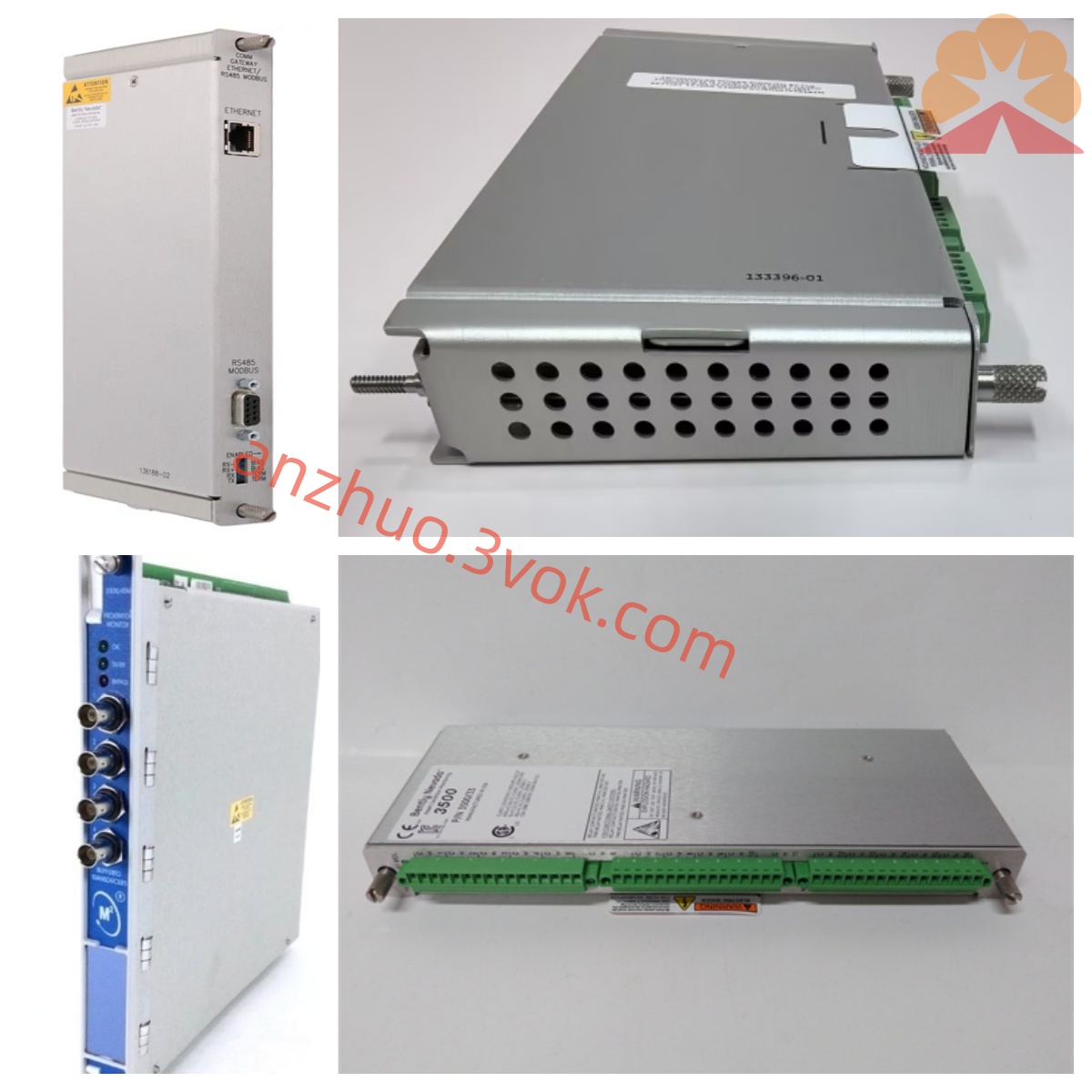
Bently Nevada 3300/16-02-05-01-00-00-00-00 XY Dual-Axis Shaft Vibration Monitoring Module
Description
Bentley 3300/16-02-05-01-00-00-00-00 XY / Gap Dual Vibration Monitoring Module Detailed Product Description
I. Product Overview
The Bentley 3300/16-02-05-01-00-00-00-00 is a rack-mounted dual-channel vibration and shaft position monitoring module under the Bently Nevada brand of Baker Hughes. It is commonly known as the "XY / Gap Dual Vibration Monitor". It is specifically designed for simultaneous monitoring of X/Y bidirectional radial vibration and the average shaft position (gap) of rotating machinery. It replaces the older 3300/15 (only vibration, no gap alarm). This model is a standard configuration, with gap alarm, universal range, with display, ordinary certification, without special functions. It is widely used in steam turbines, gas turbines, centrifugal compressors, generators, etc. of key units in industries such as thermal power, nuclear power, petrochemicals, and metallurgy, providing continuous online monitoring, fault warning, and safety interlock protection, in accordance with API 670 standards.
II. Model Decoding (3300/16-02-05-01-00-00-00-00)
3300: Bentley 3300 modular TSI system, rack-mounted installation, supports hot swapping and multi-module combination;
16: Function code, XY / Gap Dual Vibration Monitoring Module, dual channels, simultaneously measure vibration and shaft gap;
02: Range and sensitivity, 0–2 mm (0–80 mil) peak-to-peak, 8 V/mm (200 mV/mil), compatible with 8 mm probe;
05: Frequency response, 4–4000 Hz (240–240,000 CPM), covers high-speed, variable frequency, and impact type vibration;
01: Display and operation, with local LCD display + LED status lights, can read locally, view alarms and configuration;
00: Output configuration, standard isolated analog output (-1~-17 VDC) + alarm relay;
00: Certification level, basic CE certification, non-explosion-proof, suitable for ordinary industrial areas;
00: Special functions, no safety barrier, no explosion-proof, no customized configuration, standard factory configuration.
III. Core Functions
Dual-channel independent monitoring: Two channels, each connected to an eddy current probe in the X and Y directions, simultaneously measure the peak-to-peak radial vibration and the average shaft - bearing gap (static position);
Vibration + Gap Dual Alarm: Each channel independently sets vibration high / extremely high alarm, gap too large / too small alarm, avoiding shaft rubbing or bearing failure;
Intelligent signal processing: Built-in OK circuit monitoring, can distinguish probe break / short circuit / signal out of tolerance and real vibration faults, preventing false shutdown;
Local display and status indication: LCD real-time displays X/Y vibration values, gap values, alarm status; LED indicates OK (normal), ALERT (warning), DANGER (danger), BYPASS (bypass);
Standard signal output: Backplane provides isolated analog output (-1~-17 VDC), can be connected to DCS/PLC; each channel is equipped with warning / danger relay contacts for interlock protection;
Parameters can be programmed: Range, sensitivity, frequency response, alarm threshold, gap alarm delay (default 6 seconds) can be set through software or local buttons.
IV. Technical Parameters
(1) Measurement Parameters
Channels: 2 independent (X, Y);
Vibration range: 0–2 mm (0–80 mil) peak-to-peak; Sensitivity: 8 V/mm (200 mV/mil), linear error ≤ ±1% FS;
Gap measurement range: 0.25–2.3 mm (compatible with 8 mm probe);
Frequency response: 4–4000 Hz (-3 dB), suitable for high-speed machinery and impact vibration;
Gap alarm delay: 6 seconds (to prevent transient false alarms);
Accuracy: vibration ±0.5% FS, gap ±1% FS;
Resolution: 0.01 mm.
(II) Electrical parameters
Power supply: -24 VDC (±10%), programmable to -18 VDC; power consumption approximately 2 W;
Probe input: compatible with 3300 XL 8 mm eddy current probe (330101/02/03/04), input impedance 10 kΩ;
Analog output: -1 to -17 VDC isolation, output impedance 100 Ω;
Relay output: 1 channel ALERT (warning) and 1 channel DANGER (danger) per channel, contacts 250 VAC/3A passive dry contacts;
Signal isolation: electrical isolation between input/output/power supply, anti EMI/RFI interference.
(III) Environmental and mechanical parameters
Operating temperature: -40℃ to +70℃;
Storage temperature: -40℃ to +85℃;
Relative humidity: 0%–95% (no condensation);
Installation: 3300 standard 19-inch rack slot, hot-swappable;
Size: approximately 220 mm (depth) × 120 mm (width) × 83 mm (height);
Weight: approximately 1.1 kg;
Protection: IP20 (in the rack);
Shell: metal panel + flame-retardant plastic, shock-resistant, corrosion-resistant.
(IV) Certification and compliance
Electromagnetic compatibility: CE (EN 61000-6-2/4);
Industry standards: API 670 Fourth Edition;
Explosion-proof: none (for ordinary areas).
V. Structural design
(1) Rack-based modularization
Standard 3300 rack compatible, directly inserted into the slot, supports hot swapping, no need to stop for replacement. Front panel has LCD, LED and operation buttons; back panel has probe input, analog output, relay contacts, power interface, clear layout.
(2) Dual-channel independent circuit
Two signals are completely independent and processed without interference; each channel contains signal conditioning, linearization, alarm comparison, OK monitoring circuits, high stability.
(3) Anti-interference and reliability
Input/output/power isolation; built-in electromagnetic shielding; OK circuit real-time diagnoses probe/cable faults; gap alarm delay 6 seconds, suppresses transient fluctuations false alarms.
VI. System compatibility
(1) Hardware compatibility
Compatible with 3300 series racks, power supply (3300/12/13), system monitoring (3300/03);
Compatible with 3300 XL 8 mm eddy current probe and preamplifier;
Analog output connected to DCS/PLC; relay contacts connected to interlock circuits.
(2) Software compatibility
Support System 1 status monitoring software, for data acquisition, trend, diagnosis, historical storage;
Parameters can be set through 3300 configuration software, supports local button configuration.
VII. Typical application scenarios
Power: thermal power / nuclear power turbine, generator, feed pump's X/Y vibration and shaft gap monitoring, preventing rubbing;
Chemical industry: centrifugal compressor, process turbine, large pump group's vibration protection and bearing position monitoring;
Metallurgy: blast furnace fan, large motor, rolling mill transmission's high-speed rotating equipment monitoring;
General industry: papermaking, cement, pharmaceuticals, etc. key rotating equipment's preventive maintenance and fault warning.
VIII. Installation and maintenance
(1) Installation Tips
Frame Installation: Insert into an available slot and ensure good contact;
Probe Wiring: Connect the X and Y probes to the corresponding channels respectively. Place the probes perpendicular to the surface, with a gap of 1.27 mm (standard);
Output Wiring: Connect analog signals to the DCS, and connect relay contacts to alarms/interlocks;
Power On Configuration: Set the range, alarm threshold, and gap limit, and save the settings.
(2) Daily Maintenance
Inspection: Check LCD display, LED status, and wiring tightness;
Calibration: Once a year, calibrate vibration and gap accuracy using a standard gap block;
Cleaning: Regularly clean dust from the panel and slots to maintain good heat dissipation;
Spares: Use original probes, cables, and modules to avoid deviations caused by non-original components.
IX. Usage Precautions
Non-explosion-proof Design: Do not use in flammable and explosive hazardous areas;
Probe Matching: Must be paired with the 3300 XL 8 mm system. Do not mix 5 mm/11 mm probes;
Gap Setting: Install the static gap strictly at 1.27 mm to avoid excessive proximity for rubbing or too far for weak signal;
Do Not Modify: Do not privately modify cable length, dismantle modules, or replace non-original accessories. Otherwise, it will result in failure and loss of warranty;
Power Off Operation: Cut off the power supply of the frame when connecting, inspecting, or replacing modules to prevent short circuits / electric shock.
Get a Quote