
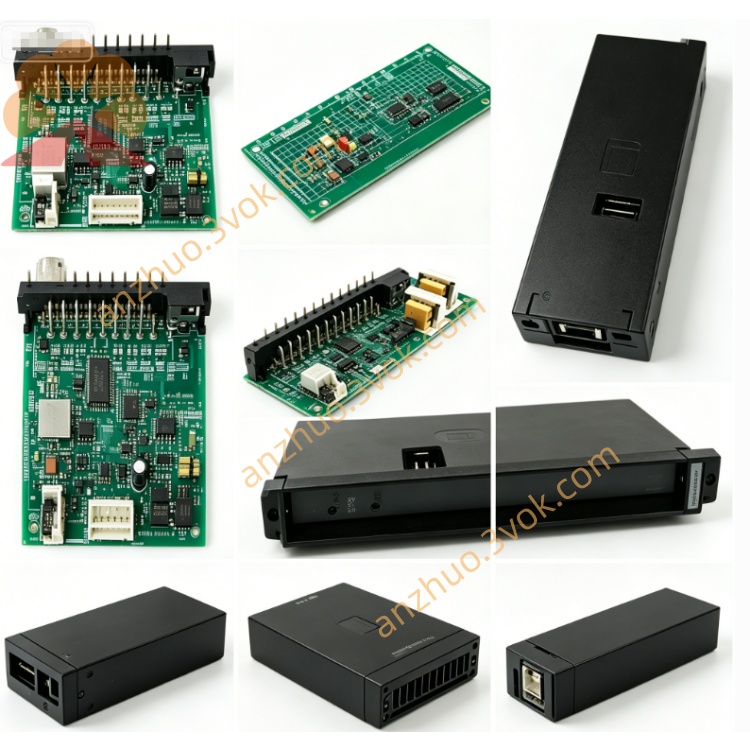
Reliance Electric 14C-305
Description
Product Description
Model Definition
14: Represents the 14C series of industrial DC drives (FlexPak Plus).
C: Stands for motor Control drive (DC drive category).
305: Indicates the power rating and input/output configuration (≈30 HP class, 208/230/460 VAC three-phase input).
-: Separator (sometimes omitted as 14C305).
Technical Specifications
Input: Three-phase AC, 208/230/460 VAC (selectable), 50/60 Hz.
Output: Adjustable DC for armature (0–460 VDC) and field (fixed/ adjustable DC).
Power Rating: ~30 HP (22 kW) at 460 VAC input.
Control Modes: Open-loop voltage regulation; closed-loop speed regulation with tachometer feedback.
Protection: Overcurrent, overvoltage, undervoltage, overtemperature, short circuit, ground fault.
Ambient: 0–55°C, 5–95% RH (non-condensing).
Mounting: Panel-mount (vertical installation required).
Interface & Wiring
Power Terminals: L1/L2/L3 (three-phase AC input), A+/A- (armature DC output), F+/F- (field DC output), PE (protective earth).
Control Terminals: Start/stop, forward/reverse, external speed reference (0–10 VDC), tachometer feedback, fault reset.
Communication: No built-in network port; all control via hardwired analog/digital signals.
Core Functions
Precision Speed Regulation: Stable speed control under variable loads via dual-loop (speed + current) regulation.
High Torque Performance: Strong starting and low-speed torque for heavy-duty loads.
Comprehensive Protection: Shuts down or limits output during faults to protect drive and motor.
Flexible Configuration: Onboard potentiometers for max speed, current limit, gain, and field weakening adjustment.
Application Scenarios
Machine Tools: Lathes, mills, grinders requiring precise DC motor control.
Material Handling: Conveyors, cranes, hoists with high starting torque needs.
Process Industry: Mixers, extruders, fans, pumps with variable speed demands.
Legacy System Replacement: Direct retrofit for old Reliance 14C series drives in aging equipment.
Usage & Maintenance
Usage
Install vertically on a rigid panel; leave ≥100 mm clearance around for heat dissipation.
Wire power, motor, and control cables per terminal labels; ensure reliable grounding.
Set parameters (max speed, current limit) via onboard potentiometers.
Perform jog test to verify motor rotation direction before full-load operation.
Avoid continuous overload; operate within rated current and voltage.
Maintenance
Every 3–6 Months: Inspect chassis, cables, and terminals for damage or loose connections.
Cleaning: Disconnect power; wipe dust with a dry cloth (no liquid cleaners).
Annual Checks: Retighten terminals; clean heat sink fins to prevent overheating.
Static Protection: Internal components are ESD-sensitive; do not open the chassis without proper grounding.
Storage: Keep spare units in a cool, dry, dust-free environment.
Get a Quote