
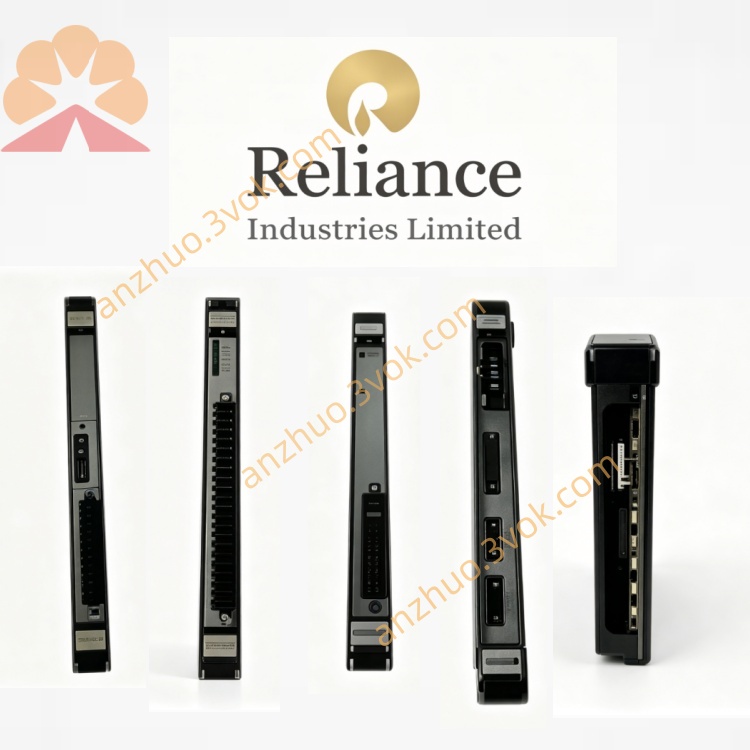
Reliance 40FN4032
The 40FN4032 is a non-regenerative DC drive of Reliance Electric FlexPak 3000 series, rated at 40 horsepower. It is designed for speed and torque regulation of industrial DC motors, featuring compact structure and flexible parameter settings for standard and medium-heavy duty applications. This model has been discontinued, and refurbished units are widely used for maintenance and replacement of legacy industrial control systems.
Description
Product DescriptionThe 40FN4032 is a non-regenerative DC drive of Reliance Electric FlexPak 3000 series, rated at 40 horsepower. It is designed for speed and torque regulation of industrial DC motors, featuring compact structure and flexible parameter settings for standard and medium-heavy duty applications. This model has been discontinued, and refurbished units are widely used for maintenance and replacement of legacy industrial control systems.
Model Number Interpretation40 refers to the rated motor power of 40 horsepower. FN stands for FlexPak 3000 series and non-regenerative type. 4032 represents 460 VAC input voltage and dedicated hardware configuration matching the 40 HP power grade.
Technical SpecificationsThe rated continuous motor power is 40 HP. The three-phase input voltage is 460 VAC with a tolerance of plus or minus 10 percent, and the operating frequency is 50/60 hertz. The armature output voltage ranges from 0 to 460 VDC, and the field voltage is adjustable. The full load RMS input current is 63 amperes. It operates in single-quadrant non-regenerative control mode, and external components are required for braking. The basic speed regulation ratio is 10 to 1, and the operating speed can be extended by field weakening function. It supports 150 percent overload current for one minute. Built-in protection includes overcurrent, overvoltage, undervoltage, overtemperature, short circuit and field loss protection. The operating ambient temperature is from 0 degree Celsius to 45 degree Celsius, and the storage temperature ranges from minus 20 degree Celsius to 70 degree Celsius. The relative humidity ranges from 5 percent to 90 percent without condensation. It adopts open chassis structure and panel mounting design. The overall weight is approximately 23 kilograms. The product complies with UL, C-UL and CE standards.
Interface and Communication ConfigurationMain power terminals are provided for three-phase AC input, DC armature output and field winding output. Control screw terminals support start and stop, forward and reverse, 0 to 10 VDC or 4 to 20 mA analog speed reference and fault reset signals. It accepts tachogenerator and encoder signals for closed-loop speed control. There is no built-in Ethernet port, and optional serial modules can be installed to connect with traditional PLC and DCS systems. The front panel is equipped with LED indicators, a digital display and operation keypad for status check and parameter setting. All connections are implemented via hardwired circuits.
Core FunctionsIt delivers stable and accurate speed and torque control with closed-loop feedback. It runs in single direction without power regeneration, so external braking resistors are needed for deceleration. Multiple operational parameters such as acceleration, deceleration and current limit are fully adjustable. The field weakening function enables the motor to operate above base speed. Comprehensive protection functions effectively prevent damage to the drive and motor under abnormal conditions. It maintains good compatibility with Reliance DC motors and existing legacy control systems.
Application ScenariosIt is suitable for general industrial equipment including conveyors, fans, pumps and mixers. It can be applied to ordinary machine tools such as lathes, milling machines and grinders where four-quadrant braking is not required. It is also widely used in papermaking, textile and food processing industries. It serves as a direct replacement for outdated FlexPak 3000 drives in old production lines.
Usage and Maintenance InstructionsMount the drive on control panels and reserve sufficient space around for heat dissipation. Complete wiring for power circuits and control circuits in accordance with circuit diagrams, and tighten all terminals firmly. Inspect input voltage and wiring condition before powering on, and set parameters according to the data on the motor nameplate. Perform regular quarterly maintenance to remove dust and check terminals, cooling components and indicators. Disconnect all power sources and wait for internal capacitors to fully discharge before carrying out inspection and maintenance work.
Get a Quote