
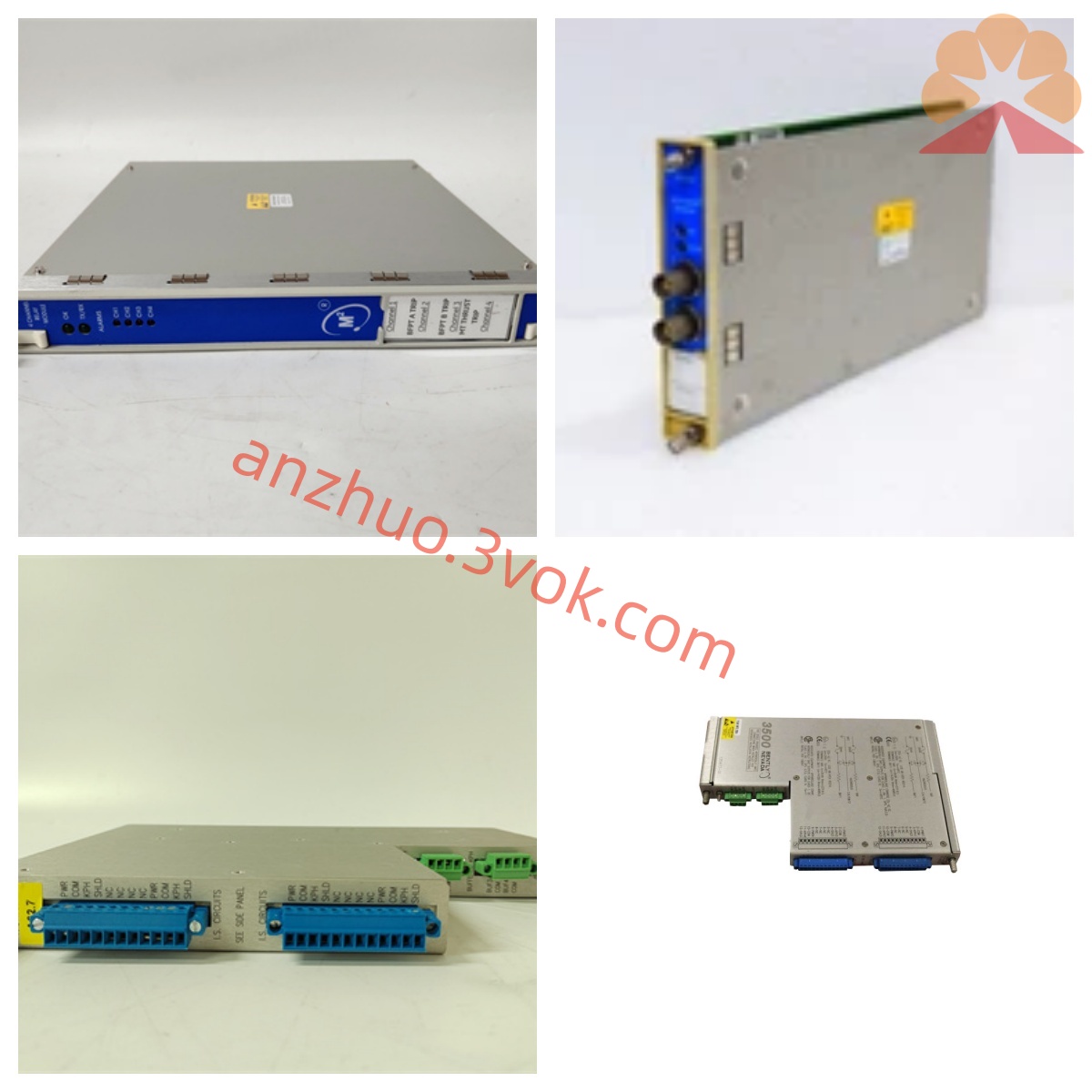
Bently Nevada 330101-00-40-10-02-00 Eddy Current Proximity Probe
Description
Bentley 330101-00-40-10-02-00 Electromagnetic Eddy Current Probe Detailed Product Description
I. Product Introduction
330101-00-40-10-02-00 is a 8mm standard non-armored eddy current probe of the 3300 XL series from Bentley Nevada under Baker Hughes. It is the front-end sensing component of the rotating machinery TSI condition monitoring system and must be used in conjunction with the same series extension cables and preamplifiers to form a complete measurement circuit. The product adopts full-length threads, a 4.0-inch ultra-short housing, 1-meter standard non-armored cable, and an ordinary industrial type (without explosion-proof certification) structure. It is specifically designed for shallow installation holes, space constraints, full-thread locking, and conventional non-explosion-proof areas. It is used for radial shaft vibration, axial displacement, shaft eccentricity, key phase and rotational speed monitoring of large rotating machinery and complies with API 670 standards. It has strong anti-electromagnetic interference capability, stable measurement, and good temperature adaptability. It is widely used in power, petrochemical, metallurgy, coal chemical, and other conventional industrial sites.
II. Model Code Interpretation (330101-AA-BB-CC-DD-EE)
330101: 3300 XL 8mm probe series, non-armored structure, standard thread specification 3/8-24 UNF (American standard fine thread);
00 (AA): No exposed rod section, full-length thread design, uniform installation force, and secure fixation;
40 (BB): Total shell length 4.0 inches (approximately 101.6mm), belonging to an ultra-short housing, suitable for shallow installation holes and narrow space measurement points;
10 (CC): The probe comes with a 1.0-meter cable length, medium-distance wiring, original factory length ensures impedance matching, cannot be cut or spliced;
02 (DD): Equipped with a miniature ClickLoc coaxial connector, paired with standard non-armored cable, tool-free insertion and removal, convenient disassembly and assembly;
00 (EE): Without explosion-proof or special certification, it is a standard industrial configuration, only applicable to non-flammable and non-explosive environments.
III. Mechanical Structure and Materials
The probe housing is made of AISI 303/304 stainless steel, corrosion-resistant, vibration-resistant, and not prone to deformation; the sensing end is made of high-temperature resistant PPS material, using the patented TipLoc one-piece molding process, the end is closely combined with the housing, and can withstand equipment vibration for a long time without loosening or falling off. The cable is a non-armored flexible structure, with oil resistance, aging resistance, and bending resistance characteristics, suitable for flexible wiring in the field; the miniature ClickLoc coaxial connector is inserted into the alignment slot to lock, dust-proof and moisture-proof, and maintenance is convenient. The overall protection level is IP54, suitable for dry, less dust, and non-corrosive medium industrial environments; the installation thread is 3/8-24 UNF fine thread, suitable for standard installation bases, the tightening torque is strictly controlled within 1.1–1.4N·m, avoiding thread slippage or housing damage.
IV. Electrical Performance Parameters
As an 8mm standard eddy current probe, the core electrical parameters have high consistency and strong stability:
Standard measurement sensitivity: 7.87V/mm (200mV/mil), linear error ≤ ±1%;
Effective linear measurement range: 2.0mm, effective working range 0.25mm–2.3mm;
Frequency response: 0Hz–10kHz, covering the full frequency range of rotational machinery vibration signals;
Output signal: When paired with the 3300 XL series preamplifier, the output is -1VDC to -17VDC standard direct current voltage;
DC resistance: The 1-meter cable's overall resistance is 7.59Ω ± 0.50Ω, impedance matching is precise;
Required target surface: Minimum diameter 8.9mm, engineering application recommends shaft diameter ≥ 50.8mm, ensuring measurement stability; Anti-interference performance: It can resist electromagnetic interference from equipment such as frequency converters, high-power motors, and contactors, and the signal transmission is without distortion.
V. Environmental Adaptability Conditions
Working environment
Working temperature: -52°C to +177°C, can withstand +218°C high temperature for a short period, suitable for equipment in high-temperature working conditions;
Storage temperature: -52°C to +260°C, does not affect performance after long-term storage;
Relative humidity: 5%–95%RH, no condensation or water accumulation, avoid damage to internal coils in humid environments;
Applicable areas: No explosion-proof certification, prohibited to install and use in flammable and explosive hazardous areas, only applicable to conventional industrial sites.
Installation and wiring environment
Cable laying needs to be separated from high-voltage cables and power cables to reduce electromagnetic interference; non-armored cables have a minimum bending radius of no less than 3 times the outer diameter of the cable, no sharp bends, dragging, or crushing, to prevent wire core breakage; the end face of the probe needs to be parallel to the surface of the measured shaft, the installation hole position needs to be cleaned to avoid debris affecting installation accuracy.
VI. Core Functions
1. Non-contact precise measurement
Based on the eddy current effect, the probe coil receives the high-frequency excitation signal (0.5 MHz – 2 MHz) output by the preamplifier to form an alternating magnetic field. The magnetic field acts on the rotating metal shaft, and the metal surface induces eddy currents, reversing the inductance and impedance of the coil. The probe transmits parameter changes to the preamplifier, converts them into linear voltage signals, accurately measuring the gap between the probe and the shaft, simultaneously collecting static displacement and dynamic vibration data. The entire process has no mechanical contact and zero wear, suitable for long-term monitoring of high-speed rotating equipment.
2. Ultra-short shell suitable for shallow holes and narrow spaces
The 4.0-inch ultra-short shell is designed with a full-length thread, specifically for installation holes that are shallow, equipment compactness, and limited installation space. It has moderate rigidity, anti-vibration performance, high installation coaxiality, and is not prone to deviation during long-term operation. The fixation effect is stable, solving the pain point of conventional long shells not being suitable for shallow holes.
3. Standard cable suitable for conventional wiring
1-meter non-armored flexible cable, suitable for medium-distance connection scenarios between the probe and the preamplifier, extension cable, etc. The wiring is flexible, and normal bending can be performed in narrow spaces. The original factory length ensures impedance matching, and it is not allowed to cut or splice privately to avoid signal attenuation or measurement errors.
4. Wide temperature operation and temperature compensation
Built-in high-temperature coils and insulation materials, combined with the system's automatic temperature compensation circuit, suppresses temperature drift within the -52°C to +177°C wide temperature range, with a sensitivity fluctuation of ≤ ±1.5%. Measurement data in different working conditions and temperatures is continuous and accurate.
5. Line self-check and rapid maintenance
Works in conjunction with the 3300 XL series preamplifier to achieve line fault detection, accurately identifying faults such as broken wires, short circuits, cable damage, and poor contact at the connection points, outputting fault signals to trigger alarms; probes, cables, and preamplifiers of the same specification have strong interchangeability, allowing for on-site replacement of spare parts without the need for recalibration, shortening maintenance downtime and reducing maintenance costs.
6. Multi-parameter synchronous monitoring
Can simultaneously monitor radial shaft vibration, axial displacement, shaft eccentricity, key phase, and rotational speed of rotating machinery, providing comprehensive data support for equipment dynamic balance correction, fault diagnosis, and condition-based maintenance, meeting the multi-parameter integrated monitoring requirements of the TSI system.
VII. Working Principle
The coil inside the probe is supplied with high-frequency alternating current to generate a stable electromagnetic field. The magnetic field penetrates the air gap and acts on the measured metal shaft. In the metal surface, a closed eddy current is formed; the intensity of the eddy current changes with the gap between the probe and the shaft, and the larger the gap, the weaker the eddy current intensity, and the more obvious the change in coil inductance and impedance. The probe transmits the inductance and impedance change signals to the preamplifier, which converts the physical gap quantity into a continuous DC voltage in a ratio of 7.87V/mm. The larger the gap, the closer the output voltage is to -17VDC, and the smaller the gap, the closer the output voltage is to -1VDC. The upper-level monitoring system analyzes the voltage values and converts them into parameters such as shaft vibration amplitude, axial displacement, rotational speed, and phase, enabling online monitoring and safety interlock protection of the equipment.
VIII. Installation and Wiring Specifications
Before installation, clean the threaded holes and debris inside the installation base to ensure there are no burrs or impurities, and avoid threaded jamming or installation tilt.
Slowly insert the probe into the installation base to ensure that the end face of the probe is parallel to the surface of the measured shaft. Set the initial installation gap at the midpoint of the linear range, corresponding to an output of approximately -9VDC, to achieve the best linear measurement performance.
Strictly follow the 1.1–1.4N・m standard torque for thread tightening. Do not use brute force to tighten to prevent thread slippage and shell deformation.
The cable laying is separated from high-voltage cables and power cables, with a spacing of ≥30cm to reduce electromagnetic interference. Follow the minimum bending radius requirements throughout the process and prohibit sharp-angle bending, dragging, and crushing.
Insert the micro ClickLoc connector into the slot and hear the clicking sound to indicate a proper connection. Regularly perform dust and moisture protection for the connector to avoid poor contact.
The probe should not be immersed in oil or water for a long time. Keep the cable at the original factory length and do not cut, patch, or extend it to ensure impedance matching and signal stability.
IX. Typical Application Scenarios
Power Industry
Used for shallow hole measurement points and space-constrained measurement points of auxiliary equipment such as steam turbine generators, boiler feed pumps, induced draft fans, blowers, and circulating water pumps, to monitor shaft vibration and axial displacement, and provide early warnings of bearing wear, rotor friction, eccentricity, etc., to ensure the safe and stable operation of the unit.
Petrochemical Industry
Suitable for centrifugal compressors, gas turbines, process pumps, mixing units, pipeline pumps, etc. in non-explosion-proof factory areas. Real-time monitoring of vibration, displacement, rotational speed, and key phase, providing data support for long-term stable operation of the device, and avoiding production interruptions caused by equipment failures.
Metallurgical Industry
Deployed in high-temperature blast furnace fans, large transmission motors, rolling mill rotating mechanisms, continuous casting machine drive devices, cooling machine gearboxes, etc. to monitor the operating status, warn of abnormal vibration, equipment overload, and shaft system faults, and adapt to the conventional industrial environment with high temperatures and dust in metallurgical sites.
General Industry
Used for key phase acquisition, rotational speed measurement, and shaft eccentricity analysis of large rotating machinery, providing core data for dynamic balance correction, fault diagnosis, and condition-based maintenance; compatible with TSI monitoring cards of the 3300 and 3500 series, capable of connecting with mainstream PLC and DCS data acquisition devices, building a complete unit safety monitoring system.
X. Product Advantages
Ultra-short housing + full-length thread design, suitable for shallow installation holes and narrow space measurement points, with strong versatility and flexible installation;
Stainless steel housing + high-temperature-resistant end material, resistant to vibration, corrosion, and operating in a wide temperature range, suitable for harsh industrial environments;
7.87V/mm standard sensitivity, 2mm linear range, high measurement accuracy and excellent linearity, in accordance with API 670 standards;
1-meter non-armored cable wiring is flexible, ensuring impedance matching with the original factory length, highly interchangeable, and simple spare parts management and on-site maintenance;
Built-in temperature compensation + anti-electromagnetic interference design, stable measurement in wide temperature conditions and complex electromagnetic environments, reliable data;
Support for multi-parameter synchronous monitoring, complete line self-check function, capable of quickly troubleshooting faults, reducing operation and maintenance costs;
Industrial-grade materials are resistant to aging, fatigue, and support 7×24 continuous operation, with a long service life.
Get a Quote