
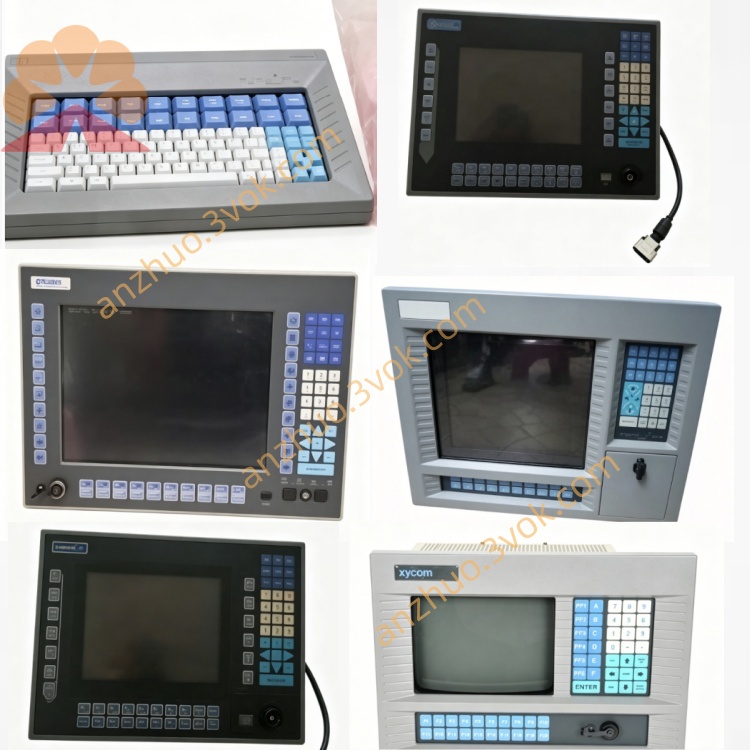
XYCOM 70630-025 Industrial Control Circuit Board
Description
XYCOM 70630-025 (XVME-630) Detailed Product Description
I. Product Overview
XYCOM 70630-025 (XVME-630) is a 6U single-slot VMEbus high-performance embedded CPU module launched by XYCOM (now part of Artisan Technology Group). The core is equipped with the Motorola 68EC030 25MHz processor, and supports an optional 68882 floating-point coprocessor. It is specifically designed for industrial real-time control, high-speed data acquisition, complex embedded computing, and harsh environment applications. As an upgraded model of the XVME-600 series, it enhances computing performance, expands storage configurations, and enriches communication interfaces. It can operate independently or serve as the core node of a multi-processor system, suitable for mid-to-high-end industrial control and measurement and control scenarios.
II. Hardware Architecture and Mechanical Characteristics
Form Specification: Standard 6U single-width (Single-Wide) VMEbus size (165.1 mm × 200.02 mm), in accordance with IEEE 1014 standard, occupying a single slot, compatible with all standard VME enclosures and backplanes, compact structure and easy installation.
PCB and Structure: Industrial-grade multi-layer reinforced PCB, with onboard 68EC030 CPU, 68882 coprocessor socket, multiple storage arrays, VME bus interface, 68562 DUSCC serial controller, power management, watchdog circuit, EMI filter components; enhanced anti-vibration and anti-shock design, capable of withstanding mechanical stress in industrial environments, suitable for wide temperature conditions.
Connectors: Front panel integrates 2 channels of DB9 serial ports, reset button, 4 channels of LED status indicators; backplane realizes bus communication and expansion I/O through VME P1/P2 connectors, with standard wiring and good shielding.
Status Indicators: Onboard power, operation, fault, watchdog LED indicators, supporting power-on self-test (POST) and real-time monitoring of operation status, facilitating rapid on-site diagnosis and maintenance.
III. Core Processor and Memory Configuration
Main Processor: Motorola 68EC030, with a frequency of 25 MHz (optional 40 MHz), 32-bit architecture, integrated memory management unit (MMU), supporting virtual memory and multi-task operating system, significantly improving computing performance compared to 68020, suitable for complex real-time control and floating-point operation scenarios.
Floating-point Coprocessor: Reserved 68882 floating-point coprocessor socket, optional for enhancing floating-point computing capabilities, suitable for scientific computing, motion control, image processing, etc., with high-precision computing requirements.
Memory Configuration:
Bank 1 (High-speed SRAM): Supports up to 4MB high-speed SRAM, zero wait access, ensuring program operation and data cache efficiency.
Bank 2 (EPROM): Supports up to 4MB EPROM, used for storing system firmware, boot programs, and user applications.
Bank 3 (Dual-port Storage): VME bus dual-port design, supporting SRAM/EPROM/Flash, up to 4MB, suitable for high-speed data sharing and system expansion.
Battery-backed RAM: Integrated 32-byte battery-backed RAM, combined with RTC for data preservation during power loss.
IV. VME Bus Interface and System Expansion
Bus Standards: Compatible with VMEbus A16/A24/A32 addressing, D08/D16/D32 data transmission, supports master/slave mode, bus arbitration, interrupts (levels 1–7), and DMA transmission, suitable for complex systems with multiple board cards working collaboratively.
Address Space: Supports 2GB A32 address range, accessible to all VME bus slave devices, compatible with XVME-500/530/560/590/600 series I/O modules, with strong expansion capability.
Bus Functions: Integrated system clock (SYSCLK), system reset (SYSRESET), single-level arbitrator, bus timer, IACK daisy-chain driver, and programmable interrupt controller, meeting the complete VME system management requirements.
V. I/O Interfaces and Peripheral Support
Serial Ports: Driven by 68562 DUSCC, providing 2 asynchronous/synchronous serial ports:
Channel A: Dedicated RS-232C (DB9), baud rate 50–115.2 kbps. Channel B: The jumper can select RS-232C/RS-485 (DB9), suitable for long-distance communication and multi-node networking.
Programmable timer: On-board 2 channels of 16-bit programmable timers, supporting timing interrupts and periodic triggering, suitable for real-time control timing requirements.
Real-time clock (RTC): Battery-backed RTC, combined with 32-byte backup RAM, retains time, date and critical data during power loss, ensuring system time synchronization and event recording accuracy.
No parallel port / IDE interface: Simplified I/O configuration, focused on high-performance computing and communication, reducing complexity and failure rate.
Six. Electrical Characteristics and Operating Environment
Power supply: VME bus + 5V/±12V power supply, typical power consumption 4.0A, supports external power supply redundancy, simplifies system wiring and power configuration.
Operating temperature: Standard 0 ℃ to + 60 ℃; optional -40 ℃ to + 85 ℃ wide temperature version, suitable for industrial, vehicle, military, aerospace and other harsh environments.
Storage temperature: -40 ℃ to + 85 ℃, reliable long-term storage.
Humidity: 5%–95% RH (no condensation), tolerant to humid and dusty conditions.
Vibration / Shock: 5–2000 Hz, 0.015" displacement, excellent anti-vibration and anti-shock performance, suitable for high mechanical stress scenarios.
Electromagnetic Compatibility: Compliant with IEC 61000-6-2/4 industrial EMC standards, strong anti-static, anti-pulse group, and anti-surge capabilities, suitable for strong electromagnetic interference environments.
Seven. Core Functions and Software Support
Real-time operating system compatibility: Supports VxWorks, QNX, MS-DOS and custom RTOS, suitable for different real-time and development requirements.
Hardware watchdog (WDT): Programmable timeout time, automatically resets when system abnormality occurs, ensuring long-term operational stability.
Power-on self-test (POST): Automatically executes hardware detection upon startup, displays results through LEDs, quickly locates faults.
Interrupts and DMA: Supports VMEbus interrupts, local timer interrupts and DMA high-speed transmission, improving I/O response and system throughput.
Software development support: Provides C language library, drivers and debugging tools, supports secondary development, suitable for customized control logic.
Eight. Typical Application Scenarios
Industrial process control: As the main control of VME system, drives analog/digital I/O modules, realizes high-precision closed-loop control of temperature, pressure, flow and other process parameters.
High-speed data acquisition: Combined with XVME-500 series high-speed analog input module, completes multi-channel high-speed data acquisition, processing and storage.
Embedded measurement and control platform: Embedded control, status monitoring and data recording in harsh environments such as military, vehicle, rail transit, aerospace and others.
Motion control and robots: Combined with floating-point coprocessor, realizes multi-axis motion control, trajectory planning and robot control.
Multi-processor system: As the master node in VME multi-processor architecture, coordinates multiple slave CPUs and I/O modules, realizes distributed control.
Nine. Product Advantages
High-performance computing: 25MHz 68EC030 + optional 68882 floating-point coprocessor, powerful computing power, suitable for complex computing scenarios.
Flexible storage configuration: Three bank storage architecture, supports SRAM/EPROM/Flash combination, maximum 12MB, meets the requirements for large-capacity program and data storage.
Rich communication capabilities: Dual serial ports (RS-232/RS-485) + dual timers, suitable for various peripherals and communication networking. Industrial-grade reliability: rugged design, wide temperature operation, hardware watchdog, EMC compliance, stable long-term operation, low maintenance cost.
Complete VME control capability: master/slave mode, bus arbitration, interrupt/DMA, complete system management functions, single card can build a complete VME system.
Get a Quote