
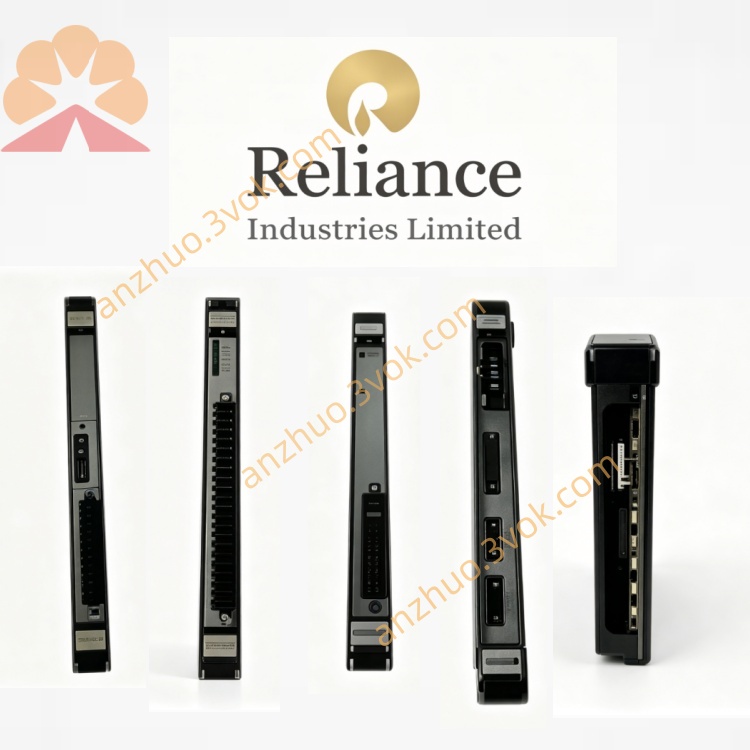
Reliance 2GU41015
Description
Product Description
Model Number Interpretation
2: Standard industrial drive series
GU: GP‑2000 series, 460 VAC voltage class
41015: 4 = 460 VAC; 1015 = 15 HP; 15 = hardware revision
Technical Specifications
Motor Power: 15 HP (11 kW), 16.7 kVA
Input Voltage: 460 VAC ±10%, three‑phase, 50/60 Hz
Output Voltage: 0–460 VAC, three‑phase
Output Frequency: 0–400 Hz
Rated Input Current: 25.4 A (max)
Rated Output Current: 21 A (continuous)
Control Mode: Open‑loop V/F (volts‑per‑hertz)
Protection: Overcurrent, overvoltage, undervoltage, overtemperature, short‑circuit, ground fault
Enclosure: NEMA 1 (indoor, general purpose)
Operating Temperature: 0 °C to +45 °C
Dimensions (H×W×D): Approx. 550 × 250 × 300 mm (estimate, larger frame)
Weight: Approx. 20.9 kg (46.0 lbs)
Interface and Communication Configuration
Power terminals: Three‑phase main input, motor output, DC bus braking connection
Control terminals: ±10 V analog input (speed reference), 24 VDC digital I/O (start/stop, fault reset, jog)
Communication: Reliance proprietary protocol; no standard fieldbus ports
Operator interface: Onboard keypad + 7‑segment display for parameter setup and fault codes
Encoder interface: None; open‑loop V/F only
Core Functions
Stable V/F speed regulation for 15 HP three‑phase AC motors
Energy savings for variable‑torque loads (fans, pumps)
Supports external braking resistors for fast deceleration
Real‑time monitoring and fault code logging for quick diagnostics
Adjustable accel/decel times, current limit, and I/O logic via local keypad
Application Scenarios
Conveyors, packaging machines, assembly lines (light manufacturing)
Medium‑sized fans, pumps, agitators (HVAC, process industries)
15 HP AC motor‑driven material handling and lifting equipment
Direct replacement for legacy GP‑2000 series drives in old automation systems
Usage and Maintenance Instructions
Mount in a well‑ventilated cabinet; maintain ≥50 mm clearance around unit for cooling
Use shielded cables for power and control wiring; torque all terminals to specs
Verify input voltage before power‑up; energize control circuit first, then main power
Set parameters per motor nameplate (voltage, current, base frequency)
Quarterly: Inspect connections, clean internal dust, check for overheating
Before service: Disconnect all power; wait 5 minutes for DC bus capacitors to discharge fully
Get a Quote