
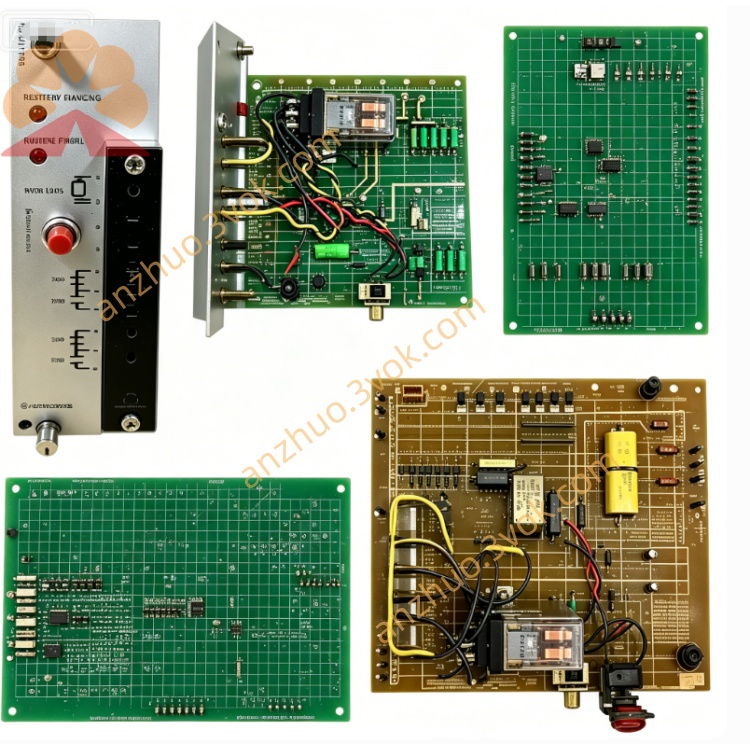
Reliance Electric 14C312U
The 14C312U is a three-phase DC drive with a rated power of 10HP (7.5kW), belonging to the Minpak+ 14C series of Reliance Electric, which is now under Rockwell Automation. The suffix U stands for NEMA 12 enclosed structure, providing good protection against dust and dripping liquid. This unit is designed for speed and torque control of medium-power DC motors, featuring stable performance and complete protection functions. It is a discontinued legacy product, and refurbished and surplus units are commonly used for maintenance and replacement of old DC drive systems on industrial sites.
Description
Product Description
The 14C312U is a three-phase DC drive with a rated power of 10HP (7.5kW), belonging to the Minpak+ 14C series of Reliance Electric, which is now under Rockwell Automation. The suffix U stands for NEMA 12 enclosed structure, providing good protection against dust and dripping liquid. This unit is designed for speed and torque control of medium-power DC motors, featuring stable performance and complete protection functions. It is a discontinued legacy product, and refurbished and surplus units are commonly used for maintenance and replacement of old DC drive systems on industrial sites.
Model Definition
14 represents the 14C series of DC drives. C means the product is a motor control drive. 312 indicates the power grade and circuit configuration of 10HP. U refers to the version with NEMA 12 dust-proof and drip-proof enclosure.
Technical Specifications
The drive adopts three-phase 460VAC power input with voltage tolerance of plus and minus ten percent, and works at 50Hz and 60Hz. The armature output voltage ranges from 0 to 500VDC, with a maximum continuous output current of 18 amperes. It supports fixed or adjustable DC output for motor field winding. It has two control modes including open-loop voltage regulation and closed-loop speed regulation with tachometer feedback. Built-in protection functions cover overcurrent, overvoltage, undervoltage, over temperature, short circuit and ground fault. The enclosure complies with NEMA 12 standard. The applicable ambient temperature is from 0 degrees Celsius to 55 degrees Celsius, and the relative humidity is 5 percent to 95 percent without condensation. The drive is designed for vertical panel mounting, and the total weight is about 30.8 kilograms.
Interface and Communication Configuration
There are dedicated terminal blocks for three-phase AC input, DC armature output, DC field output and protective grounding. Independent control terminals are reserved for start-stop signals, forward and reverse switching, 0-10VDC external speed reference, tachometer feedback and fault reset signals. The device has no built-in network communication port, and all control and signal transmission are realized through hard wiring.
Core Functions
It adopts dual-loop control to achieve precise speed regulation, maintaining stable running speed even when the load changes. It delivers strong starting torque and low-speed torque to meet heavy-duty operation requirements. The NEMA 12 enclosed structure effectively resists dust and liquid splashing, adapting to complex industrial environments. Multiple protection functions can cut off output in time when faults occur, so as to protect the drive and the matched DC motor. Users can adjust parameters such as maximum speed, current limit and gain through onboard potentiometers according to actual working conditions.
Application Scenarios
It is suitable for various medium-power DC motor equipment such as industrial lathes, milling machines and grinding machines. It is widely used in conveying equipment, small cranes and hoists that require high starting torque. It also applies to mixers, fans and pumps with variable speed demands. It serves as an ideal replacement part for renovation and daily maintenance of legacy Reliance DC drive systems.
Usage and Maintenance Instructions
Usage
Install the drive vertically on a firm mounting panel, and reserve enough space around for heat dissipation. Connect power cables, motor cables and control cables strictly in accordance with terminal marks, and ensure reliable grounding. Set relevant operating parameters via onboard potentiometers. After wiring and parameter setting, perform jog test to confirm the motor rotation direction, and then carry out load test run. Do not make the drive work under continuous overload during formal operation.
Maintenance
Carry out routine inspection every three to six months to check the housing, cables and connecting terminals for damage or loose connection. Cut off all power supply before cleaning, and wipe surface dust with dry cloth. Do not use liquid or chemical cleaning agents. Retighten all wiring terminals every year and clean dust on heat sinks to keep heat dissipation smooth. The internal components are sensitive to static electricity, so do not disassemble the drive without professional guidance. Store spare units in cool, dry and dust-free environment. All inspection and repair work shall be handled by professional technicians.
Get a Quote