
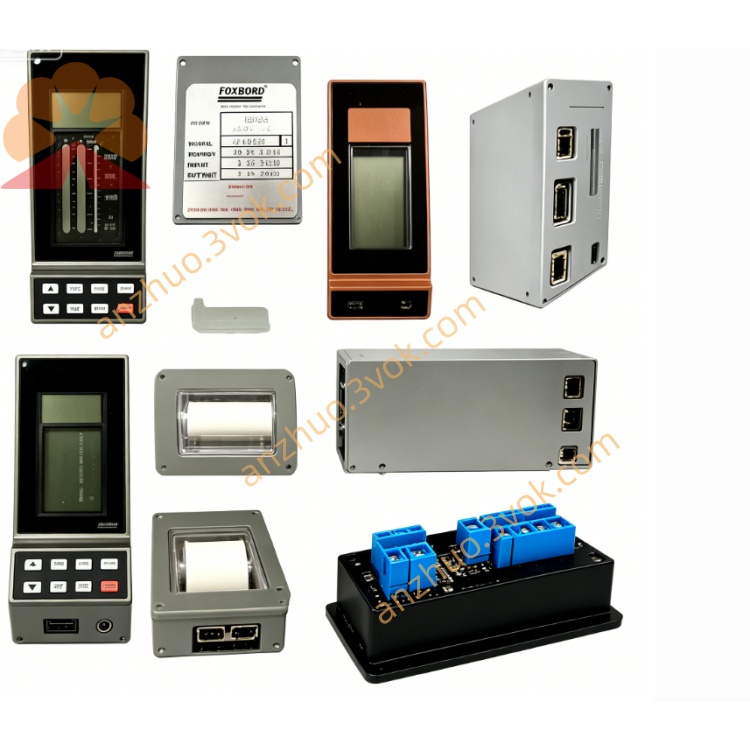
Foxboro FBM217 Product Description
The Foxboro FBM217 is a high-density, group-isolated discrete input module in the Compact 200 Series I/O portfolio, manufactured by Foxboro (Schneider Electric) for Foxboro I/A Series and Foxboro Evo™ distributed control systems (DCS). Designed for industrial on/off signal acquisition, it provides 32 channels of contact or voltage input monitoring, serving as the critical interface between field devices such as limit switches, proximity sensors, relay contacts, and the DCS controller. With robust electrical isolation, wide voltage compatibility, and support for pulse counting and sequence-of-events (SOE) logging, the FBM217 delivers reliable, high-speed discrete data capture for both general and safety-critical process applications. Its compact, rugged form factor and hot-swap capability make it ideal for high-availability, harsh-environment deployments across process industries.
Description
Foxboro FBM217 Product Description
Overview
The Foxboro FBM217 is a high-density, group-isolated discrete input module in the Compact 200 Series I/O portfolio, manufactured by Foxboro (Schneider Electric) for Foxboro I/A Series and Foxboro Evo™ distributed control systems (DCS). Designed for industrial on/off signal acquisition, it provides 32 channels of contact or voltage input monitoring, serving as the critical interface between field devices such as limit switches, proximity sensors, relay contacts, and the DCS controller. With robust electrical isolation, wide voltage compatibility, and support for pulse counting and sequence-of-events (SOE) logging, the FBM217 delivers reliable, high-speed discrete data capture for both general and safety-critical process applications. Its compact, rugged form factor and hot-swap capability make it ideal for high-availability, harsh-environment deployments across process industries.
Key Features
The FBM217 offers 32 group-isolated input channels, each supporting two-wire discrete signals with comprehensive optical isolation between field circuits and the DCS backplane. This isolation eliminates ground loops, electrical crosstalk, and transient voltage damage, ensuring stable operation in high-electromagnetic-interference industrial environments. Each channel accepts a wide range of input voltages via compatible termination assemblies (TAs): low voltage (15–60 V DC), medium voltage (120 V AC / 125 V DC), and high voltage (240 V AC), accommodating both dry contact closures and active voltage signals from field devices.
Each channel features precise on/off threshold detection, with an on-state current of ≥2.1 mA and an off-state current of ≤1.2 mA, ensuring accurate and consistent signal discrimination. A typical input current of 2.2 mA at 30 V DC minimizes power consumption while maintaining reliable sensing. The module supports pulse counting up to 250 Hz, enabling it to interface with flow meters, encoders, and other pulse-generating field devices for high-speed digital pulse acquisition.
Configurable input filter/debounce times (no filtering, 4 ms, 8 ms, 16 ms, or 32 ms) allow users to adapt to noisy field conditions, eliminating false triggering from contact bounce or electrical interference. The module also supports sequence-of-events (SOE) logging with high time resolution, capturing precise timestamps for state changes to facilitate post-incident analysis and compliance with regulatory requirements.
Communication with the DCS controller (FCP/ZCP) or fieldbus communication module (FCM) occurs via a redundant 2 Mbps module fieldbus, supporting A/B path redundancy. In the event of a communication path failure, the module automatically switches to the redundant path without data loss, ensuring continuous data transmission. The module supports both single and redundant module configurations for enhanced system availability.
Rugged construction includes an extruded aluminum enclosure and conformal-coated PCB, rated for ISA S71.04 Class G3 harsh environments to resist dust, moisture, vibration, and wide temperature fluctuations. Front-panel LED indicators display module power, channel status, and fault conditions for quick on-site troubleshooting. Hot-swap capability allows module replacement during system operation without shutting down the DCS or interrupting process control.
Technical Specifications
Manufactured by Foxboro (Schneider Electric), the FBM217 is fully compatible with Foxboro I/A Series and Foxboro Evo™ DCS platforms. The input signal types include dry contact closures and voltage signals across three ranges: 15–60 V DC, 120 V AC / 125 V DC, and 240 V AC.
The input threshold levels are defined as on-state ≥2.1 mA and off-state ≤1.2 mA, with a typical input current of 2.2 mA at 30 V DC. Input source resistance limits are ≤1 kΩ (on-state at 15 V DC) and ≥100 kΩ (off-state at 30 V DC). The response time is ≤5 ms, ensuring fast capture of field signal changes.
Communication is via a redundant 2 Mbps module fieldbus, supporting A/B path redundancy with automatic failover. The power supply requirement is 24 V DC (operating range: 18–32 V DC, +5% / -10% tolerance), with a maximum power consumption of 3 W at 24 V DC.
Operating temperature ranges from –20 °C to +70 °C (–4 °F to +158 °F), with storage temperature from –40 °C to +70 °C (–40 °F to +158 °F) and 5%–95% non-condensing relative humidity. The module can operate at altitudes from –300 m to +3,000 m (–1,000 ft to +10,000 ft).
The enclosure is extruded aluminum with a conformal-coated PCB, rated IP20. Dimensions are approximately 102 mm × 45 mm × 104 mm (4.0 in × 1.8 in × 4.1 in), with a weight of 0.3 kg (0.66 lb). Certifications include CE, UL, CSA, ABS Type Approval, and Bureau Veritas Marine certification, complying with global industrial and marine standards.
Applications
The FBM217 is widely deployed across process industries requiring high-density, reliable discrete signal monitoring. In chemical and petrochemical plants, it interfaces with limit switches, pressure switches, and valve position sensors on reactors, distillation columns, and pipelines, providing critical on/off status data for process control and safety interlock systems.
In oil and gas facilities, including refineries, offshore platforms, and gas processing stations, it monitors emergency shutdown (ESD) switches, fire and gas detectors, and pump/compressor status contacts, ensuring rapid detection of abnormal conditions and safe plant operation.
In power generation plants, it connects to turbine supervisory systems, boiler limit switches, and auxiliary equipment status sensors, supporting reliable monitoring of critical power plant components. In water and wastewater treatment plants, it interfaces with level switches, flow switches, and valve position indicators, enabling precise control of treatment processes.
In pharmaceutical, food and beverage, and manufacturing industries, the FBM217 monitors production line sensors, conveyor switches, and safety interlocks, ensuring process efficiency and compliance with safety regulations. Its pulse counting capability is utilized for flow totalization and equipment speed monitoring in various industrial applications.
The redundant communication path and hot-swap features make the FBM217 particularly suitable for high-availability and safety-critical applications, where uninterrupted signal monitoring is essential.
Installation & Integration
The FBM217 installs on standard DIN rails in Foxboro I/A Series or Evo™ DCS cabinets, mounting on a dedicated Compact 200 Series baseplate for power and communication with the DCS backplane. Field wiring connects to a compatible termination assembly (TA), which provides voltage attenuation, optical isolation, and external power connections for field devices. Multiple TA types are available to support the three voltage input ranges, allowing flexibility in field device integration.
Standard industrial shielded cables are recommended for field wiring, with proper grounding to optimize noise immunity. The module supports both internal (via TA) and external power for field devices, accommodating diverse field wiring configurations.
System configuration is performed via Foxboro DCS software, enabling users to configure input filter times, pulse counting parameters, SOE logging, and fail-safe modes. For redundant communication, the module is configured to utilize both A and B fieldbus paths, with automatic failover logic. The module is plug-and-play compatible with existing Foxboro systems, requiring minimal on-site setup and supporting hot-swap replacement for maintenance without system shutdown. It integrates seamlessly with other Compact 200 Series modules, including controllers, analog I/O modules, and communication cards, forming a unified, scalable process control solution.
Maintenance & Support
Routine maintenance for the FBM217 includes visual inspection of the aluminum enclosure for physical damage, dust accumulation, or loose connections, and verification of front-panel LED indicators for normal operation. Periodic testing of channel status, input threshold accuracy, and communication integrity is recommended, especially in high-vibration, corrosive, or strong electromagnetic interference environments. The conformal coating on the PCB protects against moisture and dust, reducing the need for frequent cleaning.
Faulty modules can be repaired by authorized Schneider Electric service providers, with standard repair times of 2–4 weeks and expedited options available for critical applications. The FBM217 comes with a standard 12-month warranty against manufacturing defects, with extended warranty options available to support long-term operational reliability. For redundant communication configurations, periodic testing of path failover functionality is recommended to ensure fault tolerance readiness.
Get a Quote