
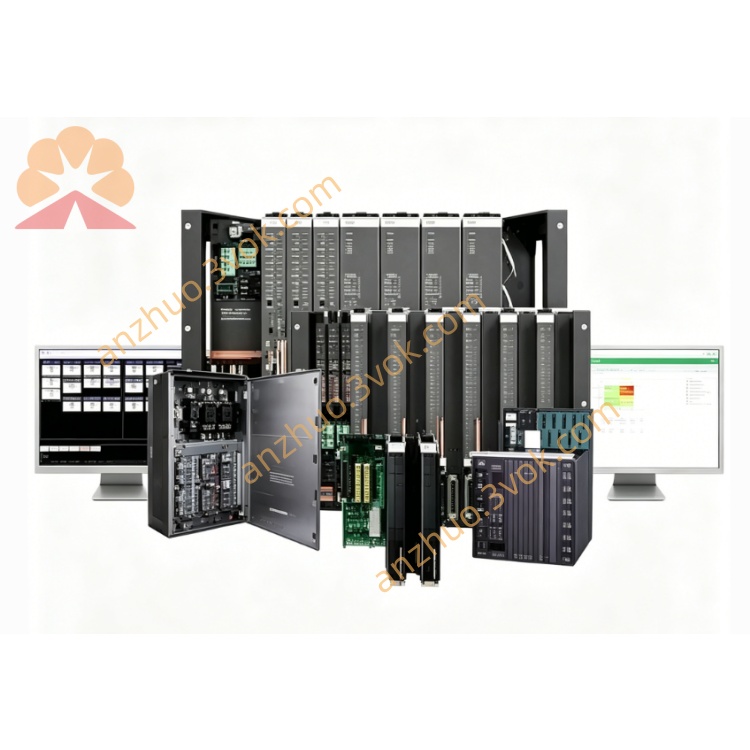
TRICONEX 4000042-310 factory pre-terminated heavy double-shielded hybrid QD cable
TRICONEX 4000042‑310 is a factory pre-terminated double heavy-shielded hybrid QD cable assembly designed exclusively for Tricon 3000 SIL 3 triple modular redundant safety instrument systems, compatible with system firmware versions V6 through V11. This harness integrates triplicated RS-485 TMR synchronization bus conductors and dedicated 24VDC auxiliary power twisted pairs, acting as the dedicated interconnection wiring between main processor chassis and adjacent stacked expansion I/O chassis inside compact safety control cabinets.
It adopts independent twisted differential signal bundles with individual aluminum foil shielding plus an overall dense braided copper shielding layer equipped with a dedicated grounding drain wire, which effectively suppresses severe EMI and RFI interference generated by cabinet power supplies, variable frequency drives and field communication wiring. Fixed factory-defined pinouts on dual molded green quick-lock QD connectors guarantee stable TMR bus synchronization, continuous auxiliary power delivery and full chassis self-diagnosis logic operation. The complete signal and power transmission loop satisfies IEC 61508 SIL 3 matching requirements and holds UL, CE and RoHS industrial safety certifications. It is widely deployed in safety-critical industrial applications including petrochemical emergency shutdown systems, fire and gas monitoring systems, steam turbine protection trip systems, boiler burner management systems and natural gas compressor anti-surge safety control systems.
Description
1. Product Brief Introduction
TRICONEX 4000042‑310 is a factory pre-terminated double heavy-shielded hybrid QD cable assembly designed exclusively for Tricon 3000 SIL 3 triple modular redundant safety instrument systems, compatible with system firmware versions V6 through V11. This harness integrates triplicated RS-485 TMR synchronization bus conductors and dedicated 24VDC auxiliary power twisted pairs, acting as the dedicated interconnection wiring between main processor chassis and adjacent stacked expansion I/O chassis inside compact safety control cabinets.
It adopts independent twisted differential signal bundles with individual aluminum foil shielding plus an overall dense braided copper shielding layer equipped with a dedicated grounding drain wire, which effectively suppresses severe EMI and RFI interference generated by cabinet power supplies, variable frequency drives and field communication wiring. Fixed factory-defined pinouts on dual molded green quick-lock QD connectors guarantee stable TMR bus synchronization, continuous auxiliary power delivery and full chassis self-diagnosis logic operation. The complete signal and power transmission loop satisfies IEC 61508 SIL 3 matching requirements and holds UL, CE and RoHS industrial safety certifications. It is widely deployed in safety-critical industrial applications including petrochemical emergency shutdown systems, fire and gas monitoring systems, steam turbine protection trip systems, boiler burner management systems and natural gas compressor anti-surge safety control systems.
2. Model Definition Explanation
TRICONEX is the triple modular redundant safety control hardware brand belonging to Schneider Electric, formerly Invensys, and the 4000XXX serial part number range covers all factory prefabricated chassis interconnection harnesses, field I/O cables and terminal base matching wiring accessories for Tricon safety systems.The base number 4000042 represents the hybrid signal plus auxiliary power QD chassis interconnection cable family, which is fundamentally different from the 4000043 series pure communication chassis cables that contain no power supply conductors.The suffix 310 defines the fixed finished physical length of the cable assembly as 9 feet, equivalent to 2.74 meters, and indicates the standard industrial heavy-duty double-shielded construction with dual ends fitted with green anti-loosening buckle-style proprietary QD connectors.
Within the 4000042 product family, different suffix digits correspond to distinct fixed lengths for different cabinet layout demands. This 2.74-meter variant is engineered for compact safety cabinets with moderately spaced stacked main and expansion chassis, and it cannot be substituted with generic multi-core field cables or other series wiring assemblies such as 4000058 and 4000093, which are only used for connections between I/O modules and field termination bases. There are no customized high-temperature or offshore marine special versions of this cable, and only the universal indoor cabinet installation grade is available.
3. Core Technical Parameters
Cable Structure and Signal & Power Performance
The overall factory finished length of the cable assembly is fixed at 2.74 meters. Inside the outer sheath are three fully independent twisted differential RS-485 signal bundles that correspond to the A, B, C three redundant TMR communication channels, alongside separate shielded twisted pairs dedicated to transmitting 24VDC auxiliary operating power for expansion I/O chassis. Each individual signal and power twisted bundle is wrapped with thick aluminum foil inner shielding, and the entire cable core set is covered by a continuous dense braided copper outer shielding layer with a separate grounding drain wire to form dual heavy anti-interference protection.All internal conductors adopt 22 AWG high-purity oxygen-free stranded copper, delivering ultra-low signal attenuation for differential bus transmission and stable continuous current carrying capacity for power supply circuits. The internal wire pin sequence strictly follows the original factory fixed definition to support three-channel synchronous TMR bus communication, reliable chassis auxiliary power feed and full-range chassis hardware self-diagnosis functions. The internal crosstalk suppression performance complies with ISA S71.04 G3 heavy industrial anti-corrosion and anti-electromagnetic interference grade. Both cable ends are equipped with original proprietary rectangular QD locking connectors with thick gold-plated contact pins and green side threaded anti-loosening buckles, resisting poor contact caused by long-term cabinet vibration and thermal expansion. The minimum allowable wiring bending radius is 11.684 centimeters to prevent permanent damage to internal twisted shielding conductors.
Electrical Insulation and Protection Specifications
The dielectric withstand voltage between internal conductors and the overall outer shielding layer reaches 1500VAC. Independent electrical isolation is maintained between each TMR communication bundle and auxiliary power pairs to eliminate cross-channel signal coupling and short-circuit interference faults. The outer jacket is constructed with heavy-duty low-smoke zero-halogen flame-retardant PVC material, featuring strong resistance to industrial oil mist, concentrated chemical volatile vapor and sustained high cabinet humidity. This cable assembly is a fully passive wiring accessory without any built-in electronic components, so it will not draw extra load power from the rack TriBus backplane bus or occupy the logic scanning and operation resources of main processors. The rated overall working voltage is 300V alternating or direct current, each single signal core supports a rated continuous current of 1.5 amperes, and the dedicated power twisted pairs support a continuous rated current of 3 amperes. Surge and short-circuit faults originating from field equipment cannot be coupled back into the rack internal TMR communication and power circuits through this cable assembly.
Environmental and Mechanical Specifications
The continuous stable operating temperature range is from minus 40 degrees Celsius to positive 105 degrees Celsius, while the long-term spare storage temperature range extends from minus 40 degrees Celsius to positive 85 degrees Celsius. It operates normally under relative humidity conditions of 5 percent to 95 percent without surface condensation. The cable assembly passes full industrial EMC verification tests including electrostatic discharge, radiated radio frequency interference, surge impact and fast transient pulse interference. Its mechanical vibration resistance reaches 2G within the frequency band of 10Hz to 150Hz, and impact resistance reaches 15G with a duration of 6 milliseconds, making it suitable for installation inside cabinets in chemical plants, compressor rooms and offshore Zone 2 control facilities. The cabinet internal installation protection grade is IP20, and the cable carries no intrinsic safety certification, so it cannot be directly routed into Zone 0 or Zone 1 explosive hazardous enclosures. The net weight of a single complete cable assembly is approximately 0.8 kilograms.
Safety Matching Certification Standards
The complete transmission loop composed of the 4000042‑310 cable assembly, Tricon main processor chassis, expansion I/O chassis and three redundant 8111 main processors fully meets the IEC 61508 SIL 3 safety integrity matching standard, and has obtained official TÜV, UL and RoHS industrial electrical safety certifications. All internal twisted shielding cores and QD connectors are industrial long-life components with a design service life of 15 years. The multi-group independent shielding structure eliminates common cause failure paths between redundant communication and power loops; local aging or partial damage to the cable will only affect partial channel communication or auxiliary power supply and will not trigger misjudgment of full-rack safety interlock logic.
4. Interfaces and Communication Configuration
Main Chassis End QD Interface
The male rectangular QD connector on one end precisely matches the rear composite communication and power integrated socket of Tricon V9 and V10 main processor chassis. After full insertion into the chassis port, the green side locking buckle must be fully tightened to form stable electrical connection for three groups of TMR redundant RS-485 bus lines and 24VDC auxiliary power pairs. This connector bidirectionally transmits synchronized sampling and logic data between main processors and expansion I/O chassis, chassis hardware fault diagnosis signals and continuous auxiliary operating power for expansion chassis circuits. Differential RS-485 transmission effectively suppresses complex electromagnetic interference inside the cabinet, and abnormal signals on a single redundant channel will not interrupt normal data transmission of the other two parallel redundant channels.
Expansion I/O Chassis End QD Interface
The matching female rectangular QD connector on the opposite end directly plugs into the central hybrid communication and power dedicated interface of Tricon expansion I/O chassis. All TMR TriBus signal lines and auxiliary power circuits on the expansion chassis correspond one-to-one with the fixed internal wire sequence of the cable assembly, realizing standardized 2.74-meter medium-distance hybrid signal and power transfer between main control chassis and closely stacked expansion I/O chassis. No adjustable hardware switches, dial codes or signal amplification circuits are integrated on the cable itself; all bus communication threshold parameters and diagnosis logic thresholds are solidified inside the internal communication circuits of Tricon chassis hardware.
Internal Signal and Power Transmission Mechanism
Triplicated synchronous data between main processors and expansion I/O chassis is transmitted through the triple-shielded twisted RS-485 conductors of the cable. Three independent signal bundles exchange redundant bus data synchronously on the A, B and C three redundant communication channels, then synchronized sampling and safety logic data are shared among three 8111 main processors via the TriBus backplane bus to complete two-out-of-three voting fault judgment. Meanwhile, 24VDC auxiliary power is fed from the main chassis to the expansion I/O chassis through dedicated shielded power twisted pairs inside the harness, providing standby operating power for expansion chassis logic circuits and hardware self-diagnosis circuits. All fault signals including bus open circuit, power overload, undervoltage and short circuit detected by chassis internal logic circuits are synchronously fed back to the main chassis through this cable assembly; fault information with millisecond timestamps is uploaded to TriStation configuration software for unified real-time display and historical recording.
5. Core Functions
First, it provides 2.74-meter compact triple heavy-shielded hybrid TMR TriBus and auxiliary power interconnection between stacked main and expansion chassis. Three fully isolated thick twisted communication bundles plus independent shielded power pairs transmit the redundant synchronization bus signals and chassis auxiliary power required by Tricon multi-chassis SIS architecture. Dual-layer heavy shielding drastically reduces electromagnetic interference generated by cabinet power cables, variable frequency drives and multi-group field communication wiring. The factory fixed internal wire sequence guarantees normal TMR bus synchronization, stable power supply and full chassis self-diagnosis operation for safety systems; generic non-original multi-core cables cannot replace this assembly, as substitution will lead to severe bus signal attenuation, redundant channel synchronization loss, expansion chassis undervoltage and complete failure of hardware self-diagnosis functions. The 2.74-meter fixed length is specifically optimized for compact safety cabinets with moderately spaced stacked expansion chassis layout.
Second, factory prefabricated dual-ended QD quick-lock connectors realize standardized wiring for compact multi-chassis safety cabinets. Each cable assembly is fully assembled and 100% electrical tested at the factory with matched proprietary QD connectors on both ends, eliminating on-site wire stripping, crimping and hybrid signal and power wiring errors. The green anti-loosening buckle design supports fast plug-and-play chassis stacking installation and prevents unstable contact caused by long-term cabinet vibration and thermal expansion, shortening the construction and maintenance cycle of compact safety instrument cabinets and achieving neat, dense standardized wiring layout for stacked multi-chassis racks.
Third, high-temperature heavy flame-retardant outer sheath adapts to harsh closed industrial cabinet environments. The thick low-smoke zero-halogen flame-retardant outer jacket blocks flame spread under accidental short-circuit thermal conditions, and exhibits outstanding resistance to heavy industrial oil mist, concentrated chemical volatile vapor and sustained high humidity. It maintains stable insulation performance under long-term continuous operation and will not harden, crack or suffer premature aging inside closed high-temperature compact control cabinets with dense component arrangement.
Fourth, passive ultra-low attenuation signal transmission and low voltage drop power supply without additional safety loop load. As a fully passive wiring accessory with no built-in electronic components, it does not consume extra power from the rack backplane bus or auxiliary cabinet power supply, and will not occupy scanning and operation resources of main processor safety logic cores. RS-485 bus signal attenuation is strictly controlled within factory calibrated ultra-low limits over the full 2.74-meter length, while power twisted pairs maintain tiny voltage drop to guarantee stable continuous operation of expansion chassis auxiliary circuits.
Fifth, full-channel heavy crosstalk suppression eliminates cross-channel bus and power mutual interference. Independent thick aluminum foil shielding for each TMR communication bundle and power pair plus the overall dense braided outer shielding forms a dual isolation structure, effectively blocking signal crosstalk between three redundant communication channels and interference generated by power supply loops. Even if a single chassis bus or power loop suffers short-circuit or surge faults, interference signals cannot be coupled into other TMR redundant communication channels through internal cable conductors, improving the overall communication stability and power supply reliability of compact multi-chassis safety instrument systems.
Sixth, standardized compact-length hybrid chassis bus spare part supports full lifecycle maintenance of small and medium safety cabinets. Uniform factory specifications and fixed 2.74-meter length facilitate centralized spare parts inventory management for chemical, oil and gas enterprises equipped with compact stacked multi-chassis safety cabinets. The 15-year design service life matches the service cycle of core Tricon rack modules, and aged or damaged cables must be replaced as a complete assembly; on-site partial core splicing repair that violates safety certification specifications is strictly prohibited.
6. Applicable Scenarios
This cable assembly is suitable for small and medium petrochemical local emergency shutdown compact main safety cabinets, used for 2.74-meter spaced interconnection between Tricon V9/V10 main processor chassis and stacked expansion I/O chassis, realizing synchronized TMR TriBus communication and auxiliary power supply for safety measurement and control channels of small reactor units.It can be deployed inside compact fire and gas Zone 2 explosion-proof control cabinets at onshore single-well oil and gas stations, connecting main fire and gas logic chassis and small multi-channel gas detection expansion I/O chassis, adapting to cabinet environments with high salt fog and strong mechanical vibration.It fits auxiliary small boiler and single-unit turbine SIL 3 safety protection compact cabinets in thermal power plants, realizing short-distance synchronized communication and auxiliary power transmission between main turbine protection chassis and flame detection and overtemperature expansion I/O chassis, resisting strong electromagnetic interference generated by turbine auxiliary variable frequency equipment.It applies to mini regional natural gas compressor anti-surge compact control cabinets, connecting main anti-surge logic chassis and local pressure and flow measurement expansion I/O chassis via 2.74-meter hybrid QD chassis bus wiring.It matches small-scale fine chemical reactor auxiliary safety monitoring compact cabinets, cooperating with certified intrinsically safe isolation barriers for Zone 1 field instruments to complete short-distance synchronized TMR bus communication and auxiliary power supply between main safety chassis and small signal expansion I/O chassis.It is applicable to renovation and spare parts replacement projects of old compact Tricon multi-chassis safety cabinets, fully compatible with all standard Tricon main processor chassis and expansion I/O chassis running firmware V6 to V11, and completely incompatible with Trident compact small safety system wiring accessories and non-Tricon third-party control equipment terminals.
7. Usage and Maintenance Instructions
Installation Requirements
First, strict compatibility restrictions apply. TRICONEX 4000042‑310 can only be matched with original Tricon V9/V10 main processor chassis and corresponding expansion I/O chassis hybrid QD communication and power ports. Replacement with third-party non-original multi-core cables will invalidate TMR bus synchronization performance, auxiliary power stability and chassis self-diagnosis functions, and void the entire system SIL 3 safety certification. The complete system must be equipped with three 8111 TMR main processors to realize three-channel bus voting fault judgment; single or dual processors cannot complete full synchronized chassis communication diagnosis.Second, standardized wiring layout constraints must be followed. This hybrid chassis cable shall be routed separately from high-current power cables and variable frequency drive output lines inside cabinets, maintaining a separation gap of no less than 10 centimeters to reduce electromagnetic coupling interference to RS-485 differential signals and power pairs. After fully inserting QD connectors at both ends into main and expansion chassis hybrid ports, the green side locking buckles must be fully tightened to prevent loosening caused by long-term vibration and thermal expansion. A bending radius of no less than 11.684 centimeters must be reserved during wiring, avoiding sharp bending and sharp metal extrusion that would damage internal thick shielding conductors. Sufficient small ventilation gaps shall be reserved along the entire cable routing path to prevent long-term high temperature from accelerating outer sheath aging.Third, hazardous area deployment restrictions must be observed. The cable assembly itself is only approved for wiring inside Zone 2 control cabinets and cannot directly connect field instruments located in Zone 0 or Zone 1 explosive hazardous areas. Certified intrinsically safe isolation barriers must be installed between expansion I/O chassis and field measurement equipment to limit loop energy and meet global explosion-proof safety specifications.
Daily Routine Inspection Standards
Daily visual inspection requires verifying that QD locking buckles at both cable ends are fully fastened without looseness, the entire outer sheath shows no cracking, abrasion, discoloration or oil contamination, and no dust accumulates at connector insertion openings and gold-plated contact pins.Daily software inspection requires logging into TriStation configuration software each day to review chassis communication and power diagnosis logs, confirming no continuous intermittent bus synchronization loss, signal drift, power undervoltage and crosstalk interference alarms caused by poor connector contact or damaged shielding layers.Bi-weekly mechanical inspection checks all cable fixing wire clamps along the full routing length for looseness, and verifies that the cable outer shielding drain wire is reliably single-point grounded to the cabinet public grounding bus bar to eliminate multi-point grounding induced communication and power interference faults.Monthly maintenance uses anti-static soft cloth to wipe dust and oil stains on the entire cable surface and QD connector pins, inspects the outer sheath for aging embrittlement, and measures internal cabinet ambient temperature to confirm operation within the range of minus 40 degrees Celsius to positive 105 degrees Celsius.
Regular Inspection and Calibration Cycle
For standard indoor low-interference control rooms, a full cable function inspection shall be conducted every 12 months, including full-length internal conductor continuity testing, shielding layer integrity detection, three-channel RS-485 bus isolation performance testing, power pair voltage drop testing and TMR communication synchronization accuracy verification. For coastal salt fog workshops, high-temperature furnace-side cabinets and compressor room strong vibration environments, the inspection cycle shall be shortened to 6 months.During regular inspection, slight cable extrusion and QD connector looseness shall be simulated to verify system communication and power fault diagnosis sensitivity. All historical intermittent signal and power fault records shall be exported, and paper inspection records including inspection date, test data and operator information shall be retained for factory safety compliance audit filing.
Common Fault Handling Procedures
When TriStation software reports simultaneous intermittent bus synchronization loss and expansion chassis undervoltage alarms, first check whether the green QD locking buckles at both ends of 4000042‑310 are loose. Pull out the QD connectors, clean internal gold-plated pins with anti-static cleaning agent, reinsert and fully lock the buckles. If the fault persists, internal twisted communication or power conductors have fractured due to long-term bending fatigue, and the complete cable assembly must be replaced with the same model spare part.When analog measurement channel values continuously drift and expansion chassis occasionally restart, inspect whether the cable outer shielding drain wire is disconnected or multi-point grounded along the routing path. Rearrange single-point shielding grounding wiring, separate the cable from adjacent high-power interference cables, and replace the entire cable assembly if internal channel shielding layers are damaged or power conductor aging causes excessive resistance.When an entire expansion chassis shows permanent loss of communication and auxiliary power supply, disconnect the cable from the main chassis and expansion chassis respectively, and use a multimeter to test full-length continuity of internal communication and power conductors. If any conductor presents open circuit failure, replace the complete cable assembly; on-site splicing of broken internal cores is strictly forbidden.When local sections of the cable outer sheath show obvious cracking, hardening or oil corrosion, directly replace the whole cable assembly. Partial wrapping repair cannot restore the original heavy shielding and flame-retardant performance, and will invalidate the safety certification of the entire chassis communication and power hybrid transmission loop.
On-site disassembly of QD connectors, cutting of the outer sheath to splice internal communication and power conductors, and modification of internal wire sequence are all prohibited operations. Any disassembly or hardware transformation will invalidate SIL 3, UL and CE safety certifications of the whole TMR chassis hybrid signal and power transmission loop, and faulty cables must be replaced as a complete unit rather than partial component repair.
Spare Cable Storage and Full Lifecycle Management
Offline spare TRICONEX 4000042‑310 cable assemblies shall be stored in constant-temperature dry warehouses with ambient temperature maintained between 0 degrees Celsius and 40 degrees Celsius and relative humidity controlled below 70 percent. Original plastic protective caps shall be placed over both-end QD connectors to protect gold-plated contact pins, cables shall be coiled with a loose large radius without tight binding, and sealed inside original anti-static packaging bags to prevent static electricity from damaging internal thin shielding conductors. Storage environments with direct sunlight, corrosive chemical gas and heavy dust accumulation are prohibited.Every six months, spare cable assemblies shall be taken out for a 30-minute joint power-on test matched with corresponding main and expansion I/O chassis, verifying continuity of all communication and power conductors, shielding layer integrity, stable power output and normal operation of channel self-diagnosis functions. The design service life of cable assemblies under rated continuous operation is 15 years, and all on-site installed cables shall be replaced in batches upon reaching the design service life to maintain the overall SIL 3 safety integrity level of Tricon safety instrument systems.
Maintenance Safety Prohibitions
Unauthorized disassembly of dual-ended QD connectors, cutting of the cable outer sheath, rearrangement of internal communication and power conductor wiring or stripping of shielding layers of TRICONEX 4000042‑310 is strictly prohibited. Any hardware modification will invalidate all SIL 3 functional safety, UL and CE electrical safety certifications of the entire short-distance chassis hybrid signal and power transmission loop.This cable assembly shall not be routed alongside high-current power cables exceeding 300V alternating or direct current for long-term periods; prolonged adjacent electromagnetic radiation will permanently damage the internal heavy shielding performance of signal and power conductors.All maintenance operations including plugging and unplugging QD hybrid cable connectors, rearranging cable routing and replacing complete cable assemblies must be performed by certified SIS safety instrument maintenance personnel. Before conducting any cable maintenance, corresponding multi-chassis safety control loops must be isolated and locked to avoid safety interlock misjudgment and unplanned production shutdown accidents caused by transient loss of communication or power during disconnection.Plugging or replacing cable assemblies during critical production startup phases, full-load continuous operation periods and emergency accident handling stages is forbidden. All cable maintenance work must be scheduled during planned full-equipment shutdown maintenance windows.This cable assembly cannot independently realize TMR chassis synchronization communication and auxiliary power supply without matching Tricon main processor chassis, dedicated expansion I/O chassis and redundant 8111 main processor racks, and cannot be modified to connect terminals of non-Tricon third-party safety control equipment.
Get a Quote