
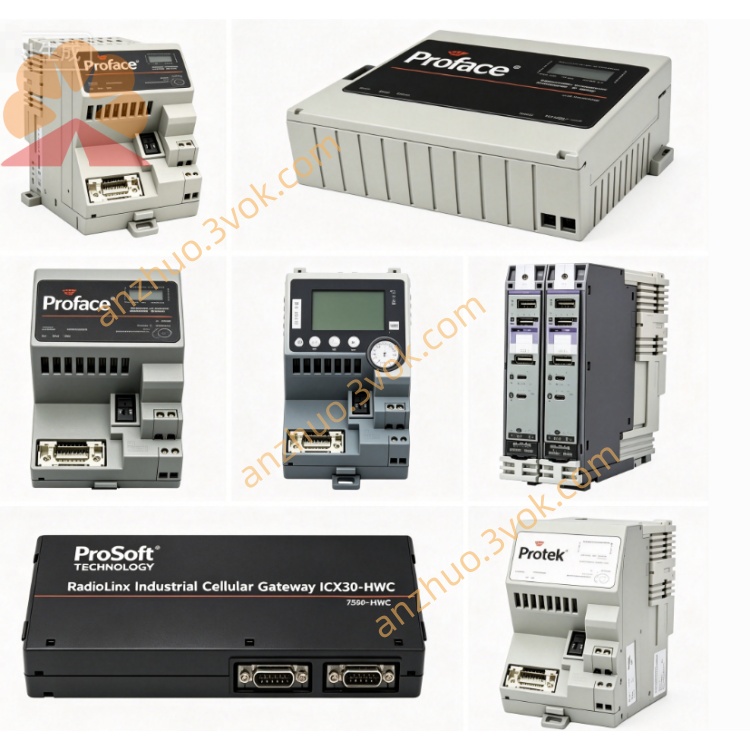
MVI69‑MCM Single‑Slot Modbus RTU/ASCII Master‑Slave Module for 1769 CompactLogix and
Description
ProSoft MVI69-MCM Product Description
MVI69-MCM (Modbus Master/Slave Communication Module) is a high-performance dual-channel Modbus serial communication module developed by ProSoft for the Rockwell CompactLogix / MicroLogix 1500 platform. It provides 2 independent, fully isolated RS-232/422/485 ports that can be independently configured as Modbus master or slave, supporting both RTU/ASCII protocols. It is an industrial-grade standard solution for medium and large-scale systems, multi-device networking, and high-speed data interaction.
I. Model Interpretation
MVI69: Standard series of CompactLogix 1769 platform
MCM: Modbus Master/Slave (Modbus Master/Slave Station)
Core Positioning: Two independent serial ports, full electrical isolation, any combination of master/slave, large-capacity data buffer, high performance, single slot, zero PLC load
II. Core Hardware Specifications
Compatible Platforms
CompactLogix: Full series L20/L23/L30/L31/L32/L35, L43/L45 (v16.03+)
MicroLogix 1500: LRP firmware v6.0+
1769 I/O bus, single-slot installation
Backplane power consumption: Maximum 800mA @ 5.1VDC
Serial interfaces (3 ports)
Application ports (P1, P2): 2 independent, jumpers selectable for RS-232/RS-422/RS-485, RJ45 (with DB9 adapter)
RS-232: Supports hardware handshake (RTS/CTS)
RS-485: 2-wire half-duplex, 32 nodes, long distance (1200m@19200bps)
Configuration port (CFG): 1 channel, only RS-232, for configuration/debugging
Electrical isolation: 500Vrms optical isolation (between backplane and serial ports)
Baud rate: 110 ~ 115200 bps
Data format: 7/8 data bits, 1/2 stop bits, no / even / odd parity
Data buffer: 4000 bytes (2000 bytes read / 2000 bytes write) super-large bidirectional database
Modbus capacity
Each port can be independently configured as a master or slave
Master mode: Each port can have a maximum of 64 commands, polling 32 slave stations
Slave mode: Each port can be fully accessed by the remote master station
Supported function codes: 1, 2, 3, 4, 5, 6, 8, 15, 16, 17, 22, 23
Data format: Standard 16-bit integer, standard floating point, Enron/Daniel floating point
LED status: OK, BP, CFG, P1, P2, ERR six groups of indicator lights
Operating environment
Temperature: 0°C ~ +60°C
Storage: -40°C ~ +85°C
Humidity: 5% ~ 95% (no condensation)
Certification: CE, UL, cURus, RoHS
III. Core Functions and Performance
1. Dual-channel independent Modbus communication (core advantage)
Dual ports are completely independent
P1 and P2 ports do not interfere with each other, can run different protocols, modes, and baud rates simultaneously
Flexible networking: Master + Master, Master + Slave, Slave + Slave in any combination
Protocol support: Modbus RTU (efficient binary) and Modbus ASCII (compatible with old devices)
Strong polling capability of the master station
64 user-defined commands per port, supporting continuous, conditional, and event-triggered
Command priority, polling interval, and retry count can be finely configured
Support for broadcast write commands, simultaneously controlling multiple slave stations
Transparent communication of slave stations
As a Modbus slave station, respond to all standard function codes
Direct mapping of database to PLC memory, remote master station can directly read and write PLC data
Advanced data processing
Support for floating-point, bit operations, word/byte order swapping, compatible with all third-party devices
Data scaling, slope/intercept correction, directly processing raw data from instruments
Real-time monitoring of command status, response time, and error count
2. Seamless integration with PLC system
Deep integration with Studio 5000/RSLogix
Provides AOI, UDT, example programs, no need for low-level protocol programming
Module status, port status, commands, errors all mapped to PLC tags
Configuration files saved to PLC project, one-click backup/restore ProSoft Configuration Builder (PCB)
Visual drag-and-drop configuration, command editor, data monitoring
Online debugging, data capture, log analysis
Configuration export/import, batch deployment, project cloning
3. Industrial-grade reliability
Full electrical isolation
500Vrms isolation: anti-surge, anti-static, eliminating ground circulation, protecting PLC and field devices
Powerful diagnostics and redundancy
Automatic reconnection in case of disconnection, command retry, timeout handling
Detailed error codes, event logs, communication statistics
Dual-port redundancy, hot backup of critical links
Independent operation
Zero PLC CPU load,不影响 system scanning time
Module failure does not affect PLC host
4. Core features and advantages
1. High performance, large capacity
Two independent ports: double communication capability, saving slots, reducing costs
4000-word database: meeting requirements for massive data collection, large SCADA systems
128 main station commands (64×2): preferred for complex multi-device networking
500V full isolation: stable operation in extreme industrial environments
2. Flexible, universal
RS-232/422/485 three modes: compatible with all serial devices
Any combination of master/slave stations: suitable for all networking architectures
RTU/ASCII dual protocols: fully compatible with old and new devices
Compatible with CompactLogix/MicroLogix: cross-platform universal
3. Easy to use, reliable
AOI/UDT ready to use out of the box: rapid development, reducing debugging
PCB visual configuration: lowering technical threshold, improving efficiency
Industrial design, wide temperature range, no fan: long-term stability, maintenance-free
3-year warranty, global technical support: ensuring investment, trouble-free operation
5. Typical application scenarios
Medium-sized OEM equipment: dual-path independent connection of Modbus instruments, frequency converters, servo, HMI
Multi-device data collection: polling 32+ Modbus slave stations (instruments, sensors, PLCs)
Dual network communication between PLCs: dual-link redundancy between CompactLogix and third-party PLCs
SCADA system: as a Modbus slave station, connecting to upper-level SCADA
Old factory renovation: dual-path parallel upgrade, simultaneously connecting new and old Modbus devices
Distributed control: RS-485 long-distance networking, remote I/O, drivers, instruments
6. Summary
MVI69-MCM is the flagship standard module for Modbus serial communication on the CompactLogix platform. With two independent fully isolated serial ports (RS-232/422/485), any combination of master/slave stations, Modbus RTU/ASCII dual protocols, 4000-word ultra-large database, 128 main station commands, zero PLC load, deep integration with Studio 5000, industrial-grade reliability, 3-year warranty, as core advantages, it is designed specifically for medium-sized systems, multi-device networking, high-speed data interaction, critical link redundancy, large-scale old factory renovation, and is a high-performance, high-reliability, one-stop industrial-grade solution for Rockwell PLCs accessing Modbus serial networks.
Get a Quote