
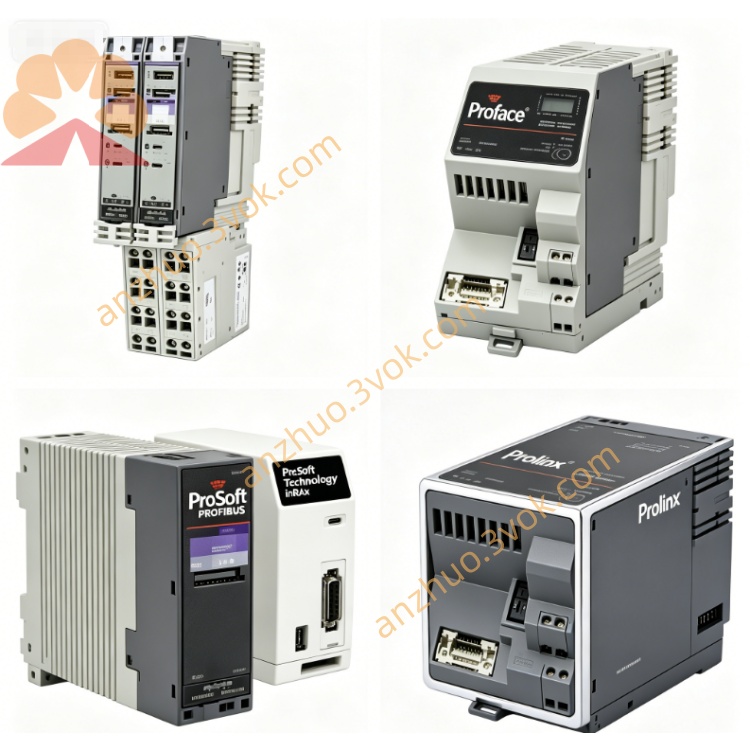
MVI69‑DFCM Single‑Slot DF1 Master‑Slave Serial Communication Module for 1769 CompactLogix and MicroLogix‑1500 Controllers
Description
Product Description of ProSoft MVI69-DFCM
MVI69-DFCM (DF1 Communication Module) is a DF1 master/slave station communication module specially designed by ProSoft for the Rockwell CompactLogix/MicroLogix 1500 platform. It provides 2 independent and software-configurable RS-232/422/485 serial ports. Each port can be independently set as a DF1 master station or slave station, enabling stable communication between CompactLogix and SLC 500, PLC-5, MicroLogix, and various DF1 protocol devices. It is the core communication module for integrating old AB systems and networking multiple PLCs.
I. Model Analysis
MVI69: Specialized module for CompactLogix / MicroLogix 1769 platform
DFCM: DF1 Communication Module (DF1 communication module)
Core Positioning: Dual-port independent, DF1 master/slave station, optically isolated, fully compatible with all AB series, backplane high-speed communication
II. Core Hardware Specifications
Compatible Platforms:
CompactLogix: L20/L30/L35/L43/L45 (L43/L45 need to be installed in the first 2 slots of the rack) MicroLogix 1500 LRP
Incompatibility: 1769-L23E-QBFC1B, 1769-L16x, 1769-L18x
Slot occupation: Single slot (standard 1769 size)
Backplane power consumption: 800mA @ 5.1VDC (no 24VDC power consumption)
Serial port application (2 ports: P1 / P2):
Electrical standard: RS-232/RS-422/RS-485 software configurable
Isolation voltage: 500V optically isolated (protecting PLC from field devices)
Mode: Full duplex / Half duplex configurable
Baud rate: 110bps ~ 115.2kbps
Connector: RJ45 (with RJ45→DB9 adapter)
Flow control: Hardware handshake (RTS/CTS), supporting radio, Modem
Configuration port (CFG): RS-232 (RJ45), used for module configuration, firmware upgrade
Internal database: Maximum 5000 register (user can customize)
Command list: 100 DF1 commands per main station port
Single command length: Read / Write maximum 125 bytes
Data support: Integer, floating-point data transmission
Check method: CRC, BCC error checking
Status indicator: OK, ERR, P1, P2 four groups of LED
Operating temperature: 0°C ~ +60°C
Storage temperature: -40°C ~ +85°C
Humidity: 5% ~ 95% (no condensation)
Certification: CE, UL, cURus, RoHS
III. Core Functions and Performance
1. DF1 protocol support (core advantage)
Dual port independence: P1, P2 ports are completely independent and can be freely combined as master / slave stations
Master station mode: Active polling of DF1 slave station devices (PLC, instrument, sensor)
Slave station mode: Respond to read/write requests from external DF1 master station (PLC, upper computer)
Protocol compatibility: Fully compatible with Allen-Bradley DF1 full protocol (ASCII, RTU, transparent transmission)
Broadcast communication: Supports address 255 broadcast commands
Master station optimization: Automatically optimizes polling sequence, automatically retries in case of communication failure
Slave station transparent: External master station can directly access the 5000-byte database of the module, mapping PLC tag
2. Serial port communication characteristics
Electrical isolation: 500V optically isolated, stable and reliable in strong electromagnetic environment
Multi-machine network:
RS-485: 32-node point-to-point bus
RS-422: Full-duplex point-to-point
RS-232: Point-to-point (≤15m)
Hardware flow control: Supports RTS/CTS, compatible with wireless radio, modem
Data format: 7/8 data bits, 1/1.5/2 stop bits, odd/even/no parity
3. Backplane high-speed communication (PLC interaction)
Asynchronous exchange: Module and PLC data exchange is asynchronous with the DF1 network, does not affect PLC scanning
Data mapping: 5000-byte database directly mapped to PLC controller tag
Interaction mode:
Periodic I/O data mirroring
Ladder diagram AOI, MSG instruction control
Real-time reporting of status, error code
Transmission delay: < 1ms (backplane high-speed bus)
4. Configuration and diagnosis
Configuration software: ProSoft Configuration Builder (PCB)
Visual configuration of ports, master station commands, database mapping
Configuration file download, backup, batch copying
Online diagnosis:
Port status, communication traffic, error count
Master station polling status, slave station response monitoring
Module operation log, fault code
IV. Core Characteristics and Advantages 1. Seamless integration of AB system
Native compatibility: Specifically designed for CompactLogix/MicroLogix, single slot, backplane power supply
Plug-and-play: PLC automatically recognizes as I/O module, no additional programming required
Tag mapping: Direct conversion of DF1 data to PLC tags, simplifying program development
Program support: Provides Studio 5000 AOI, ladder diagram routines
2. Dual-port independent, flexible networking
One master and one slave: Polling subordinate devices simultaneously, responding to the superior PLC
Dual master stations: Simultaneously controlling two groups of DF1 slave station networks
Dual slave stations: Simultaneously accessing two DF1 master station systems
Mixed electrical: P1 = RS-232, P2 = RS-485, suitable for different devices
3. Industrial-grade reliability
Optical isolation: 500V isolation against surges, interference, and ground potential difference
Independent operation: Module failure does not affect the PLC host
Power loss protection: Configuration and command list not lost during power failure
Wide temperature design: 0~60℃, suitable for harsh factory environments
4. Efficient development, easy maintenance
Visual configuration: PCB software drag-and-drop configuration, rapid deployment
Online debugging: Real-time monitoring of communication status, quick fault location
Batch application: Configuration files can be copied in one click, rapid production at multiple sites
V. Typical application scenarios
Integration of old AB systems: CompactLogix connects to SLC 500, PLC-5, MicroLogix networks
Multi-PLC networking: DF1 master-slave communication and data sharing between AB PLCs
Connection of intelligent instruments: Connecting power monitoring, energy meters, sensors, HMI, etc., to DF1 devices
Remote wireless communication: Realizing remote DF1 communication through radio stations, GPRS Modem
Slave station proxy: CompactLogix acts as a DF1 slave station, responding to SCADA, upper computer monitoring
Data forwarding gateway: Dual-port transparent transmission and protocol conversion between DF1 ↔ DF1
Renovation of old equipment: Connecting non-ethernet old equipment to CompactLogix system
VI. Summary
MVI69-DFCM is the standard solution for DF1 protocol communication on the CompactLogix platform. With dual independent isolated serial ports, flexible master/slave station configuration, 5000-byte large data buffer, backplane high-speed asynchronous communication, full series of AB compatibility, industrial-grade reliability, and visual configuration as core advantages, it is specifically designed for upgrading old AB systems, multi-PLC networking, DF1 instrument connection, and remote wireless communication scenarios. It is the preferred communication module for achieving full interconnection of Rockwell's entire series of equipment in industrial automation.
Get a Quote