
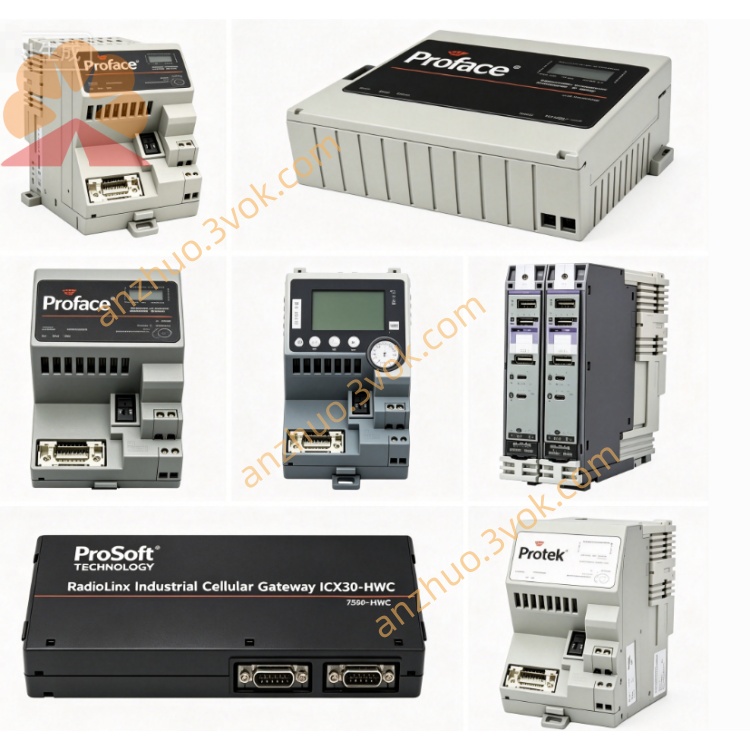
MVI69‑ADMNET Single‑Slot C‑Programmable Application‑Development Module with Ethernet for 1769 CompactLogix and MicroLogix‑1500 Controllers
Description
Product Description of ProSoft MVI69-ADMNET
MVI69-ADMNET (Application Development Module with Ethernet) is a C-language programmable application development module with Ethernet specially designed by ProSoft for the Rockwell CompactLogix/MicroLogix 1500 platform. It adds 10/100Mbps Ethernet ports to the MVI69-ADM model and supports custom C programs, dual isolated serial ports, Ethernet communication (such as Modbus TCP/IP, EtherNet/IP, etc.). It is the core development tool for the CompactLogix platform to achieve highly customized communication + Ethernet networking.
I. Model Analysis
MVI69: Specialized module for CompactLogix / MicroLogix 1769 platform
ADM: Application Development Module
NET: Integrated 10/100Mbps Ethernet interface
Core Positioning: C language programmable, independent operation, dual isolated serial ports, Ethernet networking, algorithm protection
II. Core Hardware Specifications
Compatible Platforms: Rockwell CompactLogix (L20/L30/L35/L43/L45 etc.), MicroLogix 1500 LRP, Soft Technology Inc.
Incompatible: 1769-L23E-QBFC1B, 1769-L16x, 1769-L18x
Slot Occupancy: Single slot (standard 1769 size)
Backplane Power Consumption: 800mA @ 5.1VDC, 3mA @ 24VDC
Processor: 32-bit high-speed RISC CPU (independent of PLC, does not occupy main CPU resources)
Serial Port Configuration (3 Ports):
CFG: RS-232 (RJ45/DB9), used for debugging / configuration / program download
PRT1 / PRT2: 2 fully isolated application serial ports
Electrical Standards: RS-232/RS-422/RS-485 software configurable
Isolation Voltage: 2.5kV photoelectric isolation
Connector: DB9 pin
Ethernet Interface (1 Port):
Standard: 10/100Base-TX adaptive
Connector: RJ45
Protocols: Supports Modbus TCP/IP client/server, EtherNet/IP, custom TCP/UDP
Connection Number: Maximum 32 concurrent TCP connections
Memory:
Flash: 512KB (stores C programs, configuration, firmware)
RAM: 512KB (program execution, data cache)
Data Buffer:
Input/Output Mirror: Maximum 4000 bytes / direction
User Data Area: 64KB shared RAM (PLC ↔ ADMNET high-speed interaction)
Status Indicators: OK, APP, ERR, PRT1, PRT2, CFG, LINK, ACT eight groups of LEDs
Operating Temperature: 0°C ~ +60°C
Storage Temperature: -40°C ~ +85°C
Humidity: 5% ~ 95% (no condensation)
Anti-interference: Vibration 5g, shock 30g (running) / 50g (non-running)
Certifications: CE, UL, cURus, RoHS
III. Core Functions and Performance
1. C language programmable (core advantage)
Development Environment: Supports standard C language programming (ProSoft dedicated compiler/library)
Operating System: Real-time multi-tasking kernel (DOS 6-XL)
Independent Operation: C program is fully executed on the module, not affecting PLC scanning
Algorithm Protection: Dedicated algorithms are fixed in the module Flash, preventing copying and reverse engineering
Development Support: Provides function libraries (serial port, Ethernet, backplane, timer, interrupt), routines, debugging tools
2. Dual Isolated Serial Port Performance
Baud Rate: 110bps ~ 115.2kbps fully configurable
Data Format: 7/8 data bits, 1/1.5/2 stop bits, odd/even/no parity
Flow Control: RTS/CTS, XON/XOFF configurable Work mode: Full-duplex / Half-duplex, Point-to-point / Multi-point (RS-485)
Single port maximum nodes: RS-485 supports 32 nodes, multi-slave network
3. Ethernet communication performance
Modbus TCP/IP: Supports 32 client/server connections, function codes 01-06, 08, 15, 16, 22, 23
EtherNet/IP: Supports explicit information messages, PLC tag reading and writing
Custom TCP/UDP: Supports Socket programming to implement private Ethernet protocol
Data throughput: Ethernet data exchange < 5ms delay
IP configuration: Static IP, DHCP automatic acquisition
4. Backplane communication (PLC interaction)
Data interaction: Through 1769 backplane for high-speed data exchange with CompactLogix
Interaction mode:
Input / Output data mirroring (periodic)
64KB shared data area (random read/write, event triggered)
Support MSG instructions, ladder diagram AOI, status/error code reporting
Data throughput: Backplane data exchange < 1ms delay
5. Advanced development features
Multi-task: Supports multi-threaded C programs (serial port task, Ethernet task, algorithm task, timing task)
Interrupts: Serial port receive/send interrupt, Ethernet interrupt, timing interrupt, backplane interrupt
Timers: High-precision software timers (1ms resolution)
Hot swapping: Supports CompactLogix rack replacement online
Power-off protection: Flash stored programs/configuration, no loss of data upon power failure
Firmware upgrade: Supports online firmware update via CFG port or Ethernet
4. Core features and advantages
1. Highly customizable (solving non-standard + Ethernet issues)
Break through PLC limitations: Achieve non-standard protocols, dedicated messages, encryption algorithms, high-speed acquisition, Ethernet networking, etc. that are difficult for PLC to accomplish
Two independent serial ports + Ethernet: Run two serial port protocols + one Ethernet protocol simultaneously, a single module solves the access and networking of multiple devices + networking
Independent calculation: Complex mathematical operations, filtering, logical judgment, protocol conversion do not occupy PLC scanning time
2. Industrial-grade reliability and security
2.5kV photoelectric isolation: Protect PLC and modules in strong electromagnetic environments
Independent CPU: Module failure does not affect the operation of the PLC host
Algorithm encryption: Core intellectual property is securely fixed to prevent leakage
Ethernet isolation: Built-in network isolation to protect PLC from network attacks
3. Seamless Rockwell integration
Single slot, backplane power supply, no additional power / wiring required
Provide Studio 500 AOI, ladder diagram routines, configuration software
Data transparent mapping: C program variables ↔ PLC tags directly corresponding
4. Convenient development, simple maintenance
Standard C language: Engineers can quickly get started, reducing development barriers
Debugging tools: Serial port debugging, Ethernet debugging, online monitoring, breakpoint debugging, log recording
Configuration backup / restoration: Quick deployment, batch copying
5. Typical application scenarios
Non-standard protocol + Ethernet gateway: Connect to dedicated instruments, sensors, old equipment's private serial port protocols, and upload data through Modbus TCP/IP
Industrial data encryption transmission: Serial port data acquisition + Ethernet encrypted upload, security authentication, key verification
High-speed data acquisition + networking: High-frequency sensors, high-speed counters, waveform acquisition (PLC scanning cannot keep up), upload through Ethernet in real time Multi-protocol Hybrid Gateway: Single-module implementation for Modbus RTU ↔ Modbus TCP/IP, and dedicated protocol ↔ EtherNet/IP bidirectional conversion
Intellectual Property Protection: Core control algorithms and process formulas are solidified in the module and are protected from replication
Complex mathematical operations + Remote Monitoring: FFT, PID optimization, predictive control, big data filtering, results are remotely monitored via Ethernet
Renovation of Old Equipment + Networking: Protocol-less document equipment connected to the CompactLogix system and accessed via Ethernet to the factory network
VI. Summary
MVI69-ADMNET is a CompactLogix platform with Ethernet-enabled C language programmable universal application development module. With independent 32-bit CPU, dual isolated serial ports, 10/100Mbps Ethernet, standard C programming, 64KB high-speed shared memory, seamless backplane integration, industrial-grade reliability, and algorithm security encryption as its core advantages, it is specifically designed to address customized requirements that cannot be achieved by PLC standard functions such as non-standard communication, proprietary algorithms, high-speed data, Ethernet networking, and intellectual property protection. It is the preferred development tool for industrial automation projects to break through technical limitations, protect core technologies, and achieve device networking.
Get a Quote