
From equipment to system: Schneider Electric's "Golden Quadruple" enables collaborative upgrade of food packaging
Currently, the packaging equipment market in China is experiencing steady growth. According to industry reports, by 2029, the sales volume of the Chinese food packaging industry is expected to approach 1.5 trillion yuan. Behind this huge market size lies the continuous upgrading of consumption structure and production mode: the demand for personalized packaging is constantly emerging, the material system is becoming increasingly diverse, the production process is accelerating towards digitalization, and enterprises are continuously accelerating their "going global" pace. Multiple factors are jointly shaping a new stage of industry development.
During this process, enterprises also encounter more complex practical challenges - how to maintain efficient response under the order structure of multiple SKUs and small batches, how to achieve a balance between product quality and production line speed, and how to promote digital transformation in a more controllable manner. These have become the core issues of concern in the industry. The food packaging industry is moving from the optimization and upgrading of individual equipment to a stage that places greater emphasis on systematic capabilities and overall coordination.
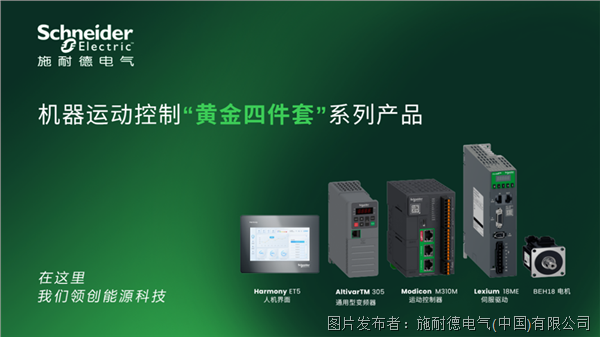
In this context, Schneider Electric introduced the new generation of machine motion control "golden quadruple" integrated solution developed locally to the food packaging industry. This solution consists of Harmony ET5 human-machine interface, Altivar 305 universal inverter, Lexium 18ME servo drive, BEH18 servo motor, and Modicon M310M motion controller. Based on the native collaboration among the core components of motion control, through systematic design, the overall performance is released. This solution has four advantages: efficient collaboration, flexible adaptation, balanced performance, and simplified operation and maintenance, providing food packaging enterprises with a more certain path for transformation and upgrading.
Native collaboration, building a solid system foundation
In the context of increasingly complex equipment and production lines, the improvement of the performance of a single equipment component often cannot independently support the overall efficiency improvement. The efficient collaboration among equipment has become one of the focuses of the industry.
The "Gold Four-Component System" achieves a more closely integrated coordination among the human-machine interface, controller, frequency converter, servo drive, and motor through unified design. This enables the system to form a more seamless connection at the communication, control, and execution levels, enhancing the equipment's response efficiency throughout the "perception-decision-execution-regulation" entire process, with the maximum improvement reaching approximately 30%. For instance, in typical application scenarios such as multi-column small bag vertical packaging machines, the combination of Lexium 18ME servo system and Modicon M310M motion controller can achieve highly consistent motion control responses, which helps improve the equipment's operational stability and output consistency.
In practical applications, this collaborative advantage is also reflected in the equipment debugging and operation maintenance stages. Through more integrated design, it can effectively simplify the system setup and debugging processes, enabling equipment manufacturers and end-users to focus more on process optimization and capacity enhancement.
Flexible adaptation to meet the changing production demands
The rapid changes in the food consumption sector are driving the packaging production lines to evolve towards a higher level of flexibility. The increase in the number of SKUs and the fragmentation of orders have placed higher demands on the equipment in terms of "changeover efficiency" and "extension capability".
The flexibility of the "Gold Four-Component System" is primarily reflected in the architecture design of the unified control platform. The Modicon M310M motion controller supports up to 64-axis synchronous control capabilities, which can cover the core application requirements of various packaging equipment such as pillow-type, vertical type, labeling, and filling, helping to reduce the complexity brought about by multi-platform parallel operations.
Meanwhile, through the formula management and parameter invocation mechanism, the production line can achieve more efficient parameter matching and adjustment during product switching. In the e-commerce-driven small-batch, multi-batch production environment, operators can call the preset formulas through the human-machine interface touch screen. The controller and each servo axis can achieve coordinated response, quickly complete parameter loading and positioning, thereby shortening the production switch preparation time and improving the overall production line utilization rate.
Furthermore, the modular expansion capability also provides greater flexibility for equipment upgrades and production line adjustments. Enterprises can gradually expand the system functions according to their business development needs, thereby more calmly advancing production line optimization and capability enhancement.
Balanced performance, taking into account both speed and quality
In the field of food packaging, high speed and high precision often need to be balanced. The overall performance of the system depends on the level of coordination between the control algorithm and the execution components.
Through the deep collaboration between the controller and the servo system, the "Golden Four-Component Set" can better support scenarios of high-speed synchronous control. For instance, in a multi-column small bag vertical packaging machine, the native collaborative communication between the Modicon M310M motion controller and the Lexium 18ME servo helps achieve millisecond-level synchronous control. Combined with a maximum speed loop bandwidth of 3.2 kHz, the system can more quickly correct deviations during high-speed operation, thereby reducing the occurrence of missed or incorrect packaging.
When handling fragile materials such as bread and puffed foods, the BEH18 servo motor is equipped with a 23-bit high-resolution encoder, providing a foundation for achieving sub-millimeter-level precise positioning. At the same time, the adaptive gain algorithm built into the Lexium 18ME servo driver can compensate for load changes, making the motion trajectory smoother and thereby helping to reduce the rate of packaging damage.
This synergy between rigid control and flexible handling enables the equipment to maintain balanced performance under various conditions, providing support for enhancing the overall efficiency of the equipment.
Simplify complexity and promote the implementation of digital capabilities
Although digital transformation has become an industry consensus, in the actual implementation process, enterprises pay more attention to the feasibility of the path as well as the balance between investment and output.
The "Gold Four-Component System" lays the foundation for subsequent digital applications by pre-installing data collection and communication capabilities at the equipment level. For instance, traditional pillow-type packaging machines, due to the lack of standard interfaces, rely heavily on manual data recording. By adopting the overall solution of the "Gold Four-Component System" and using the Modicon M310M motion controller as the data node, key operational parameters such as servo torque and inverter energy consumption can be collected and transmitted in real time, providing support for production visualization and status monitoring.
At the development and operation levels, for complex packaging equipment, the EcoStruxure Machine Expert software platform provides standardized function blocks and industry application templates, which helps to shorten the development cycle and reduce the reliance on professional programming skills, making digitalization capabilities more easily implemented.
Based on the above data and the platform capabilities, enterprises can also gradually explore application scenarios such as remote diagnosis and predictive maintenance, promoting the transformation of the operation and maintenance model from passive response to active management. For example, in multi-column packaging machines, the Modicon M310M gateway can be used to achieve remote access to the servo operation status, which not only helps in quickly locating faults but also facilitates risk prediction based on data analysis.
Application Practice: The Manifestation of Collaborative Value in Equipment Innovation
In the cooperation with a leading packaging equipment enterprise in Zhejiang Province, the "Golden Four-Component Set" served as the control core for the new generation of high-speed pillow-type packaging machines and intelligent material handling lines, demonstrating the integration value brought about by system collaboration.
During the project commissioning phase, the data showed that by adopting advanced automation technology and mechanical design, the packaging speed of the high-speed pillow packaging machine could reach 1,500-2,000 packages per minute; and by using intelligent algorithms for automatic parameter adjustment, the intelligent belt materializing line could reduce the need for manual parameter adjustments by approximately 20%, resulting in significant improvements in production efficiency and product quality.
With the continuous evolution of food consumption structure and production mode, the competitive logic of packaging equipment is shifting from a single performance indicator to a comprehensive manifestation of system collaboration capabilities and long-term competitiveness. How to maintain flexible response and stable operation in the complex and ever-changing market environment has become an important issue of concern for enterprises. Schneider Electric's machine motion control "Golden Four-Component Package" overall solution is centered on native collaboration. Through the design of software and hardware integration, it provides a more sustainable upgrade path for the food packaging industry.