
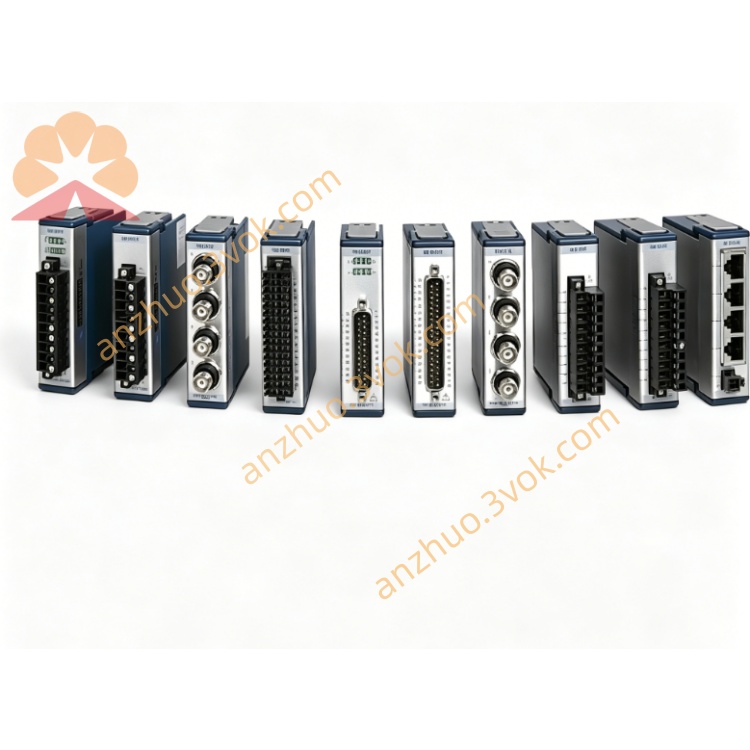
NI SCXI-1303 High Voltage Screw Terminal Block
Description
I. Product Introduction
NI SCXI-1303 is a 32-channel thermocouple-specific terminal board of the SCXI series. It is mainly used in combination with SCXI-1100, SCXI-1102, SCXI-1102B/C, etc. as analog input modules. The product is equipped with an isothermal copper plane and high-precision thermistors, enabling precise cold-end compensation. It also has a thermocouple open-circuit detection function, specifically designed for high-precision temperature measurement. This product is now discontinued. Currently, spare parts and related technical support are available.
II. Model Interpretation
SCXI represents the instrument signal conditioning expansion series. 1303 is an exclusive model, positioned as a 32-channel isothermal type thermocouple-specific terminal board. The standard component number of the product is 777687-03. In the same series, 1300 is a general terminal board, 1302 is a high-density general terminal board, and 1303 focuses on high-precision temperature measurement for thermocouples.
III. Technical Parameters
It is equipped with 78 screw terminals, including 32 differential signal terminals, chassis ground, shielding terminals, and reserved terminals, fully supporting 32 differential signal inputs. The applicable wire gauge range is 26 to 14 AWG. The rated voltage to ground for the signal is positive and negative 10 volts, and the insulation resistance under 500 volts DC is not less than one megohm.
An internal high-precision thermistor is used for cold-end compensation. The compensation accuracy in the 15 to 35°C range is ±0.5°C, and in the 0 to 15°C and 35 to 55°C ranges, the accuracy is ±1°C. The repeatability error within this temperature range does not exceed ±0.35°C. Each channel is equipped with a 10-megohm pull-up resistor to enable open-circuit fault detection of the thermocouple.
The equipment uses a full-metal shielded enclosure combined with an internal isothermal copper plane to effectively eliminate temperature differences in the terminal area. The common-mode suppression ratio is not less than one decibel. It supports standard SCXI panel installation and DIN rail installation. The operating temperature range is 0 to 55°C, the storage temperature range is -40 to 85°C, and the working environment humidity is controlled at 5% to 95% without condensation.
IV. Interface and Communication Configuration
The front of the equipment has 78 screw terminals, divided into signal terminals, grounding terminals, shielding terminals, and reserved interfaces. The back uses a 96-pin DIN connector, directly connecting to the corresponding SCXI acquisition module front end, without an independent communication interface. The product operates based on the entire SCXI system, is compatible with the NI-DAQmx driver program, and can be used normally in mainstream development environments such as LabVIEW, C language, LabWindows/CVI.
V. Core Functions
With the isothermal copper plane structure, the temperature gradient in the terminal area is significantly reduced, and high-precision thermistors are used to complete cold-end compensation, effectively improving the temperature measurement accuracy of thermocouples. Each channel integrates a detection circuit. When the thermocouple line is disconnected, it can be recognized by the system, facilitating rapid troubleshooting of the line faults. An internal bias circuit provides a stable reference potential for non-grounded floating thermocouples, reducing signal interference. The fully shielded structure can resist external electromagnetic interference, ensuring the stable transmission of weak thermoelectric potential signals. The screw connection structure and the appropriate installation method ensure firm connection, resistance to vibration, and suitability for long-term use in industrial sites.
VI. Application Scenarios
It is suitable for industrial furnaces, heat treatment equipment, environmental test chambers, and other occasions requiring high-precision multi-point temperature measurement. A 32-channel thermocouple centralized acquisition system can be built, widely used in industrial automation production line temperature monitoring. It is also very applicable to scientific research scenarios such as laboratory material thermal performance testing and precise equipment temperature calibration, and can meet the measurement requirements of various floating thermocouples.
VII. Usage and Maintenance Instructions Instruction Manual
Before installation, make sure to cut off the power supply of the equipment. Align the terminal board with the front end of the acquisition module and push it in smoothly to ensure that the rear connectors are fully pressed and locked. Complete the wiring according to the markings, tighten the connection screws, and reliably connect the shielding terminals to the system ground. In the accompanying software, enable the cold end compensation and open circuit detection functions, and match the type of the on-site thermocouple. Strictly follow the rated voltage requirements and avoid using the equipment under overvoltage conditions to prevent damage.
Maintenance Instructions
Maintain the equipment in a well-ventilated and dry environment, away from corrosive gases, dust, and strong electromagnetic interference. Regularly inspect the connection terminals and wires, check for any looseness, oxidation, or damaged insulation layers, and handle them promptly. Cleaning the equipment should be done while the power is off. Use isopropyl alcohol to wipe the surface and terminals, and wait until it is completely dry before reconnecting the power. When encountering data anomalies or alarm prompts, prioritize checking the wiring, connection status, and grounding settings, and then investigate the contact condition of the connectors and software configuration. For equipment that has been out of use for a long time, disconnect all lines, clean them, and store them in an anti-static bag in a cool and dry location.
Get a Quote